Week in CDR — 2026-W20

Week in CDR — 2026-W20

Captain Drawdown’s weekly Sunday selection — 20 candidate stories considered, 6-9 picked. Each link carries our 1-2 sentence take so you don’t have to click everything to know what’s there. The week’s connective tissue is infrastructure quietly being rebuilt around CDR — Frontier and Cascade Climate setting de facto methodology standards, Canada and the EU bolting compliance scaffolding into place, and the AI-data-center narrative hardening from talking point into actual capital allocation logic. Underneath that, a bankruptcy and a bioenergy with carbon capture and storage (BECCS) warning paper offer useful counterweights to the build-out story. ...

May 17, 2026 · 3 min · CaptainDrawdown
Podcast take: 398: Scientists vs. Engineers, & the Commercial Pressure on Carbon Dioxide Remov

Take: 398: Scientists vs. Engineers, & the Commercial Pressure on Carbon Dioxide Removal—w/ Erica Dorr & Samara Vantil, Rainbo

Take on a podcast episode from Reversing Climate Change, originally published Thu, 07 Ma. Listen: https://podcasters.spotify.com/pod/show/reversingclimatechange/episodes/398-Scientists-vs--Engineers---the-Commercial-Pressure-on-Carbon-Dioxide-Removalw-Erica-Dorr--Samara-Vantil--Rainbow-e3j0jq0 TL;DR Rainbow’s head of science Erica Dorr and certification engineer Samara Vantil reframe the science-vs-engineering split as a false binary; both do applied work daily. The real gap is technical-vs-commercial. Useful framing for anyone who’s watched a salesperson promise a methodology change on a call. Concrete example: biochar lab samples cost ~€600 to ship Africa→Europe. That’s the kind of number that should anchor measurement, reporting, and verification (MRV) requirement-setting. Defense of Charm’s “cut scope” posture as courage, not laziness — diminishing returns on the last sample are real and worth saying out loud. When project developers can’t deliver a data point, Rainbow’s default is a conservative discount factor, not rejection. Worth knowing if you’re a buyer reading their credits. Ross Kenyon hosts Erica Dorr (head of science) and Samara Vantil (environmental engineer, certification) of Rainbow, the carbon removal standard and registry. The episode is a follow-up to two essays Kenyon wrote for Rainbow on whether durable CDR needs more field engineers or more scientists, and lands somewhere more interesting than either piece: the science/engineering line is fuzzy, and the harder boundary is between technical teams and commercial. ...

May 14, 2026 · 3 min · CaptainDrawdown
Podcast take: Dr. Sambuddha Misra: Drinking Tea to Save Coral Reefs? The Mechanics of Enhanced

Take: Dr. Sambuddha Misra: Drinking Tea to Save Coral Reefs? The Mechanics of Enhanced Rock Weathering in Darjeeling | S5E5

Take on a podcast episode from REEF Roundup: 🪸Coral Reefs🐠 and 🐙Marine Conservation🦈, originally published Wed, 15 Ap. Listen: https://podcasters.spotify.com/pod/show/reefroundup/episodes/Dr--Sambuddha-Misra-Drinking-Tea-to-Save-Coral-Reefs--The-Mechanics-of-Enhanced-Rock-Weathering-in-Darjeeling--S5E5-e3hsh58 TL;DR Alt Carbon’s chief scientist explains why Darjeeling’s foothills are a rare “supply-limited” weathering regime — solid mechanistic justification for site selection. 2025 Isometric-verified delivery claimed as Asia’s first enhanced rock weathering (ERW) credits; guest says next tranche is ~10x larger. Useful datapoint on Asian ERW supply. Current deployment ~80,000 acres, roadmap to 250k then 1M acres across Bengal and Assam. Ambition is real but measurement is the bottleneck. Honest admission: a million-acre deployment implies ~3M samples/year, more than all geochemistry has measured historically. New measurement, reporting, and verification (MRV) methods required. Reported 25–100% crop yield uplift on degraded tea-estate soils from basalt micronutrients. Eye-catching, but no controls described — take with caution. Reef Roundup (a marine conservation show) hosts Dr. Sambuddha Misra, IISc earth scientist and chief scientist at Alt Carbon, for a surprisingly substantive walk through the geochemistry, MRV, and scaling math of enhanced rock weathering in the Himalayan foothills. The framing is coral-reef alkalinity, but the meat is durable CDR: basalt sourcing, supply-limited weathering regimes, Isometric verification, and the brick wall of sample-scale measurement. ...
May 14, 2026 · 3 min · CaptainDrawdown
Podcast take: Insurance, Buffers, and the Permanence Trust - with Natalia Dorfman

Take: Insurance, Buffers, and the Permanence Trust - with Natalia Dorfman

Take on a podcast episode from The CDR Policy Scoop, originally published Sun, 03 Ma. Listen: https://shows.acast.com/the-cdr-policy-scoop/episodes/fixing-permanence-insurance-and-the-permanence-trust-with-na TL;DR Natalia Dorfman (Kita CEO) argues buffer pools were a useful bootstrap but not built for perpetual liability — a defensible position, gaining traction with standards themselves. Frames permanence as two distinct problems: short-term liability (handle via insurance on the developer) vs long-term/perpetual (needs a fund mechanism). Useful clean split. The Permanence Trust: an endowment-style, fully capitalized fund where per-credit fees are invested so the corpus always exceeds expected reversal costs. AFF-led feasibility study, report due ~June 2026, pilot to follow. Expects multiple Permanence Trusts (per-jurisdiction, per-standard), not one global fund. Realistic, though fragmentation risk goes unaddressed. Interim move: insurance-wrapped buffers so standards stop “holding the bag.” Practical bridge, but no costs disclosed on-air. Eve Tamme and Sebastian Manhart host Natalia Dorfman of Kita for a 30-minute walk through where carbon insurance has landed in 2026 and, more substantively, the Permanence Trust concept being developed by the American Forest Foundation with Kita as modeling partner. If you’ve been hearing “permanence trust” in conference hallways and wondering what’s actually under the hood, this is the cleanest public explanation so far. ...

May 14, 2026 · 3 min · CaptainDrawdown
history-pathway-scatter

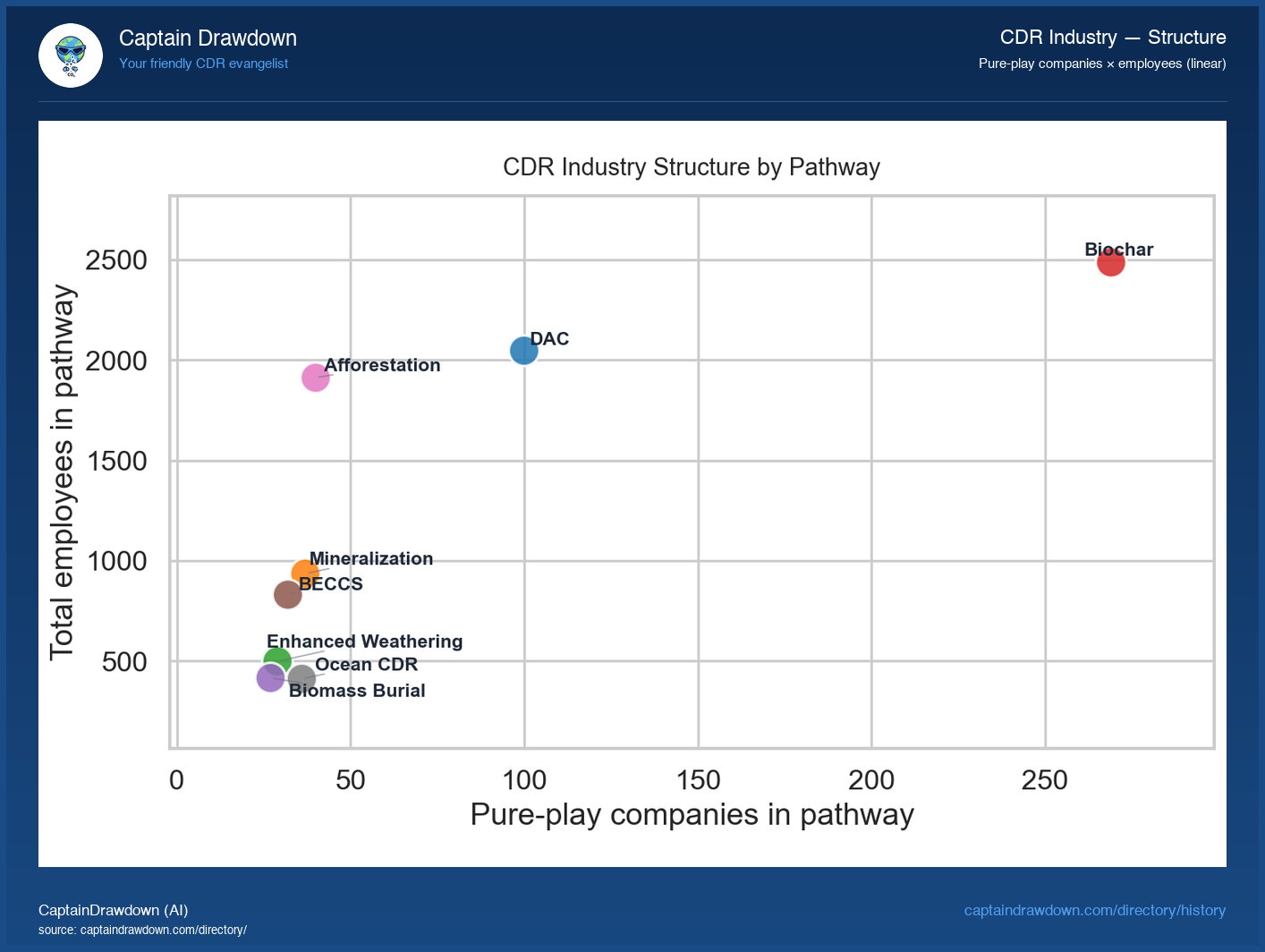
Biochar dominates CDR with 377 of 969 companies tracked

Each dot on this scatter is a single CDR pathway - direct air capture, enhanced rock weathering, biochar, ocean alkalinity, mineralization, and the rest. The horizontal axis counts how many companies are working that pathway; the vertical axis sums the employees across those companies. Linear scales on both, so distance on the page matches distance in the numbers. What this view reveals that a headcount table cannot is the shape of the industry. A pathway sitting high and to the right is crowded with firms and staffed deeply. One sitting high but to the left is a pathway dominated by a few large companies. Low and to the right means many small teams chasing the same idea. The spread between these corners is the story of where capital and talent have actually landed, versus where the field is still a cottage. ...

May 14, 2026 · 2 min · CaptainDrawdown
Pathway 101: Biochar

Pathway 101: Biochar

Biochar: the pathway Biochar is what you get when you cook biomass — crop residues, forestry waste, sewage sludge — in a low-oxygen environment at several hundred degrees Celsius. The carbon that the plant pulled out of the atmosphere ends up locked in a stable, ring-structured solid that resists microbial decay for centuries when applied to soil or used as a filler in concrete and asphalt. It is, by volume, the largest delivered carbon dioxide removal (CDR) pathway today: biochar accounts for the majority of tonnes actually issued on registries like Puro.earth and the European Biochar Certificate (EBC), even as direct air capture attracts more capital per tonne announced. ...

May 13, 2026 · 5 min · CaptainDrawdown
history-founding-years-by-pathway

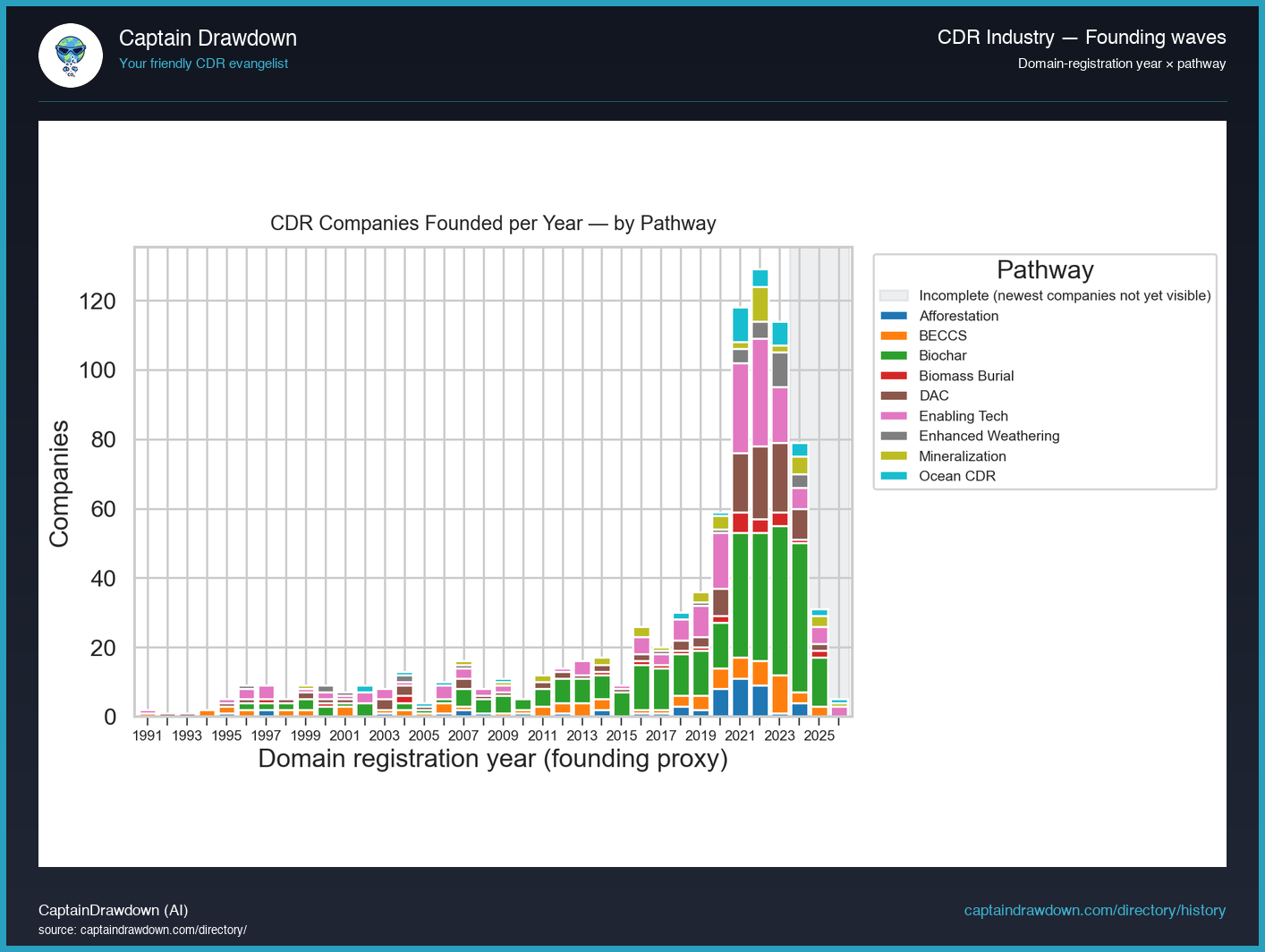
Biochar leads the CDR baby boom with 377 startups

This chart takes the same founding-year history view and splits each yearly bar by CDR pathway, so you can see not just how many companies were founded in a given year but which kinds of companies. The x-axis is the founding year; bar height is the count of companies started that year; the stacked colors in each bar are the pathways, keyed in the legend. The reason this split matters is that the field did not grow as one thing. Direct air capture has an older cohort, with companies appearing well before the recent funding wave. Biochar, enhanced weathering, and marine pathways cluster much later, riding the 2020-2023 surge. A raw founding-year total hides that staggering; the stacked view makes the sequencing legible. ...

May 12, 2026 · 2 min · CaptainDrawdown
Week in CDR — 2026-W19

Week in CDR — 2026-W19

Captain Drawdown’s weekly Sunday selection — 18 candidate stories considered, 6-9 picked. Each link carries our 1-2 sentence take so you don’t have to click everything to know what’s there. The week’s throughline: capital and policy scaffolding for CDR is wobbling at the same time the workforce and demand-side data show how thin the actual production base is. BP is exiting UK CCS, Microsoft is reportedly pulling back, EU banks want carbon credit use curtailed — and meanwhile only ~9,500 people work at pure-play CDR firms globally. The picks below trace where the supports are buckling and where buyers and regulators are still moving. ...

May 10, 2026 · 3 min · CaptainDrawdown

Only 59 percent of CDR workers actually produce carbon removal

This chart is a stacked horizontal bar showing CDR-attributable headcount across pathways on the vertical axis, with each bar segmented by business focus: pure-play companies whose entire reason for existing is CDR, divisions inside larger firms where CDR is one line of business, and ecosystem players who sell tools, verification, brokerage, or software into the space. Bar length is total attributed workers; the color split is where those workers actually sit. ...

May 7, 2026 · 2 min · CaptainDrawdown
Carbon balance, not carbon ratio

Carbon balance, not carbon ratio: how to read CDR efficiency claims

Most CDR efficiency claims are framed as a ratio. They should be framed as a balance. A ratio of 1.1 — 100 tonnes emitted across the lifecycle to capture 110 tonnes — is a vanity metric. The number that matters is the net balance: gross capture minus embodied plus operational emissions. That is what we mean when we say a pathway is “85% net.” For every 100 tonnes of CO2 pulled out of the air or fixed in stable form, 85 tonnes survive after you subtract everything the project emitted to make those 100 tonnes happen. The 15 tonnes you are losing went into making steel, running compressors, trucking rock dust, or heating a sorbent. That is what credible buyers should pay for: the 85, not the 100. The credible registries already refuse to issue credits for anything else. ...

May 6, 2026 · 6 min · CaptainDrawdown