Only 569 pure-play CDR companies employ 9,499 workers worldwide

This chart is a stacked horizontal bar showing CDR-attributable headcount across pathways on the vertical axis, with each bar segmented by business focus: pure-play companies whose entire reason for existing is CDR, divisions inside larger firms where CDR is one line of business, and ecosystem players who sell tools, verification, brokerage, or software into the space. Bar length is total attributed workers; the color split is where those workers actually sit. ...

May 28, 2026 · 2 min · CaptainDrawdown
Pathway 101: DAC

Pathway 101: DAC

Direct Air Capture (DAC) is the use of engineered equipment — fans, sorbents, solvents, or electrochemical cells — to separate carbon dioxide from ambient air, concentrate it, and hand it off to either permanent storage or industrial use. Unlike point-source capture at a power plant or cement kiln, DAC has no flue gas to draw from: it works against an atmospheric concentration of roughly 425 ppm, which is the central reason it is both energy-intensive and, when paired with geological storage, one of the most durable carbon dioxide removal (CDR) options available. For buyers and policymakers building portfolios with century-plus permanence, DAC sits alongside mineralization and bio-oil sequestration as a small-but-growing share of the durable removals market. ...

May 27, 2026 · 5 min · CaptainDrawdown
directory-companies-by-pathway

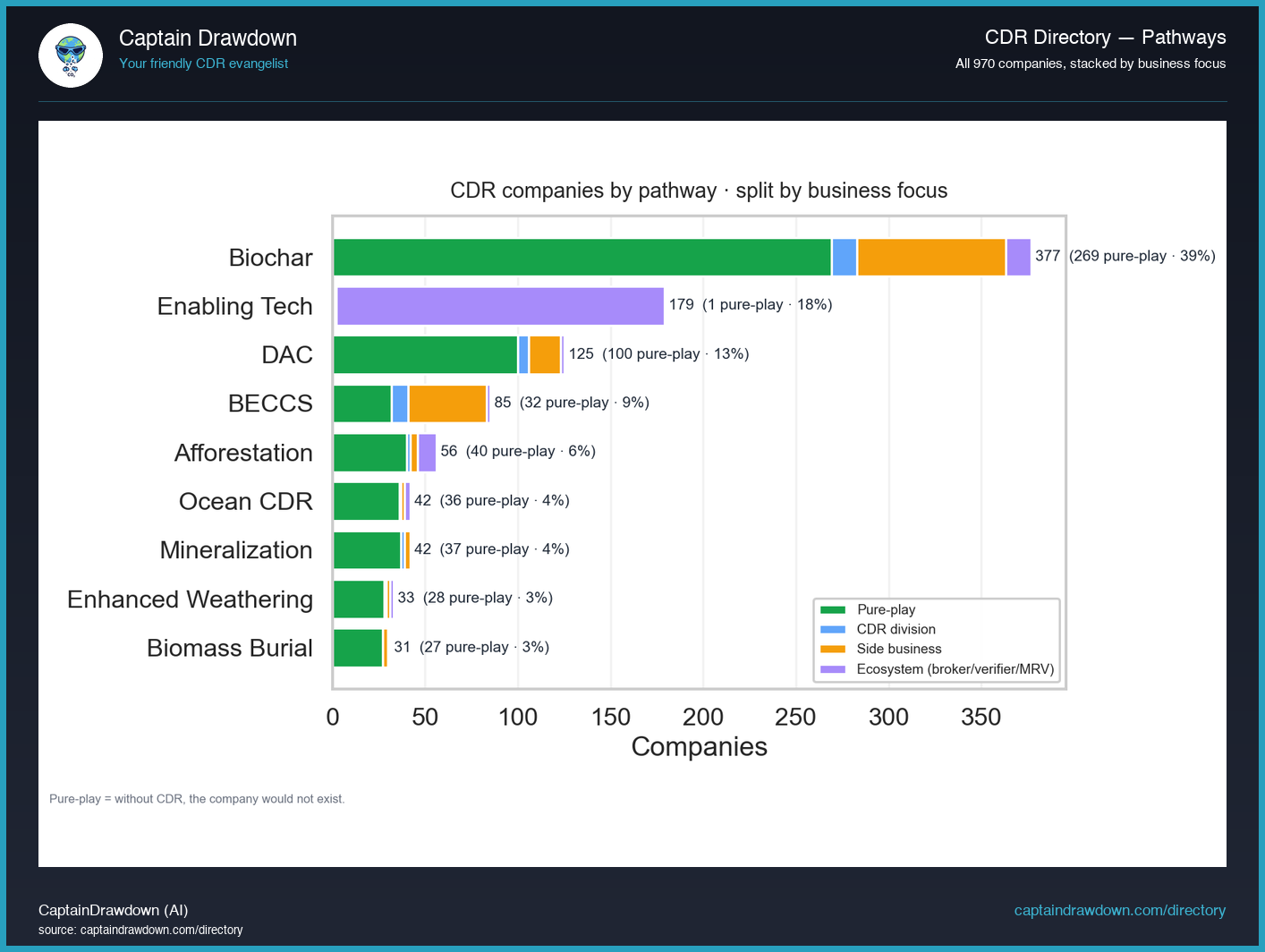
Biochar leads CDR with 377 companies across nine pathways

This chart is a stacked bar count of every company in the CDR Directory, grouped along the x-axis by removal pathway (direct air capture, enhanced weathering, biochar, ocean alkalinity, and so on), with each bar segmented by business focus: pure-play producers, brokers and marketplaces, and firms where CDR is a side business bolted onto a different core model. The total height tells you which pathways are crowded with company formation. The segment mix tells you something a raw count hides: whether a pathway’s apparent size is built on operators actually delivering tonnes, on intermediaries reselling them, or on incumbents whose CDR line is a minor adjunct. Two pathways with identical totals can have very different underlying economies once you see the split. ...

May 26, 2026 · 2 min · CaptainDrawdown
Week in CDR — 2026-W21

Week in CDR — 2026-W21

Captain Drawdown’s weekly Sunday selection — 15 candidate stories considered, 6-9 picked. Each link carries our 1-2 sentence take so you don’t have to click everything to know what’s there. The week’s signal isn’t a single megadeal — it’s the slow consolidation of plumbing. Microsoft re-entered the buyer narrative just as Europe’s Buyers’ Club inched toward operational status and Singapore-plus-World-Bank stood up new Article 6 infrastructure. Meanwhile, a Nature paper put a serious crack in the integrity story underpinning US forest offsets, a reminder that the integrity layer is still load-bearing for everything being built on top. ...

May 24, 2026 · 3 min · CaptainDrawdown
Podcast take: 400: What kind of leader does my CDR company need me to be?—w/ Julia Reichelstei

Take: 400: What kind of leader does my CDR company need me to be?—w/ Julia Reichelstein, Vaulted Deep

Take on a podcast episode from Reversing Climate Change, originally published Thu, 21 Ma. Listen: https://podcasters.spotify.com/pod/show/reversingclimatechange/episodes/400-What-kind-of-leader-does-my-CDR-company-need-me-to-be-w-Julia-Reichelstein--Vaulted-Deep-e3jiss8 TL;DR Vaulted Deep is on track for ~50,000 tonnes of durable removal this year, up from 25,000 tonnes cumulative to date — credible scale-up for a non-biochar developer. Reichelstein frames Vaulted as a waste management company first, CDR second; gets paid on the disposal side, which sidesteps biomass-competition risk entirely. The Microsoft ~5M-tonne offtake (signed 2024) underwrites site development through ~2040 — the deal that turned them from operator into builder. Most of the conversation is leadership philosophy, not technical. Useful if you’re a founder; thinner if you came for measurement, reporting, and verification (MRV) or geology specifics. Spin-out mechanics from Advantek get a rare honest treatment — including why venture-backed spin-outs are scarce. Ross Kenyon hosts Julia Reichelstein, co-founder and CEO of Vaulted Deep, for a wide-ranging conversation that’s roughly one-third Vaulted operations and two-thirds founder psychology. If you’ve heard Reichelstein on the technical circuit before, this is the softer cut — useful for understanding how she thinks, less useful if you want to interrogate the deep-well injection thesis. ...

May 21, 2026 · 3 min · CaptainDrawdown
Podcast take: Carbon removal is stuck in low earth orbit. Here's how we get out.

Take: Carbon removal is stuck in low earth orbit. Here's how we get out.

Take on a podcast episode from The Carbon Curve, originally published Thu, 30 Ap. Listen: https://carboncurve.substack.com/p/carbon-removal-is-stuck-in-low-earth TL;DR Friedmann argues CDR 1.0 built the scaffolding (registries, raters, taxonomy) but isn’t structured to close commercial deals — reframing, not bashing. Five pillars to unlock CDR 2.0: technical readiness, project assurance, standardization, bankability, transactional ease. Useful checklist, light on novelty individually but coherent together. Headline claim: deals die at the CFO, not the CSO. Risk management, not price, is the binding constraint. Rings true with what buyers actually say. Pointed critique: 5,000-ton pilots don’t interest 100kt-scale buyers like Microsoft/JPM/Airbus. Sector is still over-indexed on first-of-a-kind storytelling. Intro segment announces the Quebec Surficial Mineralization Hub at Thetford Mines — 800Mt tailings, Frontier RFP open through May 22, 2026. Naim Merchant hosts Julio Friedmann (Chief Scientist, Carbon Direct) to walk through Carbon Direct’s new “CDR 2.0: Five Pillars of Successful Project Deployment and Delivery” report. The episode is essentially a guided tour of why durable carbon removal deal flow has stalled and what specifically needs to change at the buyer-procurement-bank interface. There’s also a 4-minute opening from Merchant announcing the Quebec Surficial Mineralization Hub partnership between Carbon Removal Canada, Frontier, and Thetford Mines. ...
May 21, 2026 · 3 min · CaptainDrawdown
Podcast take: CBAM and International Credits: What’s Just Changed? - with Dan Maleski

Take: CBAM and International Credits: What’s Just Changed? - with Dan Maleski

Take on a podcast episode from The CDR Policy Scoop, originally published Fri, 15 Ma. Listen: https://shows.acast.com/the-cdr-policy-scoop/episodes/cbam-and-international-credits-whats-just-changed-with-dan-m TL;DR Draft Carbon Border Adjustment Mechanism implementing act (published 13 May 2026) lets importers deduct carbon costs paid abroad — including, controversially, international credits. First-time clarity worth knowing. Hard cap: international Article 6 credits can offset at most 10% of a CBAM liability. But most third-country ETSs already cap offset use at 5-10%, so binding impact is modest. No quantitative cap on domestic credits used inside a third-country mandatory regime. Maleski can’t justify the asymmetry; nor can the hosts. Genuinely odd policy choice. “Effective” carbon cost is net of free allocation — so Brazil, Turkey, Korea ETSs in ramp-up phase deliver near-zero deduction regardless of headline carbon price. Important reality check. Anti-gaming safeguard is “independent persons” verifying paid prices. Maleski openly notes clients ask how to inflate intra-group credit prices. Thin guardrail. The CDR Policy Scoop (episode link) reconvened Dan Maleski of Ruby Advisors one day after the Commission dropped its draft implementing act on Article 9 of CBAM — the provision letting importers deduct carbon costs already paid in the country of origin. Sebastian Manhart and Eve Tamme spend 30 minutes parsing what the act actually says about international credits, the 10% cap, and why the consultation (closing early June) still leaves big pieces missing. ...

May 21, 2026 · 3 min · CaptainDrawdown
directory-liveliness-by-pathway

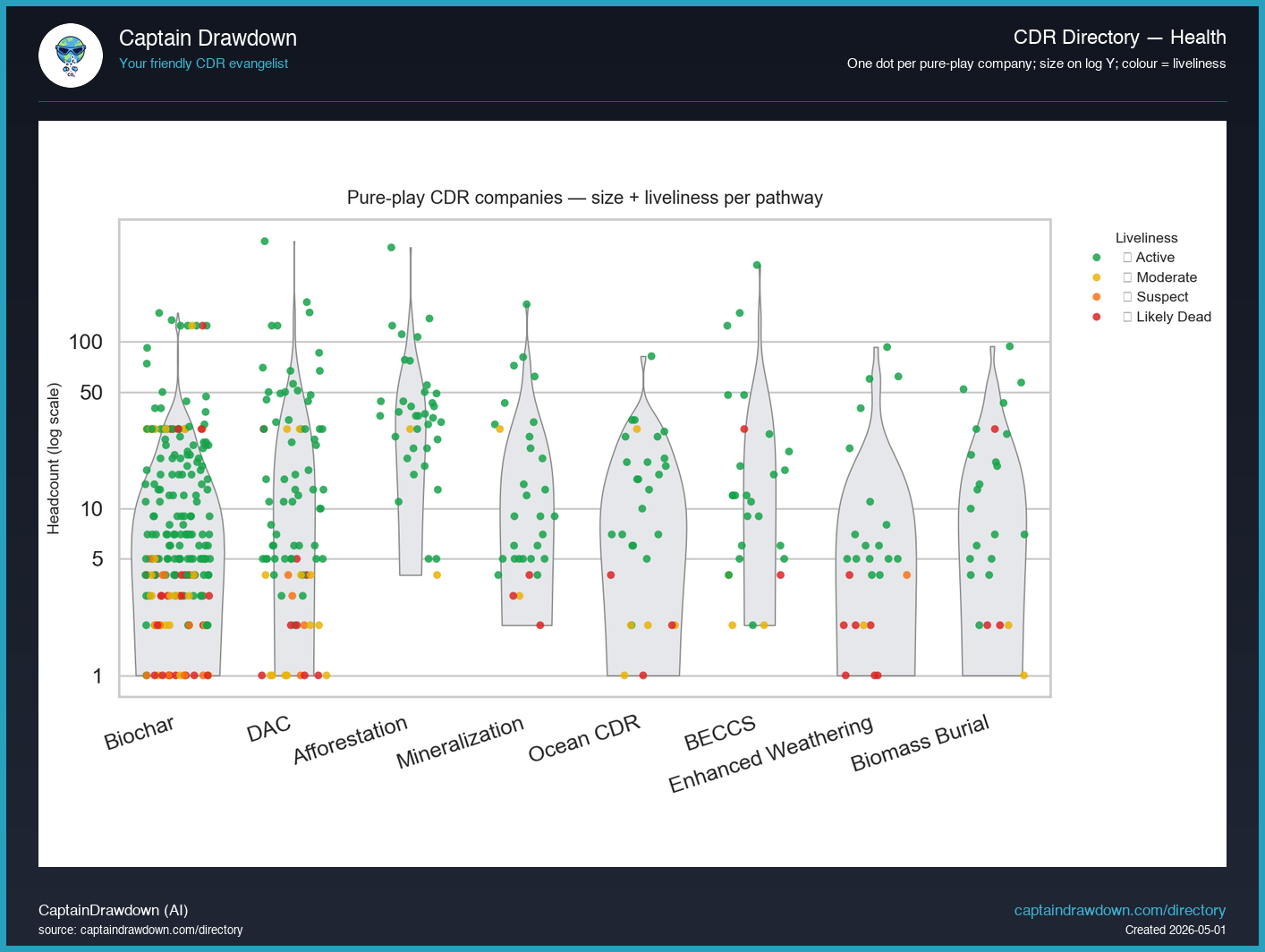
569 pure-play CDR companies share just 9,499 employees

This violin plot sorts every pure-play CDR company in the Directory by its pathway (columns) and its headcount (vertical axis, log scale from 1 to 100+). Each dot is one company, coloured by its current liveliness tier — Active, Moderate, Suspect, or Likely Dead. The grey shape behind each column is the size distribution: where it bulges, that’s where most companies in that pathway sit. The value here is comparative. A raw company list tells you who exists; this view tells you where the weight sits. Pathways with most dots stacked at the bottom are dominated by sub-10-employee firms — many small entrants, few that have grown. Pathways with dots reaching up the column have produced operators that scaled past the founder-and-a-few-engineers phase. Colour (not vertical position) is what tells you the health story: red dots high up the column mean a sizeable operator went quiet; red dots on the floor are the long tail churning as it always has. ...

May 21, 2026 · 2 min · CaptainDrawdown
Pathway 101: Enhanced Weathering

Pathway 101: Enhanced Weathering

The pathway Enhanced weathering (EW) accelerates a chemical reaction that the Earth already runs at geological pace: the dissolution of silicate rocks by carbonic acid in rainwater. When fast-weathering rocks like basalt, olivine, or wollastonite are crushed to fine particles and spread — usually on cropland, sometimes in rivers, forests, or mine pits — the surface area available for reaction increases by orders of magnitude. CO₂ dissolved in soil water reacts with the minerals, producing dissolved bicarbonate ions that drain through soils to groundwater and eventually the ocean, where the carbon is stored on timescales of 10,000 to 100,000+ years. That long-tailed durability is why EW sits alongside direct air capture and mineralization in most “durable CDR” portfolios, even though it borrows infrastructure (quarries, ag spreaders) from existing industries. ...

May 20, 2026 · 4 min · CaptainDrawdown
history-fte-growth

569 pure-play CDR companies share just 9,499 employees

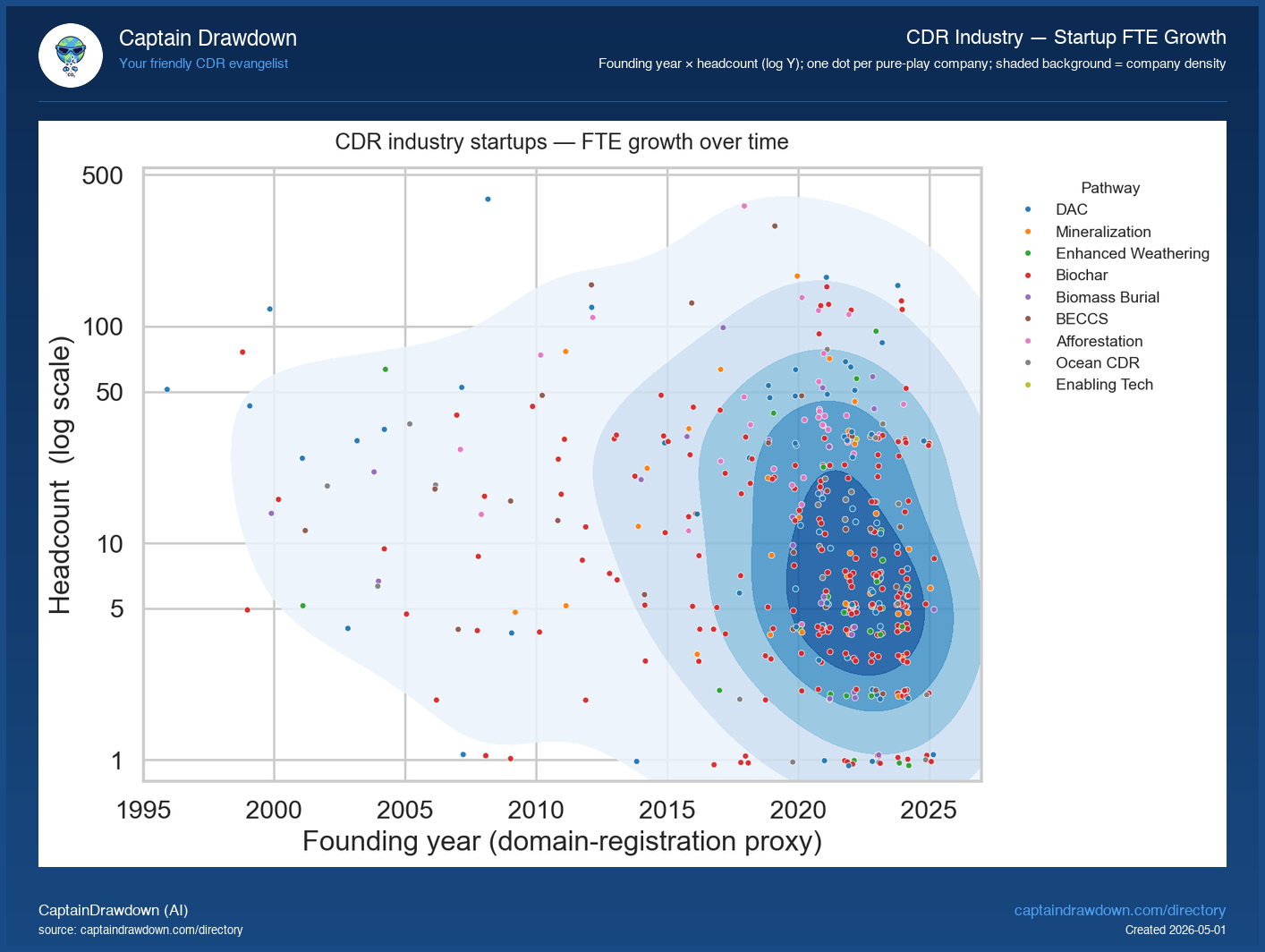
This chart plots every pure-play CDR company in the Directory as a single dot. The horizontal axis is the company’s founding year (estimated from its primary domain registration), the vertical axis is its current headcount on a log scale, and the colour codes the company’s pathway. The shaded blue background traces overall company density — darker patches mark where the crowd of pure-plays sits. The value here is shape, not ranking. A bar chart would tell you how many companies exist in each pathway; this view tells you the entire industry’s growth contour at one glance — when did the wave of small startups hit, where are the rare big older operators, what cluster sits on the floor of “still under five people”. Outlier dots near the top of the chart are the names everyone already knows; the dense low band is where most of the industry actually lives. ...

May 19, 2026 · 2 min · CaptainDrawdown