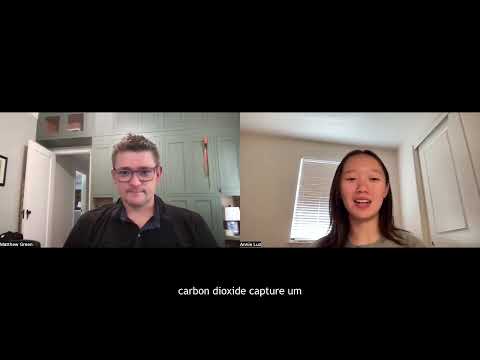
Take: Interview with Matthew Green
Take on a YouTube video from Annie Luo, originally posted 2026-08-24. Watch the source: https://www.youtube.com/watch?v=27j8NEY2bR0 TL;DR Matt Green (ASU, Center for Negative Carbon Emissions) walks through moisture-swing and polymer sorbent direct air capture. Standard intro material for CDR insiders. Claim: moisture-swing sorbents release CO₂ via humidity change, no 80–120°C thermal swing needed. Well-established (Lackner lineage) but clearly explained. Interesting application angle: coupling moisture-swing DAC to greenhouse exhaust streams to boost plant growth. Niche but concrete. Argues polymer sorbents win on cost because plastics processing infrastructure is already cheap and mature. Reasonable, underexplored framing. No new numbers, no cost figures, no pilot data disclosed. This is a public-education interview, not a technical update. Matt Green, chemical engineering professor at Arizona State University and director of the Center for Negative Carbon Emissions, sits down with student interviewer Annie Luo (video here) for a general-audience walkthrough of direct air capture (DAC): why 400 ppm makes selective sorbents hard, why polymer chemistry is well-suited to the problem, and how moisture-swing regeneration sidesteps the thermal energy penalty of amine systems. If you already know what a moisture-swing sorbent is, most of this will be review. ...