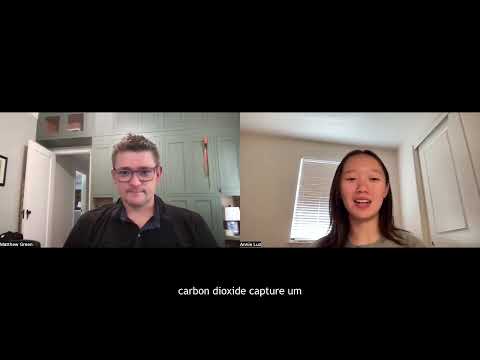
Take on a YouTube video from Annie Luo, originally posted 2026-08-24. Watch the source: https://www.youtube.com/watch?v=27j8NEY2bR0
TL;DR
- Matt Green (ASU, Center for Negative Carbon Emissions) walks through moisture-swing and polymer sorbent direct air capture. Standard intro material for CDR insiders.
- Claim: moisture-swing sorbents release CO₂ via humidity change, no 80–120°C thermal swing needed. Well-established (Lackner lineage) but clearly explained.
- Interesting application angle: coupling moisture-swing DAC to greenhouse exhaust streams to boost plant growth. Niche but concrete.
- Argues polymer sorbents win on cost because plastics processing infrastructure is already cheap and mature. Reasonable, underexplored framing.
- No new numbers, no cost figures, no pilot data disclosed. This is a public-education interview, not a technical update.
Matt Green, chemical engineering professor at Arizona State University and director of the Center for Negative Carbon Emissions, sits down with student interviewer Annie Luo (video here) for a general-audience walkthrough of direct air capture (DAC): why 400 ppm makes selective sorbents hard, why polymer chemistry is well-suited to the problem, and how moisture-swing regeneration sidesteps the thermal energy penalty of amine systems. If you already know what a moisture-swing sorbent is, most of this will be review.
The one segment worth the click is the greenhouse integration idea. Green describes using humid exhaust air from commercial greenhouses to regenerate a moisture-swing sorbent, then feeding the released CO₂ back into the greenhouse to accelerate plant growth. The humidity is free (it’s already there), the CO₂ demand is co-located, and greenhouse operators already pay for bottled or combusted CO₂ enrichment. This isn’t gigaton-scale carbon removal — it’s a revenue pathway for early sorbent deployment that competes with existing CO₂ supply rather than with $100/ton removal credits. It’s a plausible bridge market that doesn’t get discussed much next to the mineralization and ocean pathways dominating headlines.
The second useful framing: Green’s argument for why polymer sorbents specifically deserve attention is that decades of plastics R&D have already driven down the cost of monomer synthesis, functionalization, and roll-to-roll processing. So the marginal cost of manufacturing a CO₂-selective polymer membrane or resin is bounded by an existing industrial cost curve, not a de novo one. This is a real point — it’s part of why Carbon Collect’s MechanicalTree (Klaus Lackner’s spinout, also at ASU) and Mission Zero’s approach look economically different from solid amine sorbents that need bespoke synthesis.
For CDR context: the ASU center is the intellectual home of Lackner’s original passive DAC concept, and the moisture-swing mechanism Green describes is what powers Carbon Collect’s mechanical trees and adjacent work by groups like Mission Zero Technologies and Skytree in Europe. Frontier and other buyers have not yet made large moisture-swing purchases at the scale of solid-sorbent or mineralization contracts, and the field is still waiting for third-party validated energy numbers on humidity-swing systems at pilot scale. Green does not provide those numbers here — anyone hoping for updated kWh/ton or $/ton figures from the ASU work will leave empty-handed.
Useful for: educators, journalists, or new CDR analysts who need a clean verbal explanation of moisture-swing DAC and the polymer-sorbent thesis. Skip if you’ve already read Lackner’s papers or followed Carbon Collect.