Take on a YouTube video from Dirk Paessler, originally posted 2026-06-22. Watch the source: https://www.youtube.com/watch?v=mE7n4WhDXH8
TL;DR
- Lucilla Boito (likely Hamburg/UHH group based on the feedstock list) ran sequential chemical extractions on enhanced weathering soil samples to track where cations actually end up.
- Four operationally-defined pools tested: exchangeable, carbonate, oxide/hydroxide, clay. Useful framing for anyone modeling residence time.
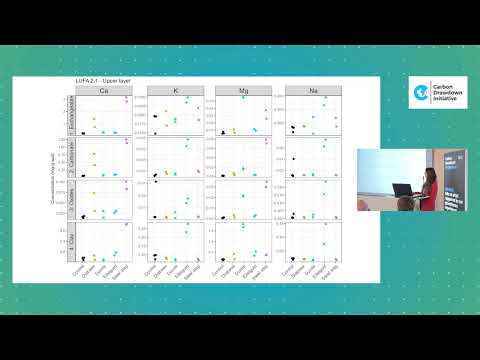
- Steel slag (40 t/ha) drove calcium up across nearly all pools; dunite drove magnesium across all pools; diabase showed up in three of four for Ca. Results track feedstock XRF composition.
- Caveat flagged by speaker: only n=2 per treatment, no statistics. Treat as directional.
- Sodium and potassium showed up in carbonate pools where they shouldn’t chemically exist — a useful reminder that sequential extractions dissolve primary minerals too, not just the named pool.
Video here. This is a CDR Symposium 2026 talk by Lucilla Boito on sequential extraction results from a multi-feedstock, multi-soil enhanced rock weathering (ERW) experiment. The core question: when basalt, diabase, dunite, steel slag, or bassanite (“Eifelgold”) weather in soil, which operationally-defined pool do the released cations end up in — exchangeable, carbonate, oxide, or clay — and does the answer depend on soil type?
The substantive content is the pool-partitioning result. Residence time of weathering-derived alkalinity depends heavily on which pool the cations occupy: exchangeable desorbs fast, carbonates and clay-bound cations hold longer. Boito’s data — caveated as n=2, no significance testing — shows steel slag at 40 t/ha pushing Ca into all four pools including clay; dunite pushing Mg across all pools; diabase hitting three of four for Ca. The feedstock XRF compositions (steel slag 43% Ca, dunite ~50% Mg) line up with the extraction signal, which is reassuring given how often sequential extractions return noise. For practitioners building monitoring frameworks, this is one of the more direct empirical attempts to ground-truth where the cations actually sit post-weathering rather than inferring from solute fluxes alone.
The methodological honesty is what makes the talk worth 15 minutes. Boito explicitly flags that K and Na showed up in the “carbonate” extraction step despite there being essentially no plausible chemistry for sodium or potassium carbonates forming in these soils. Her read: the acetic acid step is also dissolving primary minerals, so the pool labels are operational, not mineralogical. Anyone citing sequential extraction numbers in an ERW MRV (Measurement, Reporting, Verification) context needs to internalize this — the pools are defined by reagent, not by phase identity, and crossreading them as literal carbonate formation will overcount durable storage. The Poggie protocol she references is the standard reference here.
For broader context: this fits alongside work from Lithos Carbon, InPlanet, Eion, and the UNDO / Leeds groups trying to nail down the fate of weathering products in the solid phase rather than only the dissolved export. The persistent question — how much weathering-derived alkalinity is locked into pedogenic carbonates or clay-exchange sites versus exported as bicarbonate — is the bottleneck for distinguishing genuine sequestration from delayed-or-never CDR. See prior Carbon Drawdown work at carbon-drawdown.de for the experimental setup these samples came from.
Worth watching if you’re doing ERW soil chemistry, building MRV protocols that cite cation pools, or reviewing claims that lean on sequential extraction data.