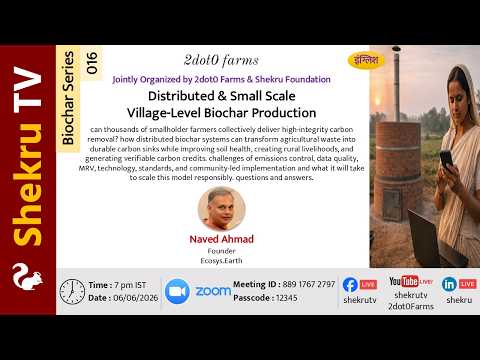
Take on a YouTube video from ShekruTV, originally posted 2026-06-08. Watch the source: https://www.youtube.com/watch?v=Z1YlrZJoxyI
TL;DR
- Naved Ahmad of Ecosis pitches village-scale biochar via modified drum kilns costing ~₹2,000–3,000 ($25–35) per unit. Useful datapoint on the floor of distributed kit cost.
- Frames carbon finance as debt relief for Indian farmers carrying ~3x annual income in debt. Reasonable framing, not new.
- Cites Verra-style methodologies as a dead-end for smallholders: ~$100K project costs, 3–4 year waits, no payouts. Matches what other practitioners report.
- Pivot point: Carbon Standards International’s 2022 biochar methodology is what made Ecosis viable. Worth knowing if you’re tracking registry choice for smallholder projects.
- Heavy on personal journey, light on production numbers, yields, or carbon volumes. Skip if you want hard data.
A long-form interview on ShekruTV’s biochar series with Naved Ahmad, founder of Ecosis, a Bangalore-region biochar outfit working with smallholder farmers. The substantive claim: distributed, drum-kiln biochar at the village level — financed via Carbon Standards International (CSI) credits — is the only carbon-market structure that actually reaches Indian smallholders, because the Verra-track methodologies price them out and pay too late.
What’s worth knowing for a CDR practitioner: first, the cost floor. Ahmad puts modified-drum kiln cost at ₹2,000–3,000 per unit (~$25–35), which is the kind of number you want when modeling whether distributed pyrolysis can compete with centralized reactors on a $/tonne-removed basis once you load in labor, feedstock collection, and sampling. He doesn’t give per-farmer tonnage or carbon yield, which is the obvious gap. Second, the registry argument: he claims farmers enrolled in Verra’s land-use methodologies (he name-checks something sounding like Verra’s FOLU-adjacent track) waited 3–4 years with no payout, and that project setup runs ~$100K — prohibitive for smallholder aggregation. He founded Ecosis specifically in response to CSI publishing its biochar methodology in 2022. Whether CSI’s lower-friction path actually delivers durable, well-sampled credits at scale is the open question he doesn’t address in this segment of the transcript.
This sits in a fairly crowded distributed-biochar conversation. Compare to Husk and the Pacific Biochar / Carbo Culture school on the industrial end, versus village-scale players like Takachar and the various flame-cap (Kon-Tiki) practitioners that CSI’s methodology was effectively written around. The interesting tension Ahmad surfaces but doesn’t resolve: the same low-cost kit that makes smallholder participation possible is also what makes measurement, reporting, and verification (MRV) hardest — drum kilns vary wildly in temperature and residence time, which drives the H:C ratio that determines credit issuance. If you’re underwriting smallholder biochar credits, that’s the risk to interrogate, and this interview won’t answer it for you.
Useful if you’re scoping distributed biochar economics in South Asia or trying to understand why CSI rather than Verra dominates small-scale biochar registration. Skip if you want production data, durability evidence, or a critical look at MRV under drum-kiln conditions — this is a founder origin story, not a technical deep-dive.