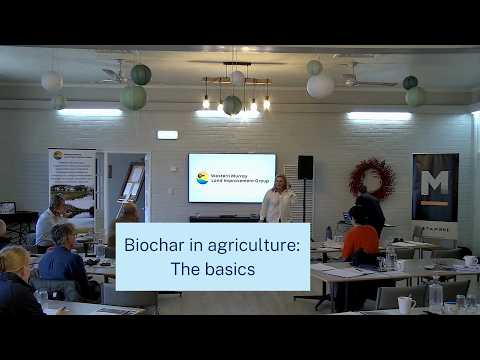
Take on a YouTube video from Local Land Services NSW, originally posted 2026-07-20. Watch the source: https://www.youtube.com/watch?v=Nuk18apLFWI
TL;DR
- Speaker claims Australian biochar carbon sells at ~AUD $200/tonne on voluntary markets — higher than what an ACCU method would pay. Useful pricing datapoint.
- ANZBIG targets 50 million tonnes of biomass pyrolysed annually: $6B biochar + $3B removals + $1-2B energy. Aspirational, no timeline given.
- Energy co-product pitch: $300-400k in thermal energy value per ~5,000 tonnes of biomass processed (she states the ratio inconsistently in the talk).
- Title says livestock; the transcript is almost entirely production economics and industry advocacy. Feed applications barely appear in this segment.
Melissa Rebeck — chair of the Australian New Zealand Biochar Industry Group (ANZBIG) and business development lead at pyrolysis equipment vendor Metamorph Engineering — presents to a Local Land Services NSW farmer audience on biochar production economics. Watch here: https://www.youtube.com/watch?v=Nuk18apLFWI. Despite the title, this is a talk about the business case for on-farm pyrolysis, not livestock feed trials.
The most useful line for carbon dioxide removal (CDR) watchers is her framing of Australian carbon accounting: the industry is pursuing an ACCU (Australian Carbon Credit Unit) method for biochar, but Rebeck says the only reason they need it is so the Australian government can count the removals toward its net-zero targets — “we’re getting far better dollar on the voluntary markets,” specifically around $200/tonne. That’s a candid admission from an industry chair that voluntary-market prices currently outcompete the prospective compliance pathway, and it matches the general pattern of biochar credits clearing above compliance-market prices globally.
The second thread is the three-revenue-stream pitch to farmers: biochar product, carbon in the biochar, and energy co-products. Metamorph’s systems recycle syngas to control char quality and output thermal energy — she cites $300-400k in energy value per 5,000 tonnes of biomass processed, though a sentence later she says “for every 1,000 tonnes,” so treat the figure as directional. She also mentions a cereal farm that bought a unit instead of a new harvester, converting crop residue to biochar plus removals — a small but concrete signal that on-farm distributed pyrolysis is finding buyers beyond pilot projects. The temperature-dependent “fit for purpose” char discussion (higher temperature → more surface area, porosity, surface charge) is standard material but a fair primer if you’re new to feedstock-endpoint matching.
The ANZBIG 50-million-tonne annual pyrolysis ambition is worth logging as an industry-stated goal, even without a timeline: her valuation stack ($6B biochar, $3B CDR, $1-2B emission avoidance) implies roughly $60/tonne of removal value at scale — notably below the $200/tonne she quotes for current voluntary sales, which suggests either expected price compression or loose arithmetic. Biochar remains the dominant delivered category in voluntary CDR purchasing, so how Australia’s ACCU process shakes out — and whether it drags prices toward compliance levels — matters for anyone modeling biochar supply curves. Industry group details are at ANZBIG.
Useful for practitioners tracking Australian biochar policy, ACCU method development, or distributed pyrolysis economics; skip if you came for the livestock feed evidence the title promises — it isn’t in this segment.