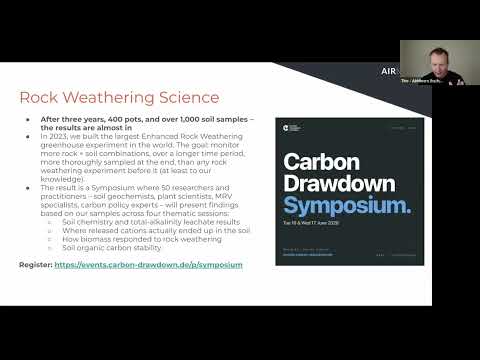
Take on a YouTube video from AirMiners, originally posted 2026-05-01. Watch the source: https://www.youtube.com/watch?v=gEWnepySw_k
AirMiners: What’s Hot in Carbon Dioxide Removal, April 2026
This is the April 2026 edition of AirMiners’ monthly “what’s hot” rundown, hosted by Tito Jankowski. It’s a roughly 10-minute state-of-the-market intro followed by breakout discussions. The framing is blunt: investors are pulling back, government funding is shaky, and Microsoft — the buyer that effectively underwrote the last two years of offtakes — has gone quiet. Tito’s pitch is to stop speculating and look at what’s actually closing.
The Microsoft section is the part most practitioners will care about, and the honest answer is: nobody knows. Tito confirms the pause appears real but is unofficial, with no stated duration or reason from Microsoft’s side. His read — that “the bucket got filled” — is speculation, but it tracks with the volume Microsoft contracted in 2023-2025. The actionable piece is the redirection: if you were in a Microsoft negotiation, your job now is finding the next buyer, not waiting. He flags the Google–AMP biochar deal as the template worth copying — a company with an existing waste-processing business bolting CDR onto an existing revenue stream, rather than a pure-play removal startup looking for its first customer. Buyers, he argues, prefer counterparties that don’t depend on the offtake to survive.
The second segment worth your time is on advocacy. The Carbon Removal Alliance helped unlock Department of Energy direct air capture hub funding for 10 of the 21 approved projects after a freeze. Tito relays Vikrum Aiyer of Heirloom’s three-part framing for Trump-administration conversations: the industry can eventually stand without subsidies, it aligns with energy security, and local communities and politicians back it. Whether you buy the framing or not, it’s a useful template for anyone rewriting their deck for a CFO or a red-state senator.
For broader context, this episode lands in the same news cycle as the pullback documented across the CDR.fyi 2025 data and Frontier’s continued — but smaller — purchase cadence. The Google-AMP model echoes what Charm Industrial and Lithos Carbon have argued for years: durable demand will come from waste-stream pathways and compliance markets, not from a handful of hyperscaler voluntary buyers. The Microsoft pause, if it persists, is the stress test of that thesis.
Useful for: founders rewriting their buyer pipeline post-Microsoft, sustainability leads benchmarking what peers are actually closing, and policy folks looking for language that survives the current administration. Skip if you’ve already read the Heatmap and Bloomberg coverage of the Microsoft pause — the analysis here doesn’t go deeper than those.