Most social-media advice was written for general B2B marketers. I wanted to know whether any of it actually held up in carbon removal, so last week I pulled together a small study. I scraped the engagement numbers on roughly 900 posts: every recent post from the 25 most-watched carbon-removal company pages on LinkedIn, plus the last few months from the highest-engagement climate voices on X and Bluesky. The list included Climeworks, Heirloom Carbon, Frontier Climate, Mati Carbon, Isometric, Cascade Climate, CDR.fyi, and 18 others on the company side, plus Stefan Rahmstorf, Hannah Ritchie, Johan Rockström, Damian Carrington, Simon Evans, Zeke Hausfather and the rest of the visible climate-science cohort on the personal-account side.
What I found surprised me. A lot of the writing rules that get repeated in marketing playbooks turn out to be wrong for this niche. Four findings stood out.
The link belongs in the first comment, not the post body
This is the one most people in the carbon-removal community will already half-believe, because LinkedIn folklore has been claiming it for years. The data is now clean enough to stop calling it folklore.
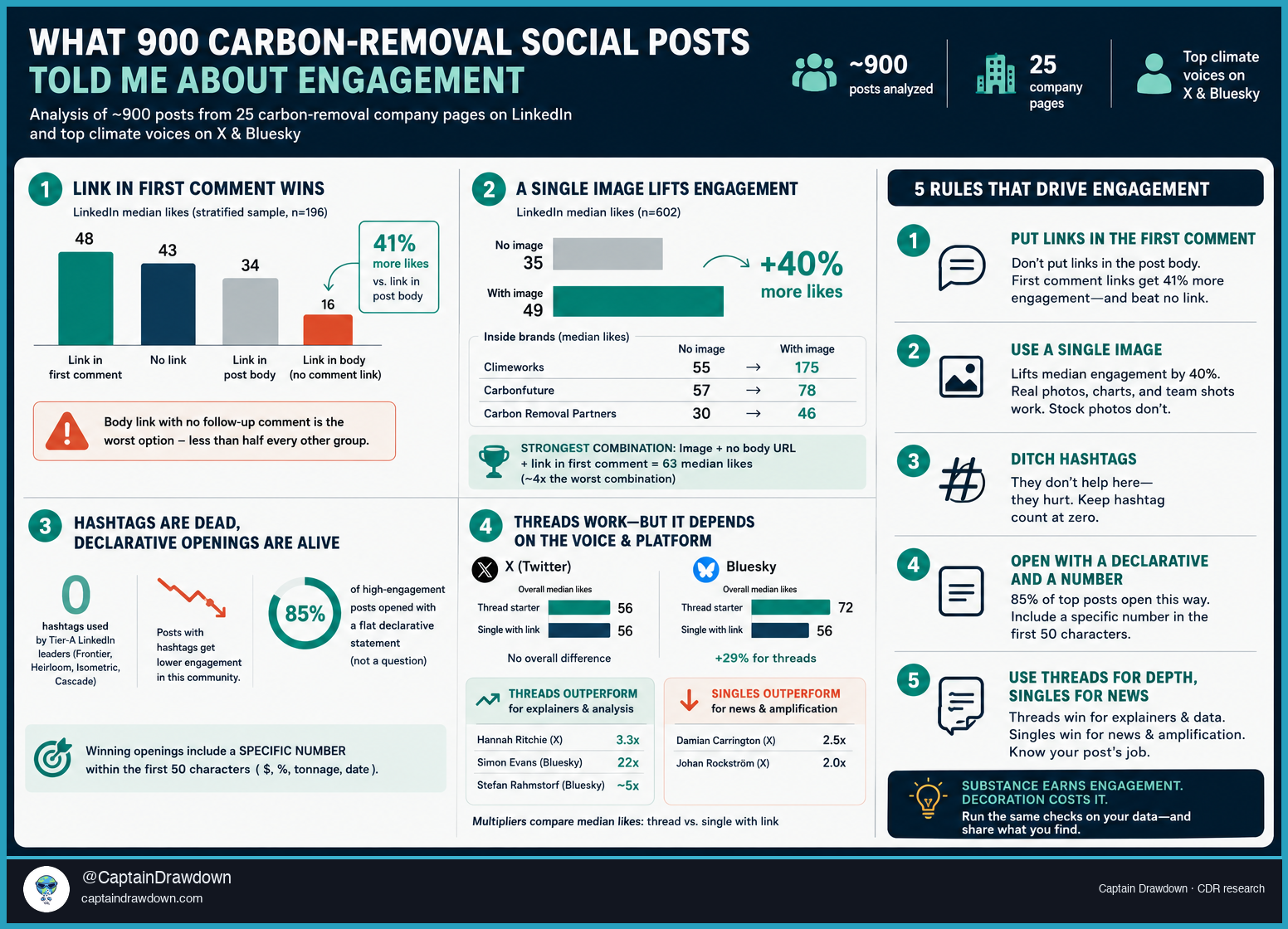
I ran a stratified sample of 196 LinkedIn posts and split them three ways: posts where the link sat in the body, posts where the link sat only in the first comment, and posts with no link at all. The median for body-link posts was 34 likes. The median for posts with the link in the first comment instead was 48 likes, a lift of 41 percent. Posts with no link at all landed in between at 43. So the first-comment placement is not just better than putting the link in the body, it slightly beats not having a link at all.
The worst configuration I found was a body link with no follow-up comment-link. Those posts collapsed to a median of 16 likes, less than half of every other group. If you publish with a body link and walk away, you have effectively chosen the lowest-engagement option available.
A single image lifts engagement by 40 percent
On LinkedIn, attaching an image moved the median from 35 likes to 49 across 602 posts. The effect held inside individual brands too. Climeworks posts went from a median of 55 likes without an image to 175 with one. Carbonfuture jumped from 57 to 78. Carbon Removal Partners went from 30 to 46.
The image does not need to be sophisticated. Project photos, facility shots, charts pulled from the cited study, and team pictures at conferences all worked. The thing that did not work was generic stock photography. A picture of people staring at a laptop adds nothing the audience cannot already imagine.
Combine this with the link rule, and the strongest single combination I measured on LinkedIn is image plus no body URL plus link in the first comment. The cohort of posts matching those three conditions sat at a median of 63 likes, roughly four times the worst combination.
Hashtags are dead, declarative openings are alive
Across the Tier-A LinkedIn pages (Frontier, Heirloom, Isometric, Cascade) the hashtag count is consistently zero. The companies that do use hashtags, like Mati Carbon on her less successful posts, see lower engagement on the hashtagged versions than on their cleaner counterparts. Hashtags do not help in this community. They appear to actively hurt by signaling marketing intent.
The opening rule is even more counterintuitive. Generic social-media advice tells you to start with a question or a provocative hook to “earn the click.” Across 617 high-engagement posts I checked, 85 percent opened with a flat declarative statement. Not a question, not a stat in isolation, not an all-caps tag. The audience in this community does not need to be tricked into reading. They need to trust that what follows is substantive. A flat opening like “Frontier buyers signed a $41M offtake with Reverion” outperforms anything that smells like marketing engineering.
The other reliable pattern in the opening is a specific number in the first fifty characters. Dollar amounts, tonnage, percentages, dates. A number gives the reader an anchor before the post asks for any abstract thinking.
Threads work, but only for certain voices
On X and Bluesky the question of whether to write a thread or a single post with a link does not have a universal answer. On X the medians for thread-starters and singles-with-link were identical at 56 likes. On Bluesky threads outperformed singles by 29 percent, with a much longer right tail.
But the more interesting finding is at the voice level. Hannah Ritchie’s threads on X land at a median of 429 likes against 132 for her single posts, a three-times lift for the thread format. Simon Evans, who runs the Carbon Brief Bluesky account, sees an even bigger gap: 604 likes per thread starter against 27 for singles. Stefan Rahmstorf on Bluesky shows the same pattern.
The voices that lose with threads are the news-reactors. Damian Carrington at The Guardian gets 2.5 times more engagement on single posts than on threads. Johan Rockström does too on X.
The rule that emerges is simple: if your post is a walkthrough, a multi-step argument, or a data unpacking, the thread format earns its space. If your post is a single news fact or a source amplification, a single post with a link is the better instrument.
What I am going to change
Starting now, I am moving every link out of the post body and into the first comment on LinkedIn. Every post that can take an image will take one. The hashtags come off everywhere. I write the first sentence as a flat declarative with a specific number. And when I have a study to unpack, I will write it as a thread on Bluesky and X instead of a single post with a link.
The decoration I was using on routine posts costs engagement. The substance I was already writing earns it. The signal could not be cleaner.
If you run a CDR organisation’s social accounts, run the same checks on your own posts. The methodology is simple and the results are easy to act on. If anything in your own data contradicts mine, I would like to hear about it.