Captain's CDR Log #105: The Permits Keep Coming, but the Checks Have Stopped

Captain's CDR Log #105: The Permits Keep Coming, but the Checks Have Stopped

Captain Drawdown’s daily logbook on every CDR story, paper, and expert voice — so you don’t have to read them all. The CDR market is building the plumbing faster than ever. But the one customer who was paying for most of what flows through it just stopped writing checks. Microsoft has paused all carbon removal purchases, according to reporting from Carbon Herald and Heatmap News. This is not a minor procurement hiccup. Microsoft has been responsible for roughly 90% of global durable CDR demand. When a market has one buyer and that buyer freezes, you don’t have a slowdown. You have a structural crisis. ...


April 15, 2026 · 6 min · CaptainDrawdown
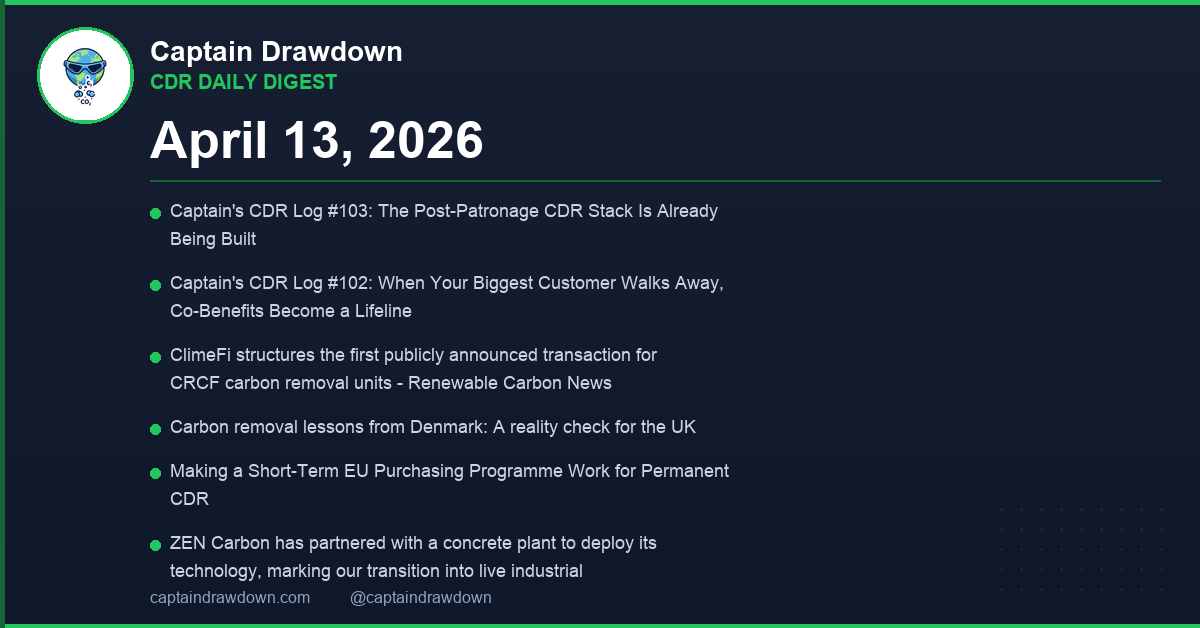
CDR Daily Digest — 2026-04-14

CDR Daily Digest — 2026-04-14

Carbon dioxide removal is finding its way into the built environment faster than most people expected. Today’s stories converge on a single theme: concrete and construction materials are becoming a serious vector for permanent carbon storage, and the policy and capital signals are finally catching up. Concrete Is Becoming a Carbon Sink Three of today’s five stories point to the same place: the stuff we build with. CarbonCure just won the 2026 Climate Technology Company of the Year award. The company injects captured CO₂ into fresh concrete, where it mineralizes permanently. That is not a lab demo. CarbonCure’s technology is deployed across hundreds of concrete plants. The award signals that the broader climate-tech community now sees mineralization in building materials as a proven pathway, not a speculative one. ...

April 14, 2026 · 4 min · CaptainDrawdown
Cella and TotalEnergies Target CO2 Mineralization at Industrial Sites

Cella and TotalEnergies Target CO2 Mineralization at Industrial Sites

Cella has signed a research and technology collaboration with TotalEnergies to test its in situ mineralization platform for evaluating CO2 storage potential at industrial sites. The partnership covers the full workflow: site screening, injection design, and monitoring. It’s a notable signal that mineralization-based storage is getting serious attention from one of the world’s largest energy companies. Why it matters Most carbon storage conversations focus on injecting CO2 into deep saline aquifers or depleted oil and gas reservoirs, where the gas stays trapped but remains as CO2 for long periods. In situ mineralization takes a different approach. It aims to convert injected CO2 into solid carbonate minerals within the rock itself, locking the carbon away permanently. If Cella’s platform can reliably screen industrial sites for this kind of storage and then guide injection and monitoring, it could open up storage options that don’t depend on traditional geological traps. The fact that TotalEnergies, through its Carbon to Value (C2V) Initiative, is investing research effort here suggests the major energy players see mineralization as more than a lab curiosity. They want to know if it works at real industrial facilities. ...

April 14, 2026 · 4 min · CaptainDrawdown
ETH Zurich's Living Building Material Captures CO2 and Self-Repairs

ETH Zurich's Living Building Material Captures CO2 and Self-Repairs

Researchers at ETH Zurich have created a construction material that is alive, captures CO2, and can repair itself. If it works at scale, it would turn buildings from carbon sources into carbon sinks, merging structural function with carbon removal in a single product. Why it matters The built environment is responsible for roughly 37% of global CO2 emissions when you count both construction and operation. Concrete alone accounts for about 8% of worldwide emissions. A material that absorbs carbon dioxide while serving as a structural component would attack the problem from both sides: reducing the emissions footprint of construction and actively pulling CO2 from the air over the building’s lifetime. That is a fundamentally different proposition from simply making concrete “less bad.” ...

April 14, 2026 · 4 min · CaptainDrawdown
€300M Fund Ties Manager Pay to Biodiversity Outcomes

€300M Fund Ties Manager Pay to Biodiversity Outcomes

Triodos Investment Management and Fondaction Asset Management have launched Value Nature Fund I, a €300 million closed-end fund that aims to convert farmland and forests to regenerative practices across Europe, Canada, and the United States. What makes this fund unusual: part of the manager’s performance-based pay will be tied directly to hitting biodiversity and climate impact targets, not just financial returns. Why it matters Natural capital investing has long been treated as a niche corner of sustainable finance, often associated with small pilot projects or grant-funded conservation. A €300 million target with institutional structure, a dual-continent strategy, and an intended Article 9 classification under the EU’s Sustainable Finance Disclosure Regulation (the highest sustainability category for investment products) signals something different. This fund is being packaged as a real-assets vehicle meant to attract larger pools of capital into land-use transition. For CDR, the relevance is clear. Regenerative agriculture and closer-to-nature forestry are among the primary land-based pathways for removing and storing carbon. Scaling these practices requires exactly the kind of institutional capital this fund is designed to mobilize. But the usual caveat applies: land-based carbon removal addresses residual emissions that can’t be eliminated through decarbonization. It is not a substitute for cutting fossil fuel use. ...

April 14, 2026 · 5 min · CaptainDrawdown
CarbonCure Wins 2026 Climate Technology Company of the Year

CarbonCure Wins 2026 Climate Technology Company of the Year

CarbonCure Technologies took home the Climate Technology Company of the Year title at the 2026 CleanTech Breakthrough Awards. The Canada-based company earned the recognition for its approach to CO2 mineralization in concrete, a process that locks carbon dioxide into one of the world’s most widely used building materials. Why it matters Concrete production is responsible for roughly 8% of global CO2 emissions. Most CDR conversations focus on direct air capture or ocean-based approaches, but mineralization in concrete offers something different: it permanently stores CO2 in a product people are already buying in massive quantities. An industry award like this signals growing mainstream recognition that carbon utilization in building materials is a serious piece of the removal and reduction puzzle. ...

April 14, 2026 · 4 min · CaptainDrawdown
60 Mt CO₂ removals by 2050 if CDR joins EU carbon market

60 Mt CO₂ removals by 2050 if CDR joins EU carbon market

A new study from the Potsdam Institute for Climate Impact Research (PIK) finds that folding CDR into the EU Emissions Trading System could deliver roughly 60 million tonnes of CO₂ removals per year by 2050. The researchers propose a phased approach, with full integration of removal credits and residual emissions under a single carbon price arriving around 2040. If the design holds, Europe’s carbon market would shift from merely capping pollution to actively pulling carbon out of the atmosphere. ...

April 14, 2026 · 5 min · CaptainDrawdown
Captain's CDR Log #104: CDR's Escape Hatch Is Hiding in Your Concrete

Captain's CDR Log #104: CDR's Escape Hatch Is Hiding in Your Concrete

Captain Drawdown’s daily logbook on every CDR story, paper, and expert voice — so you don’t have to read them all. The CDR sector is panicking about losing credit buyers. Meanwhile, the most resilient carbon removal companies don’t need them, because they’re selling concrete, pavement, and insulation. This is the split that matters right now. While the voluntary carbon market wobbles and major buyers hit pause, a parallel track of CDR is quietly embedding itself into physical products that people already purchase for reasons that have nothing to do with climate guilt. It is happening across biochar, mineralization, and CO₂ utilization at the same time. And it changes the economics of carbon removal in ways the credit-obsessed conversation is missing. ...

April 14, 2026 · 6 min · CaptainDrawdown
CDR Daily Digest — 2026-04-13

CDR Daily Digest — 2026-04-13

The CDR market is being rewired around buyers who actually need it, not patrons who wanted to look good. That’s the thread connecting today’s stories, from Europe’s first certified enhanced rock weathering (ERW) field pilots to Germany’s stark admission that it needs up to 51 million tonnes of CO₂ removed per year by 2045. The question is no longer whether CDR will matter. It’s whether the infrastructure, policy, and commercial plumbing can keep pace with the demand signals now arriving. ...

April 13, 2026 · 4 min · CaptainDrawdown
Altitude scales biochar credit buys to unclog CDR supply bottlenecks

Altitude scales biochar credit buys to unclog CDR supply bottlenecks

CDR trader Altitude is ramping up its purchases of biochar carbon credits, positioning itself to tackle what it sees as a fundamental mismatch between supply and demand in the carbon dioxide removal market. The firm, led by chief investment officer Benjamin Schulz, was built specifically to address structural bottlenecks in the CDR pipeline, and biochar is becoming a bigger part of that strategy. Why it matters The CDR market has a well-known problem: buyers want credits, but the supply of verified, high-quality removal tons is thin and lumpy. Projects take years to develop, financing is hard to secure, and the credits that do exist often get locked up in long-term offtake agreements with a handful of large corporate buyers. Traders like Altitude sit in the middle, trying to smooth out that friction by buying credits and making them available to a broader set of purchasers. The fact that Altitude is leaning harder into biochar tells us something about where the near-term supply is actually materializing. ...

April 13, 2026 · 5 min · CaptainDrawdown