Cotierra delivers 1,200 tCO₂e of soil carbon to myclimate, extends to 2027

Cotierra delivers 1,200 tCO₂e of soil carbon to myclimate, extends to 2027

Swiss agricultural carbon company Cotierra has delivered its first 1,200 tCO₂e of soil carbon removal credits to myclimate, the Zurich-based climate project foundation, and extended the offtake partnership into 2027. The delivery, drawn from Cotierra’s 2025 production year, is one of the first sizeable tranches of agricultural soil carbon removals to actually land in a buyer’s account rather than sit as a forward contract. Why it matters Agricultural soil carbon has a credibility problem. The category has been dogged by questions about permanence, measurement accuracy, and whether claimed removals are additional to what farmers would have done anyway. Actual verified delivery, not promises, is what the segment needs to rebuild trust with corporate buyers. A 1,200-tonne delivery is modest next to what engineered removal players ship, but in soil carbon it counts as a real-world receipt. The 2027 extension signals myclimate is willing to commit to a multi-year pipeline from this supplier rather than treating it as a one-off pilot. ...
April 18, 2026 · 4 min · CaptainDrawdown
REDD+ Credits Overstated Avoided Deforestation by 10.7×

REDD+ Credits Overstated Avoided Deforestation by 10.7×

First-generation REDD+ projects, the flagship forest-protection credits traded on the voluntary carbon market, claimed 10.7 times more avoided deforestation than independent evaluations can justify. That’s not a rounding error. That’s an order-of-magnitude gap between what was sold to buyers and what actually happened in the forest. Why it matters REDD+ (Reducing Emissions from Deforestation and Degradation) credits have been the single largest category of nature-based carbon credits on the voluntary market for years. If the credits overstate their climate benefit by a factor of nearly 11, then companies and governments that retired those credits believing they offset real emissions were, in effect, paying for phantom tons. This paper, published in Nature Communications, doesn’t just confirm the problem. It pinpoints why it happened, and that diagnosis matters far more than the headline number. ...

April 18, 2026 · 4 min · CaptainDrawdown
1.51M Tonnes in One Month: March 2026 Shatters CDR Records

1.51M Tonnes in One Month: March 2026 Shatters CDR Records

March 2026 was the biggest single month for durable CDR purchase commitments in recent memory. Roughly 1.51 million tonnes of carbon removal were contracted, with two deals alone accounting for over 85% of that volume. The numbers signal that corporate buyers are no longer dabbling in CDR. They’re locking in multi-year, industrial-scale supply. Why it matters Until recently, most CDR purchases were measured in hundreds or low thousands of tonnes. A month where a single deal covers a million tonnes changes the math on what suppliers can finance and build. Large offtake agreements give project developers the revenue certainty they need to break ground on facilities that cost hundreds of millions of dollars. If this pace holds, 2026 could redefine what “market-ready” means for durable carbon removal. ...

April 18, 2026 · 4 min · CaptainDrawdown
German Municipal Utility Signs Long-Term Biochar CDR and Heat Deal With Novocarbo

German Municipal Utility Signs Long-Term Biochar CDR and Heat Deal With Novocarbo

Novocarbo, a German climate tech company specializing in biochar-based carbon removal, has signed a long-term partnership with Stadtwerke Dessau, the municipal utility serving the city of Dessau in Germany. The deal will see Novocarbo supply both biochar carbon removal credits and renewable heat to the utility, a pairing that highlights how CDR infrastructure can double as local energy infrastructure. Why it matters Municipal utilities are not the buyers most people picture when they think about carbon removal demand. The typical CDR customer profile skews toward big tech companies and corporate sustainability teams chasing net-zero pledges. A German Stadtwerk, a publicly owned local utility, signing a long-term biochar deal signals something different: CDR is starting to find a home in the mundane, essential business of heating buildings and managing local energy supply. That’s a distribution channel worth paying attention to. ...

April 18, 2026 · 4 min · CaptainDrawdown
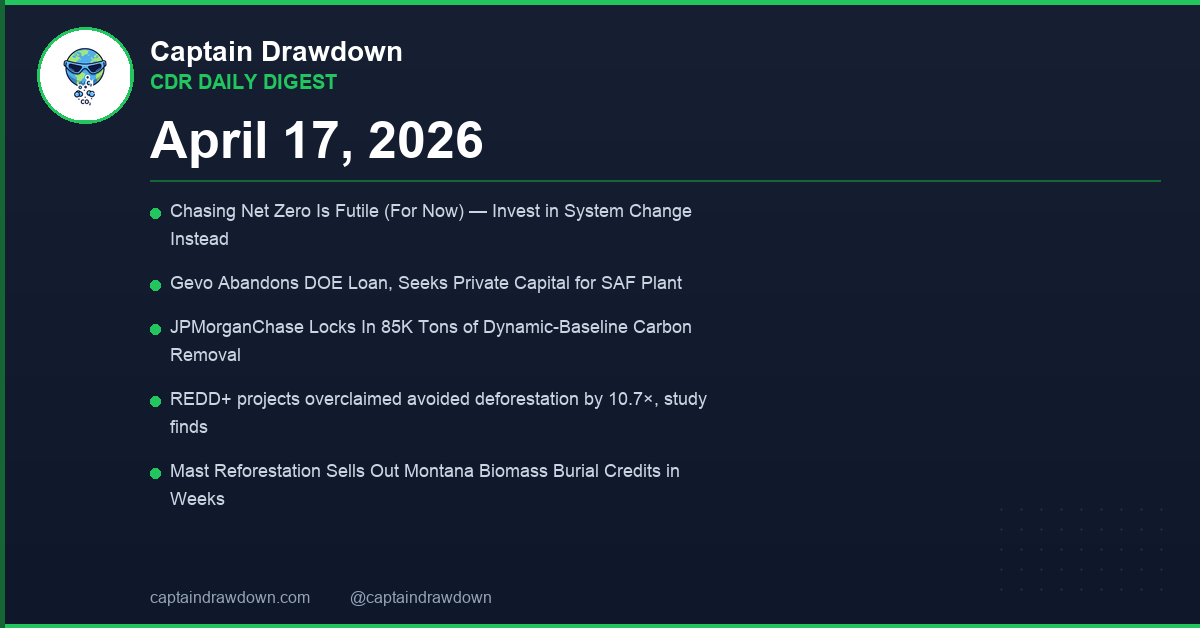
CDR Daily Digest — 2026-04-17

CDR Daily Digest — 2026-04-17

The gap between carbon credit claims and real-world carbon removal just got another data point. A new study finds that REDD+ avoided-deforestation projects overclaimed their climate benefit by a factor of 10.7. Meanwhile, buyers and developers are shifting toward removal credits with tighter measurement, and the signals are everywhere in today’s stories. The crediting gap is reshaping where money flows A peer-reviewed study found that REDD+ projects, which sell credits based on forests they claim would have been cut down, overstated their avoided deforestation by 10.7 times on average. That means for every ton of CO2 these credits claimed to protect, roughly a tenth of a ton was real. This isn’t new territory. Earlier analyses flagged similar problems. But the scale of the overclaim keeps getting confirmed, and it matters because these credits still circulate in voluntary markets. ...

April 17, 2026 · 4 min · CaptainDrawdown
Gevo Abandons DOE Loan, Seeks Private Capital for SAF Plant

Gevo Abandons DOE Loan, Seeks Private Capital for SAF Plant

Gevo Inc. has pulled its application for a U.S. Department of Energy loan guarantee for its sustainable aviation fuel (SAF) project, choosing instead to pursue alternative private funding. The move signals how shifting federal energy policy priorities are reshaping the financing landscape for low-carbon fuel ventures. Why it matters SAF is one of the few realistic options for cutting emissions from aviation, a sector that is genuinely hard to decarbonize with batteries or hydrogen alone. Projects like Gevo’s sit at the intersection of biofuels and carbon management, since the lifecycle carbon intensity of the fuel determines whether it delivers real climate benefit. When a company walks away from a major government financing mechanism, it tells you something about the current policy environment and the company’s read on where capital will actually flow. ...

April 17, 2026 · 4 min · CaptainDrawdown
Mast Reforestation Sells Out Montana Biomass Burial Credits in Weeks

Mast Reforestation Sells Out Montana Biomass Burial Credits in Weeks

Mast Reforestation sold out every carbon removal credit from its flagship Montana biomass burial project within just weeks of issuance. That’s a striking signal: voluntary buyers are hungry for biomass burial CDR credits, and they’re willing to move fast to get them. Why it matters The CDR market has a demand problem and a supply problem, depending on which pathway you’re looking at. For biomass burial, this sellout suggests the demand side is healthy, at least for projects with credible methodology and a real track record. When credits move this quickly after issuance, it tells us that buyers had either pre-committed or were watching closely and ready to act. Either way, it points to growing confidence in biomass burial as a legitimate removal method. ...

April 17, 2026 · 5 min · CaptainDrawdown
Chasing Net Zero Is Futile (For Now) — Invest in System Change Instead

Chasing Net Zero Is Futile (For Now) — Invest in System Change Instead

If just 1% of German air passengers purchased durable carbon removal to offset their flights, global annual CDR purchases would jump by 50%. That single statistic, from a recent essay by Dirk Paessler of the Carbon Drawdown Initiative, captures why system-level thinking matters more than individual purity. The Purity Trap Paessler’s argument is blunt: your personal net-zero goal is almost certainly going to fail. So is his. Not because of a lack of effort, but because the systems we live inside have not changed fast enough. When you skip a flight or cut out meat, you make a personal sacrifice. But global air traffic hit 9.5 billion passenger journeys in 2024 and is projected to reach roughly 19.5 billion by 2042. That growth is driven overwhelmingly by people in Asia, the Middle East, and Africa gaining the economic freedom and mobility that Western nations have enjoyed for decades. No realistic demand-reduction scenario stops that growth. The systemic answer, Paessler argues, has to work for a world with more flights, not fewer. ...

April 17, 2026 · 4 min · CaptainDrawdown
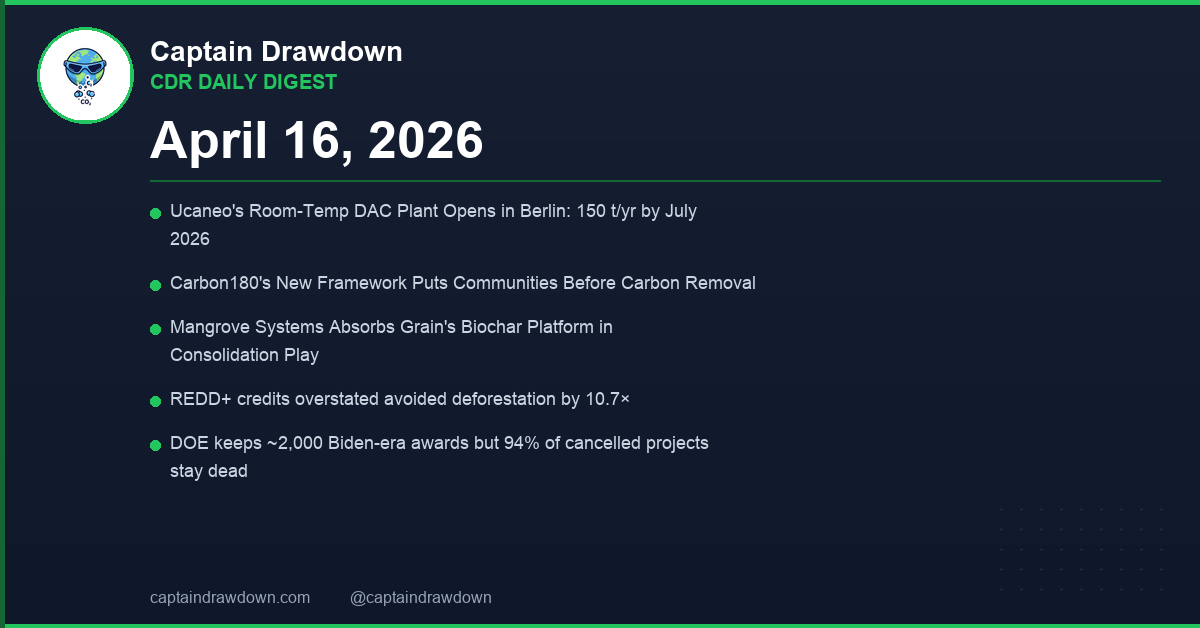
CDR Daily Digest — 2026-04-16

CDR Daily Digest — 2026-04-16

The CDR market is splitting into two lanes: one where small hardware companies race to prove unit economics, and another where policy and credit-quality questions threaten to reshape demand. Today’s five stories sit neatly across that divide. Ucaneo fires up a room-temperature DAC plant in Berlin German startup Ucaneo has opened a direct air capture facility in Berlin that operates at room temperature, a notable departure from the energy-intensive thermal processes most DAC companies rely on. The plant targets 150 tonnes of CO₂ removed per year by July 2026. That is tiny by industrial standards, but the room-temperature angle matters. Heat is the biggest cost driver in conventional DAC. If Ucaneo’s sorbent chemistry holds up at steady state, the energy bill per tonne could drop meaningfully. The next milestone to watch: whether the plant hits its 150 t/yr nameplate and what the verified cost per tonne looks like once it does. ...

April 16, 2026 · 4 min · CaptainDrawdown
CDR Daily Digest — 2026-04-15

CDR Daily Digest — 2026-04-15

CDR has a growing disconnect between paper and practice. Permits for carbon removal projects keep stacking up, but the money to build them is drying up. That gap, between regulatory green lights and actual capital deployment, is the most important pattern in today’s stories. The permits-to-payments gap Captain’s CDR Log #105 puts a sharp point on it: the pipeline of permitted CDR projects is expanding, yet financing has stalled. Permits are necessary but not sufficient. A permit lets you build. A check lets you actually do it. Right now, the industry has more of the former and not enough of the latter. ...

April 15, 2026 · 3 min · CaptainDrawdown