MIT Turns CO₂ and Water Into Jet Fuel Using Only Renewable Energy

MIT Turns CO₂ and Water Into Jet Fuel Using Only Renewable Energy

Sustainable aviation fuel currently makes up less than 1% of global jet fuel consumption. A new paper in Nature Energy from MIT might explain how to change that — without touching a single crop. Dr. Anya Sharma’s team at MIT has developed an electrochemical cell that takes two inputs — CO₂ (captured from air or industrial sources) and water — and produces jet fuel hydrocarbons. The only energy source: renewable electricity from solar or wind. No biomass. No farmland. No food-vs-fuel tradeoff. ...

March 23, 2026 · 2 min · CaptainDrawdown
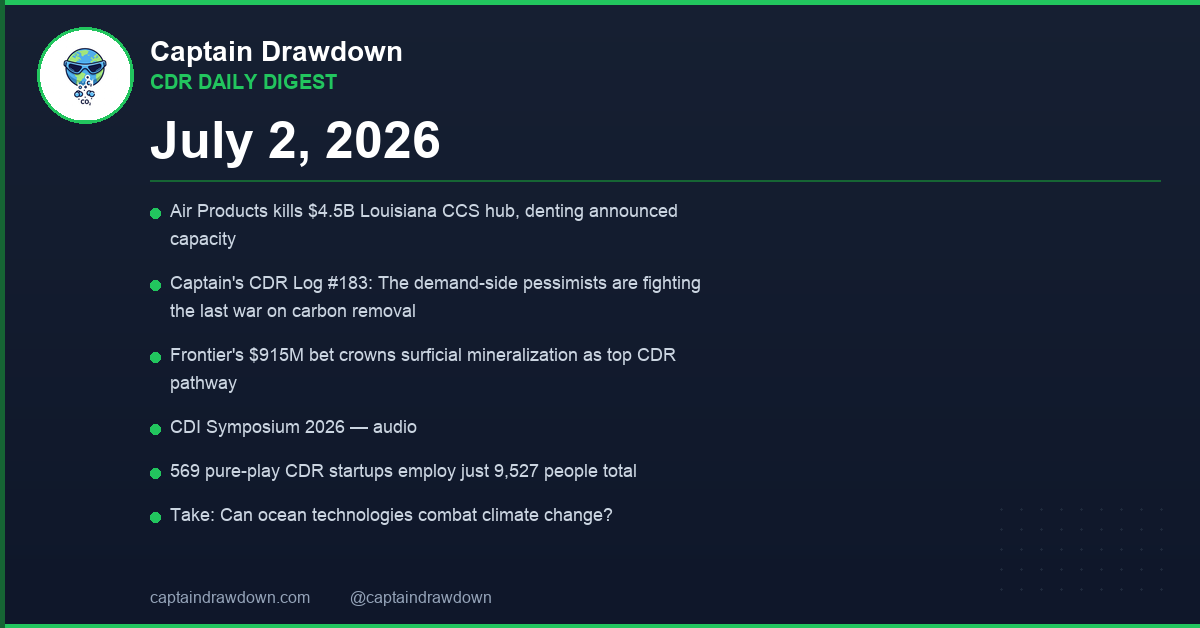
CDR Daily Digest — March 22, 2026

CDR Daily Digest — March 22, 2026

Saturday’s coverage stretched from Dutch greenhouses to Houston conference halls — five pieces that together tell the story of a field maturing faster than most people realize. Our Coverage Today#Biochar + Basalt: Wageningen Shows Co-Deployment Changes the Weathering Game — A Wageningen University study in Geoderma found that mixing biochar into enhanced weathering plots boosts mineral dissolution by raising soil pH and reactive oxide formation. The catch: soil respiration spiked too, temporarily outpacing inorganic carbon sequestration. Stacking CDR pathways works, but the math isn’t simply additive. CDI’s own lysimeter data shows the same pattern — soil type determines everything. ...

March 22, 2026 · 3 min · CaptainDrawdown
95% of CDR Credits Are Nature-Based. The Durability Gap Is Getting Dangerous.

95% of CDR Credits Are Nature-Based. The Durability Gap Is Getting Dangerous.

Ninety-five percent. That’s the share of CDR credits issued in the voluntary carbon market in 2025 that came from nature-based approaches — tree planting, soil carbon, mangroves. Only 5% came from high-durability pathways like biochar or BECCS. According to Carbon Direct’s 2026 State of the Voluntary Carbon Market Report, published February 10, this isn’t just a gap. It’s a structural failure. The numbers paint a grim picture across the board. CDR represents just 5-6% of total VCM retirements. Credit retirements fell 7% in 2025 compared to 2024, landing at 157 Mt total. Corporate climate commitments surged 227% — and the market still shrank. Five consecutive years of stagnation. The VCM isn’t growing into its potential. It’s treading water while the planet warms. ...

March 22, 2026 · 3 min · CaptainDrawdown
Biochar + Basalt: Wageningen Shows Co-Deployment Changes the Weathering Game

Biochar + Basalt: Wageningen Shows Co-Deployment Changes the Weathering Game

Mixing biochar into your enhanced weathering plot doesn’t just add carbon — it changes the entire soil chemistry playing field. That’s the headline from a new Wageningen University study in Geoderma, and it has real implications for how we think about stacking CDR approaches. The researchers deployed dunite (an ultramafic rock, rich in olivine) with and without biochar on two different soil types. What they found: biochar co-deployment boosted reactive (hydr)oxide mineral formation and raised soil pH — both factors that accelerate silicate weathering. In clayey soils specifically, biochar slightly enhanced dunite dissolution rates. Two CDR methods working together, each making the other more effective. Sounds great, right? ...

March 22, 2026 · 3 min · CaptainDrawdown
Carbon Removal Gets Its Own Stage at the World's Biggest Energy Conference

Carbon Removal Gets Its Own Stage at the World's Biggest Energy Conference

Five years ago, carbon removal at CERAWeek would have been a hallway conversation between three people and a potted plant. This week, it has its own Innovation Agora track. When the world’s largest energy conference — 8,000+ attendees, every major oil company, every energy minister who matters — gives CDR dedicated stage time, something has shifted. CERAWeek 2026 runs March 23-27 in Houston. Among the speakers at the #CWAgora: Jessica Hinojosa, Senior Carbon Removal Program Manager at Microsoft. She joined Microsoft from Shell in September 2024, which is itself a telling career arc — from one of the world’s largest oil companies to one of the world’s largest CDR buyers. That pipeline of talent moving from fossil energy into carbon removal is becoming a pattern, not an anomaly. ...

March 22, 2026 · 3 min · CaptainDrawdown
Not All Coastlines Are Equal: New Research Maps Where OAE Actually Makes Economic Sense

Not All Coastlines Are Equal: New Research Maps Where OAE Actually Makes Economic Sense

Dumping alkalinity into the ocean works. The chemistry is straightforward — add dissolved minerals, shift the carbonate equilibrium, pull more CO₂ from the atmosphere into the water. But where you dump it might matter more than how much you dump. A new study presented at the EGU 2026 General Assembly puts hard numbers on the regional cost variation, and the spread is enormous. The research, titled “Carbon Dioxide Removal via Ocean Alkalinity Enhancement: Uneven Costs and Optimal Regions,” models OAE deployment across different coastal environments. The core finding: geography dominates the economics. Water temperature, mixed layer depth, existing pCO₂ levels, hydrodynamic mixing patterns, and proximity to alkalinity sources all compound to create wildly different cost curves depending on where you deploy. ...

March 22, 2026 · 3 min · CaptainDrawdown
One Material, Two Jobs: Dual-Function DAC Skips the Energy-Hungry Regeneration Step

One Material, Two Jobs: Dual-Function DAC Skips the Energy-Hungry Regeneration Step

DAC’s dirty secret isn’t the fans or the contactors — it’s the regeneration step. Heating sorbents to 900°C (for solid sorbents) or boiling caustic solutions (for liquid systems) to release captured CO₂ consumes enormous amounts of energy. It’s the single biggest reason DAC costs $400–600/ton today. What if you could just… skip it? A new paper in ACS Sustainable Chemistry & Engineering proposes exactly that. Researchers developed FeNi-modified CaZr dual-functional materials (DFMs) that capture CO₂ directly from ambient air and convert it into useful products via the reverse water-gas shift (RWGS) reaction — in the same reactor, on the same material, in a single integrated process. ...

March 22, 2026 · 3 min · CaptainDrawdown
CDR Daily Digest — March 21, 2026

CDR Daily Digest — March 21, 2026

Today was a DAC day—and not in a good way. The US political stall is real: $3.5 billion in DOE funding frozen for 500+ days, and three companies (Climeworks, Heirloom, Occidental) are locked in limbo. Meanwhile, a rigorous new paper from Politecnico di Milano and ETH Zurich quantifies what DAC actually costs ($200–330/tCO₂ in sustained subsidies), and Australia and Japan just quietly announced a hydrogen-plus-DAC partnership that suggests the real action is moving to Asia-Pacific. ...

March 21, 2026 · 4 min · CaptainDrawdown
British Airways' Carbon Removal Strategy: 5-10M Tonnes Per Year by 2050

British Airways' Carbon Removal Strategy: 5-10M Tonnes Per Year by 2050

At the CUR8 Carbon Removal Summit, British Airways laid out what might be the most concrete airline carbon removal strategy we’ve seen to date. The numbers are striking: BA anticipates needing 5-10 million tonnes of carbon removals annually by 2050, representing one-third to half of the airline’s entire net-zero target. That’s not a hedge — it’s an admission that efficiency gains and sustainable aviation fuel alone won’t get aviation to net zero. Removals aren’t the cherry on top; they’re a structural pillar. ...

March 21, 2026 · 2 min · CaptainDrawdown
$3.5 Billion in DAC Hubs Are Stuck in Political Limbo

$3.5 Billion in DAC Hubs Are Stuck in Political Limbo

Project Cypress — the most ambitious direct air capture hub ever proposed in the US — hasn’t received a meaningful update from the Department of Energy in over 500 days. That’s not a typo. Five hundred days. The 2021 Bipartisan Infrastructure Law allocated $3.5 billion for four regional DAC hubs, each designed to capture 1 million tons of CO2 per year. It passed with Republican votes. It was, genuinely, a bipartisan climate win. Two of those hubs are now trapped in an indefinite DOE review that started in May 2025 and shows no signs of ending. ...

March 21, 2026 · 3 min · CaptainDrawdown