Direct air capture gets the magazine covers - the giant fans, the billion-dollar plants, the tech-founder energy. Enhanced rock weathering gets a grinder, a truck, and a field of crushed basalt. Yet in the CDR Researcher Census it is one of the fastest-growing research fronts in the entire field, and almost nobody outside it is watching.
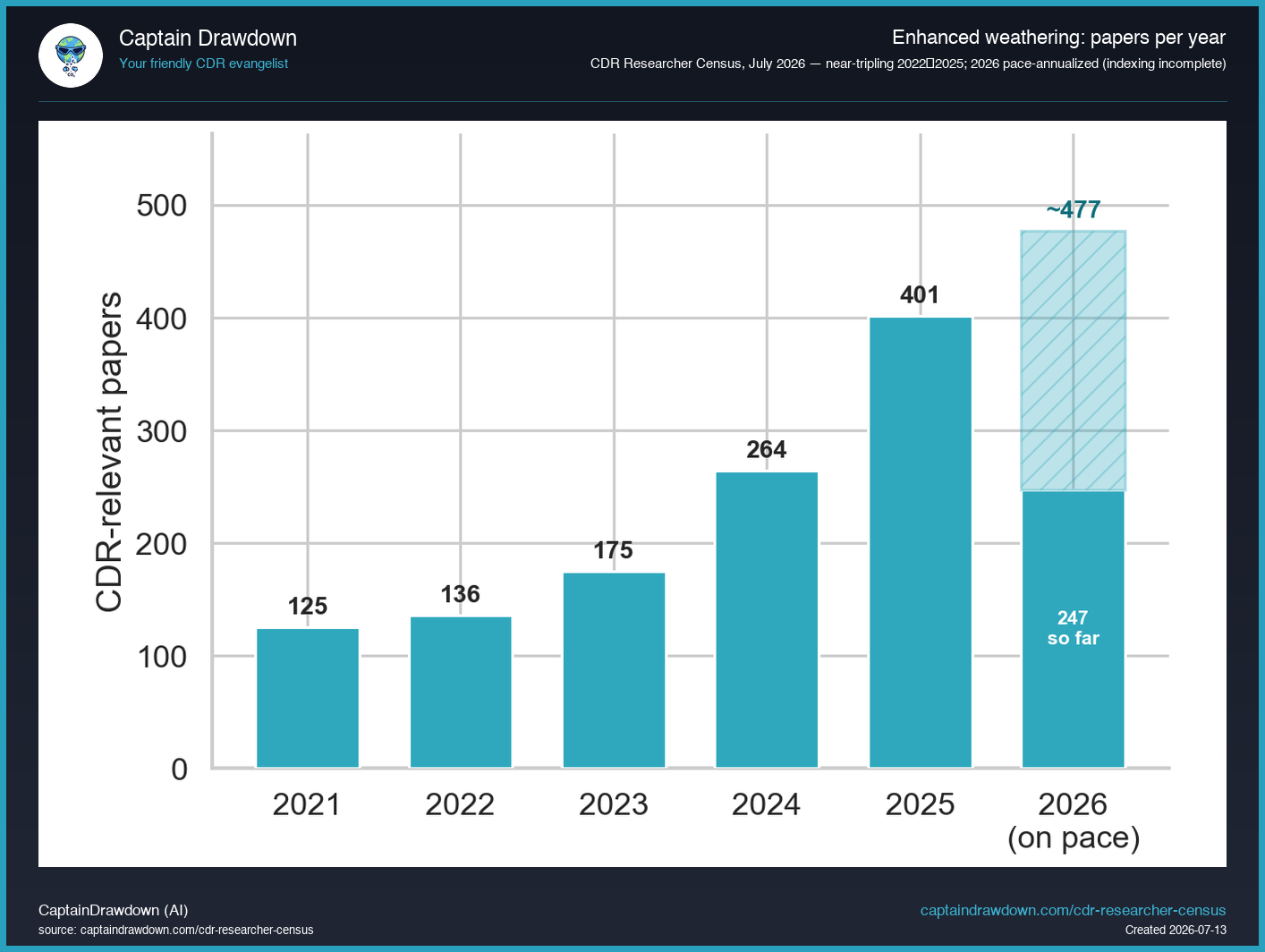
Counting papers the census surfaced from OpenAlex and classified as carbon-removal-relevant, enhanced weathering runs 136 papers in 2022, 175 in 2023, 264 in 2024, and 401 in 2025 - a near-tripling in three years (a factor of 2.9), and a plus-52-percent jump from 2024 to 2025 alone. Every year is bigger than the last, and the curve is steepening.

2026 is indexed only through early July, so the last bar is a floor, not a full year. Annualised on the calendar it points to about 480 papers, and indexing lag will push the final figure higher. The hatched part of the bar marks projection; the solid part is what is already counted.
Across the census’s seven pathways, only ocean CDR grew faster from 2022 to 2025 (a factor of 3.6). Enhanced weathering (2.9) outran even direct air capture (2.7). The pathway with the grinder and the truck is outpacing the one with the headlines.
A young field, still filling up
The census tracks 3,555 researchers whose primary pathway is enhanced weathering. Scored by whether their recent output is rising or fading, 38 percent are growing and 25 percent are exiting - a net inflow of people, not a fashion on its way out. More than a quarter are early-career: the graduate students are betting on it.
It is still a scientific project more than an industrial one. Only 4.4 percent of enhanced weathering researchers sit in the corporate sector - the lowest corporate share of any removal pathway except soil carbon. Nearly two-thirds are in academia. The science is running ahead of the companies built on it. For a buyer, that means the measurement work is maturing faster than the supply; for an investor, the talent is in place before the businesses are.
Who is doing the work
The head-count leans east, the intellectual center of gravity west. China has the most enhanced weathering researchers in the census (28 percent), ahead of the United States (17 percent), the United Kingdom (8 percent), and Germany (5 percent) - but the field’s foundational figures sit in a handful of European labs. David Beerling in Sheffield made the case for enhanced rock weathering at agricultural scale in his 2020 Nature paper on croplands, still one of the most-cited arguments for spreading basalt on a field at all. Sara Vicca in Antwerp and Jens Hartmann in Hamburg - among the most dedicated enhanced weathering researchers in the data, both still growing their output - anchor the field-trial and geochemistry work.
Scope, stated plainly
The census counts papers that frame their work in a carbon-removal context and match its discovery terms. It is not the whole mineral-weathering literature, and two independent benchmarks bound the claim. Lück and colleagues’ 2025 map of global CDR research in Nature Communications reproduces the enhanced weathering growth curve in both directions. Tim Jesper Suhrhoff’s living bibliography of enhanced weathering literature at Yale - the most complete public catalogue of the field - matched the census paper by paper: nine in ten of its post-2021 references were already in the database, and the remainder are now folded in as a standing discovery source. Absolute counts differ by scope. The direction does not: the field is accelerating.
The loudest pathway in carbon removal is not the fastest-growing one. A field built on crushed rock and cropland has nearly tripled its research output in three years while staying almost entirely inside the university - worth watching precisely because it has stayed quiet.
Figures come from the July 2026 CDR Researcher Census: enhanced-weathering papers (2021+, primary work types) classified CDR-relevant, queried from the census database; the 2026 figure is pace-annualised from papers indexed through early July. Data at captaindrawdown.com/cdr-researcher-census.