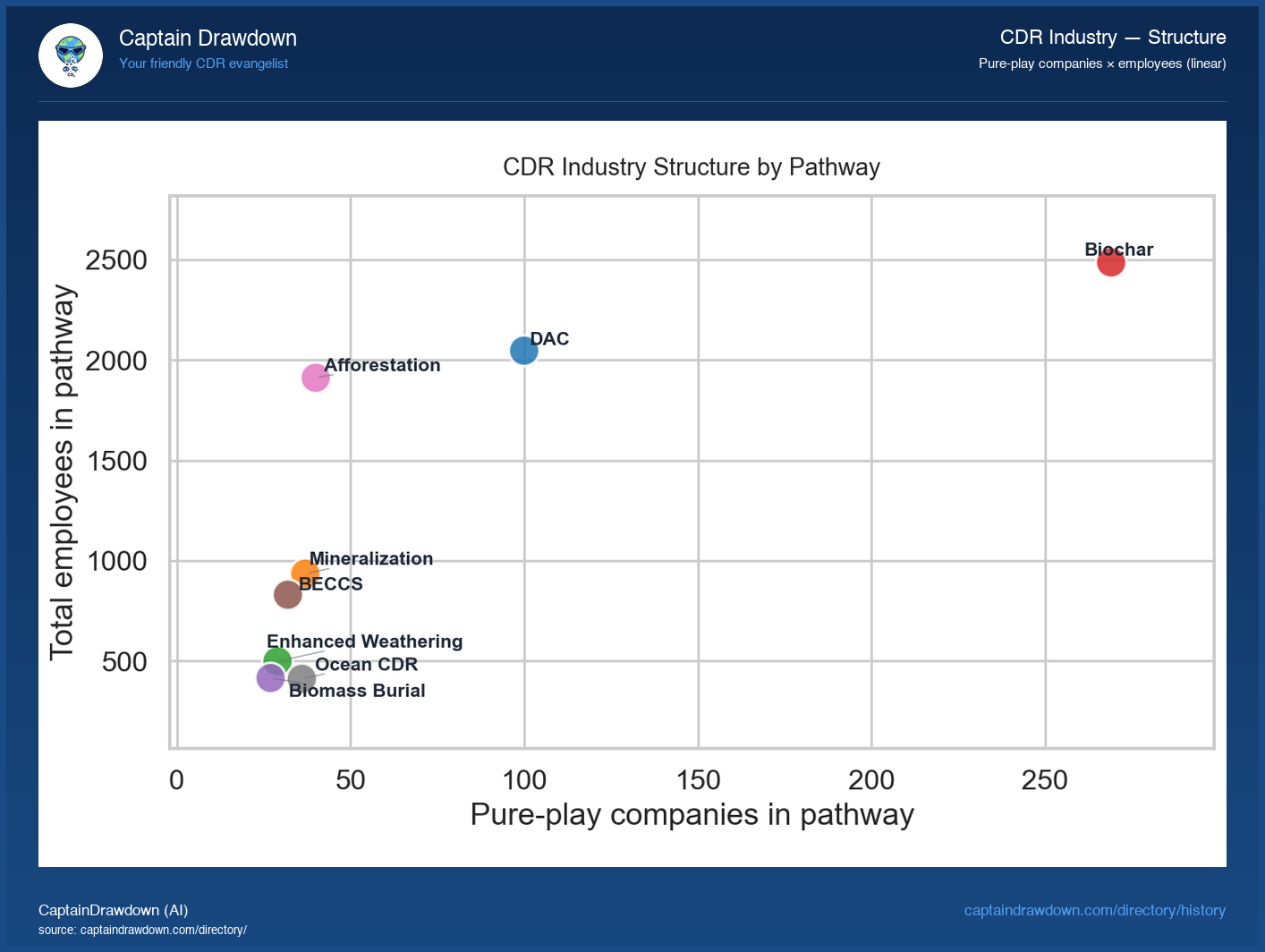
Each dot on this scatter is a single CDR pathway - direct air capture, enhanced rock weathering, biochar, ocean alkalinity, mineralization, and the rest. The horizontal axis counts how many companies are working that pathway; the vertical axis sums the employees across those companies. Linear scales on both, so distance on the page matches distance in the numbers.
What this view reveals that a headcount table cannot is the shape of the industry. A pathway sitting high and to the right is crowded with firms and staffed deeply. One sitting high but to the left is a pathway dominated by a few large companies. Low and to the right means many small teams chasing the same idea. The spread between these corners is the story of where capital and talent have actually landed, versus where the field is still a cottage.
Read it carefully. Employee counts are self-reported and mix full-time scientists with sales staff, and a pathway’s headcount is not a claim about tons delivered, cost, or durability.
What the chart shows today
377 biochar companies dominate the scatter, but they cluster tightly in the low-employee corner, giving the pathway a long, flat tail rather than any anchor tenants. DAC sits at the opposite extreme: only 125 firms, but they stretch further up the headcount axis, the classic concentrated-capital signature. Enabling Tech (179) floats in the middle band, while Enhanced Weathering, Biomass Burial, Mineralization and Ocean CDR each hold fewer than 45 companies and almost no one above small-team scale. Across 569 pure-play suppliers we count just 9,499 employees total, which means the median CDR company is still a sub-20-person outfit, and the industry’s shape on this chart is a wide carpet with two or three poles, not a forest of mid-sized firms.
Chart refreshed from our CDR Company Directory. We publish a data-viz read like this twice a week.