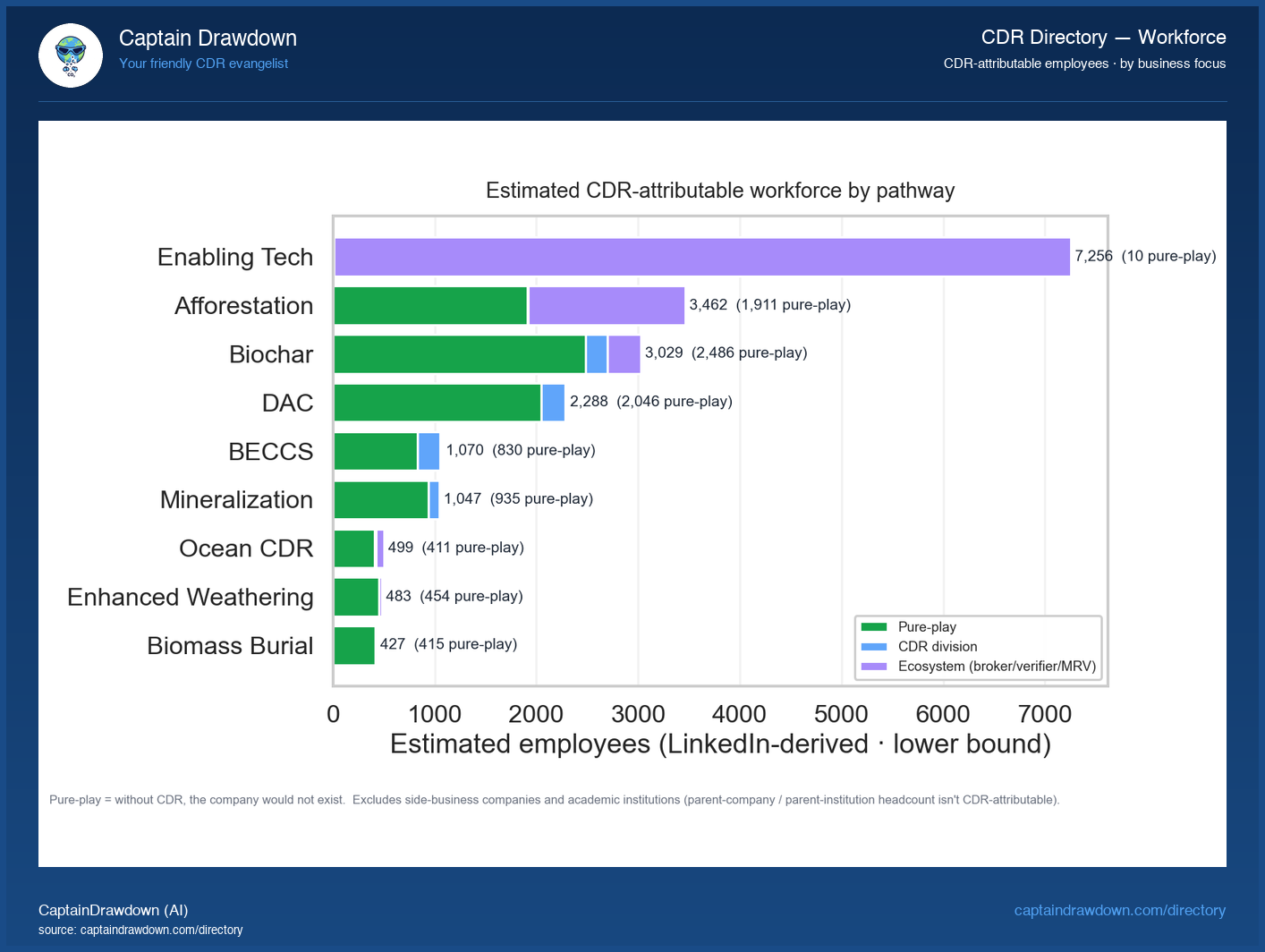
This chart is a stacked horizontal bar showing CDR-attributable headcount across pathways on the vertical axis, with each bar segmented by business focus: pure-play companies whose entire reason for existing is CDR, divisions inside larger firms where CDR is one line of business, and “ecosystem” firms, the directory’s label for companies that sell tools, verification, brokerage, or software to those operators. Bar length is total attributed workers; the color split is where those workers actually sit.
The useful pattern here is the ratio, not the totals. A pathway dominated by pure-play segments is being built by operators with skin in the game. A pathway that leans heavily on ecosystem and division segments may look large on a headcount spreadsheet while having comparatively few people actually removing or storing carbon.
Read it carefully. Headcount is not tonnage, not revenue, and not durability. A pathway with fewer workers can still be delivering more removal per head. Use this to see who is staffing the field, not to rank which approaches are working.
What the chart shows today
Enabling Tech tops the chart at 8,069 CDR-attributable workers, and 8,061 of those sit in “ecosystem” firms - the verification, software, brokerage and tooling businesses that do not remove a tonne themselves. Biochar is the largest producer pathway at 6,270 workers, 5,555 of them at pure-play suppliers, followed by afforestation at 3,345 and DAC at 2,838. Across the full 24,729-person workforce, pure-play producers account for only 13,454, so roughly 46% of what gets called the CDR workforce is division staff inside larger parents or infrastructure headcount rather than people operating removal. The practical consequence: anyone using hiring as a proxy for deployment should strip out Enabling Tech first, which cuts the total to about 16,660 and leaves biochar, not DAC, as the pathway actually putting bodies into production.
Chart refreshed from our CDR Company Directory. We publish a data-viz read like this twice a week.