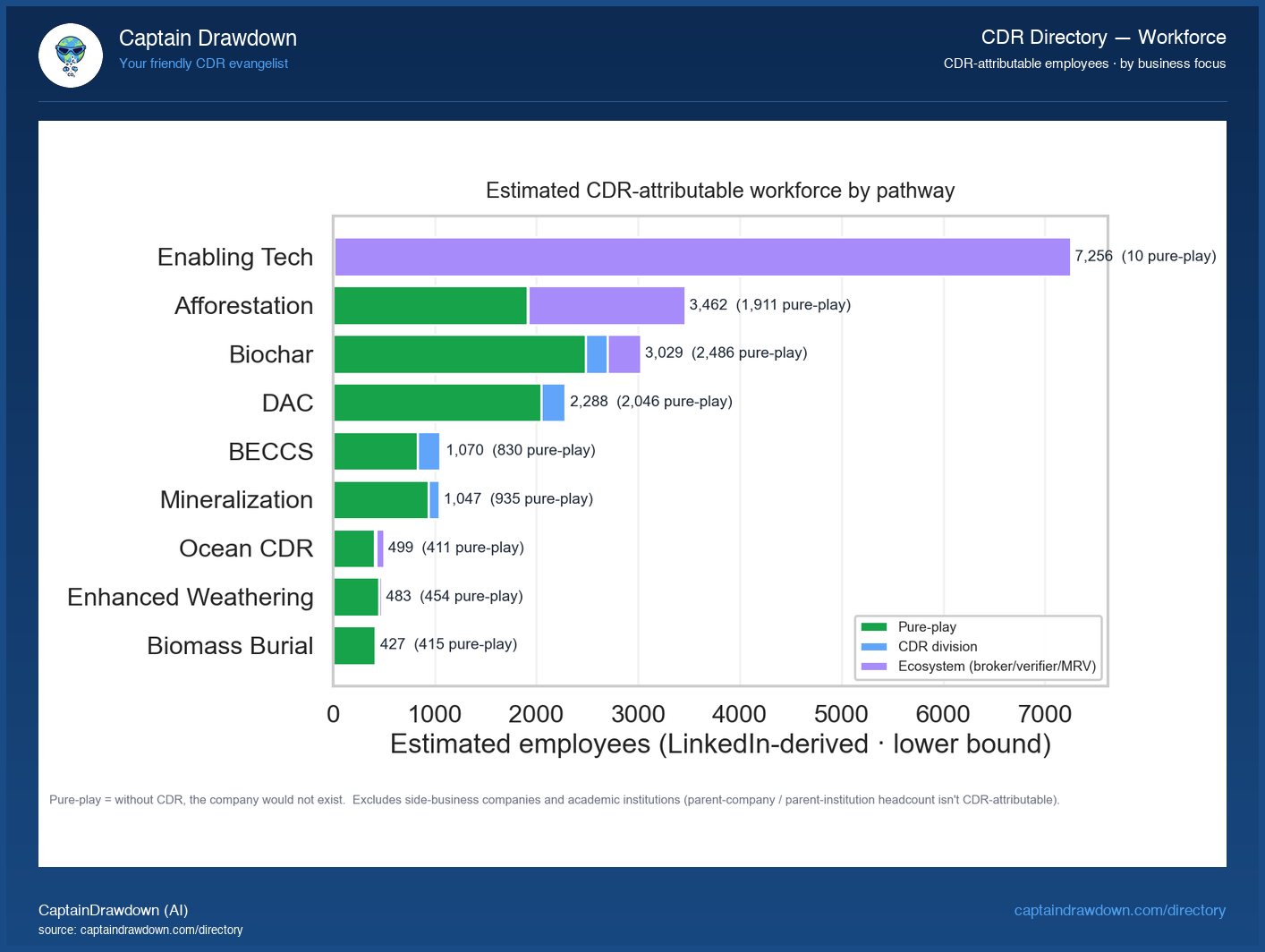
This chart is a stacked horizontal bar showing CDR-attributable headcount across pathways on the vertical axis, with each bar segmented by business focus: pure-play companies whose entire reason for existing is CDR, divisions inside larger firms where CDR is one line of business, and ecosystem players who sell tools, verification, brokerage, or software into the space. Bar length is total attributed workers; the color split is where those workers actually sit.
The useful pattern here is the ratio, not the totals. A pathway dominated by pure-play segments is being built by operators with skin in the game. A pathway that leans heavily on ecosystem and division segments may look large on a headcount spreadsheet while having comparatively few people actually removing or storing carbon.
Read it carefully. Headcount is not tonnage, not revenue, and not durability. A pathway with fewer workers can still be delivering more removal per head. Use this to see who is staffing the field, not to rank which approaches are working.
What the chart shows today
Biochar dominates the directory at 377 organizations, more than triple DAC’s 125 and over double the 179 listed under Enabling Tech. Yet across all 969 visible orgs, only 569 are pure-play suppliers, and they collectively employ just 9,527 people - an average of roughly 17 heads each. The other 400 entries are divisions (35), ecosystem players (211), and side-businesses (154), meaning a meaningful chunk of the “CDR workforce” narrative is really infrastructure and adjacencies rather than tonnes-out producers. The so-what: when someone quotes a big CDR headcount, ask what share sits inside pure-plays on a removal pathway versus a consultancy, registry, or software vendor riding the category.
Chart refreshed from our CDR Company Directory. We publish a data-viz read like this twice a week.