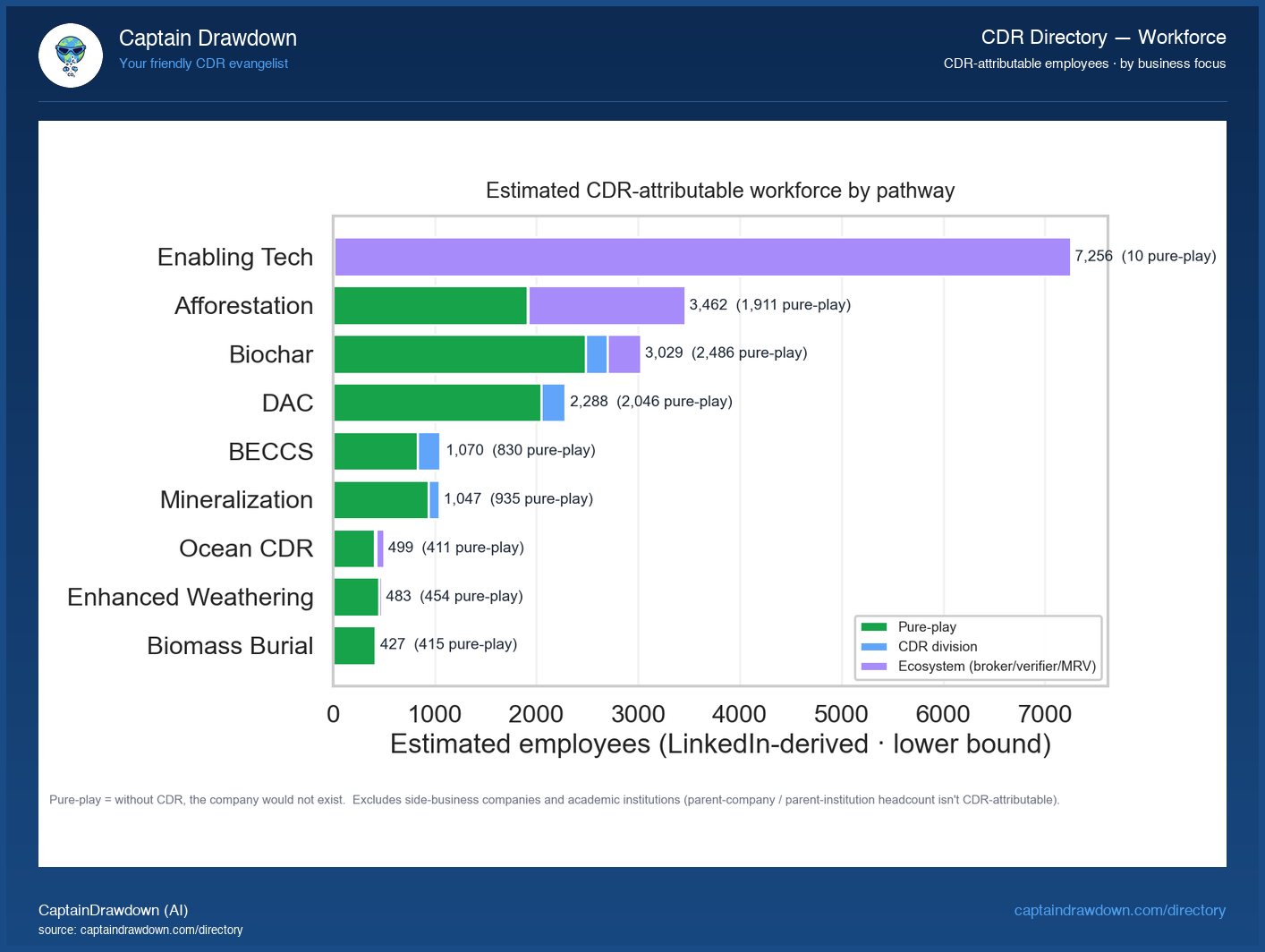
This chart is a stacked horizontal bar showing CDR-attributable headcount across pathways on the vertical axis, with each bar segmented by business focus: pure-play companies whose entire reason for existing is CDR, divisions inside larger firms where CDR is one line of business, and ecosystem players who sell tools, verification, brokerage, or software into the space. Bar length is total attributed workers; the color split is where those workers actually sit.
The useful pattern here is the ratio, not the totals. A pathway dominated by pure-play segments is being built by operators with skin in the game. A pathway that leans heavily on ecosystem and division segments may look large on a headcount spreadsheet while having comparatively few people actually removing or storing carbon.
Read it carefully. Headcount is not tonnage, not revenue, and not durability. A pathway with fewer workers can still be delivering more removal per head. Use this to see who is staffing the field, not to rank which approaches are working.
What the chart shows today
Biochar dominates the directory at 377 entities, more than triple any other pathway and roughly 39% of the 970 visible players. Suppliers (the pure-plays) account for 570 of those entities employing 9,558 workers between them, while only 35 are divisions of larger firms - meaning the “CDR workforce” headline numbers are mostly small specialists, not Fortune 500 carve-outs. Enabling Tech (179) and DAC (125) round out the top three, but note that Enabling Tech is infrastructure rather than tonnes-in-the-ground, so the real producer count is smaller than a quick glance suggests. The so-what: when someone quotes a big “CDR jobs” figure, ask how many sit inside biochar suppliers with double-digit headcounts versus actual scaled removal capacity.
Chart refreshed from our CDR Company Directory. We publish a data-viz read like this twice a week.