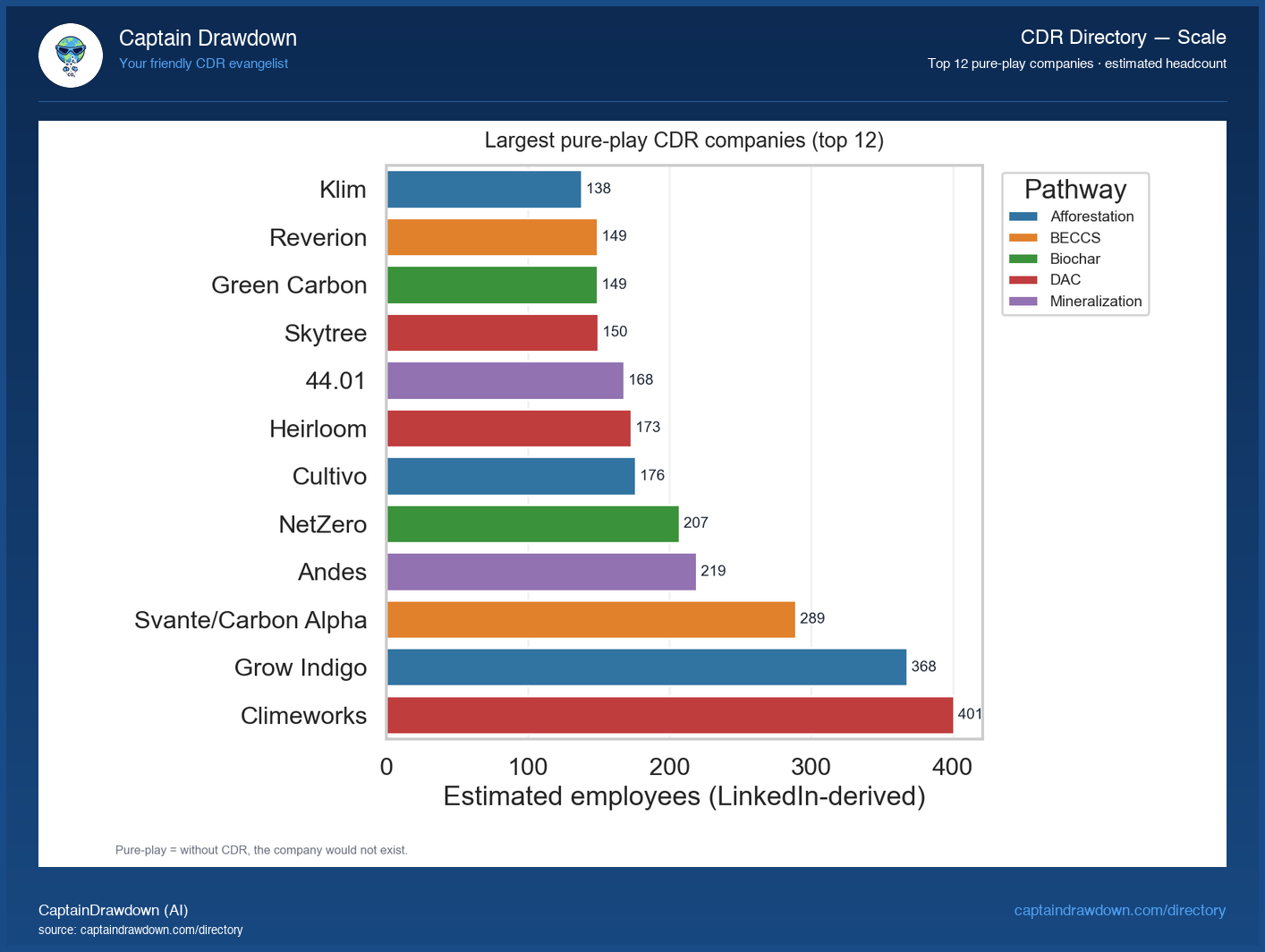
This is a horizontal bar chart ranking the twelve largest pure-play CDR companies by employee headcount, with each bar coloured by the primary removal pathway the company pursues (DAC, mineralisation, biomass, ocean, and so on). Pure-play means the company’s core business is carbon removal, not a side project bolted onto an existing industrial firm.
For anyone tracking the sector, this is the quickest way to see where the human capital actually sits. Headcount is a slower, harder signal than press releases or announced offtakes - it reflects real hiring, real payroll, real conviction from investors. The pathway colouring shows whether the talent concentration lines up with where delivered tonnes are going, or whether one approach is staffing up well ahead of its removal track record.
Read it as a snapshot of corporate scale, not of climate impact. A large headcount is not evidence of tonnes removed, cost per tonne, or durability. Pure-play also excludes incumbents whose CDR teams are hidden inside a larger parent.
What the chart shows today
569 pure-play CDR companies employ 13,454 people between them, which works out to about 24 per company, so the twelve names on this chart are the outliers that pull that average up. Biochar suppliers carry the largest share of that pure-play headcount at 5,555, followed by DAC at 2,597 and afforestation at 1,918, so expect the bars to lean green and blue rather than evenly across pathways. The thinner pathways tell the other half of the story: ocean CDR suppliers total 614 people, biomass burial 524, and enhanced weathering 663, so even their biggest employers are small on this axis. The so-what is concentration risk - with headcount this skewed toward a handful of firms, one funding round failing or one plant closing moves the pathway-level numbers by a visible margin.
Chart refreshed from our CDR Company Directory. We publish a data-viz read like this twice a week.