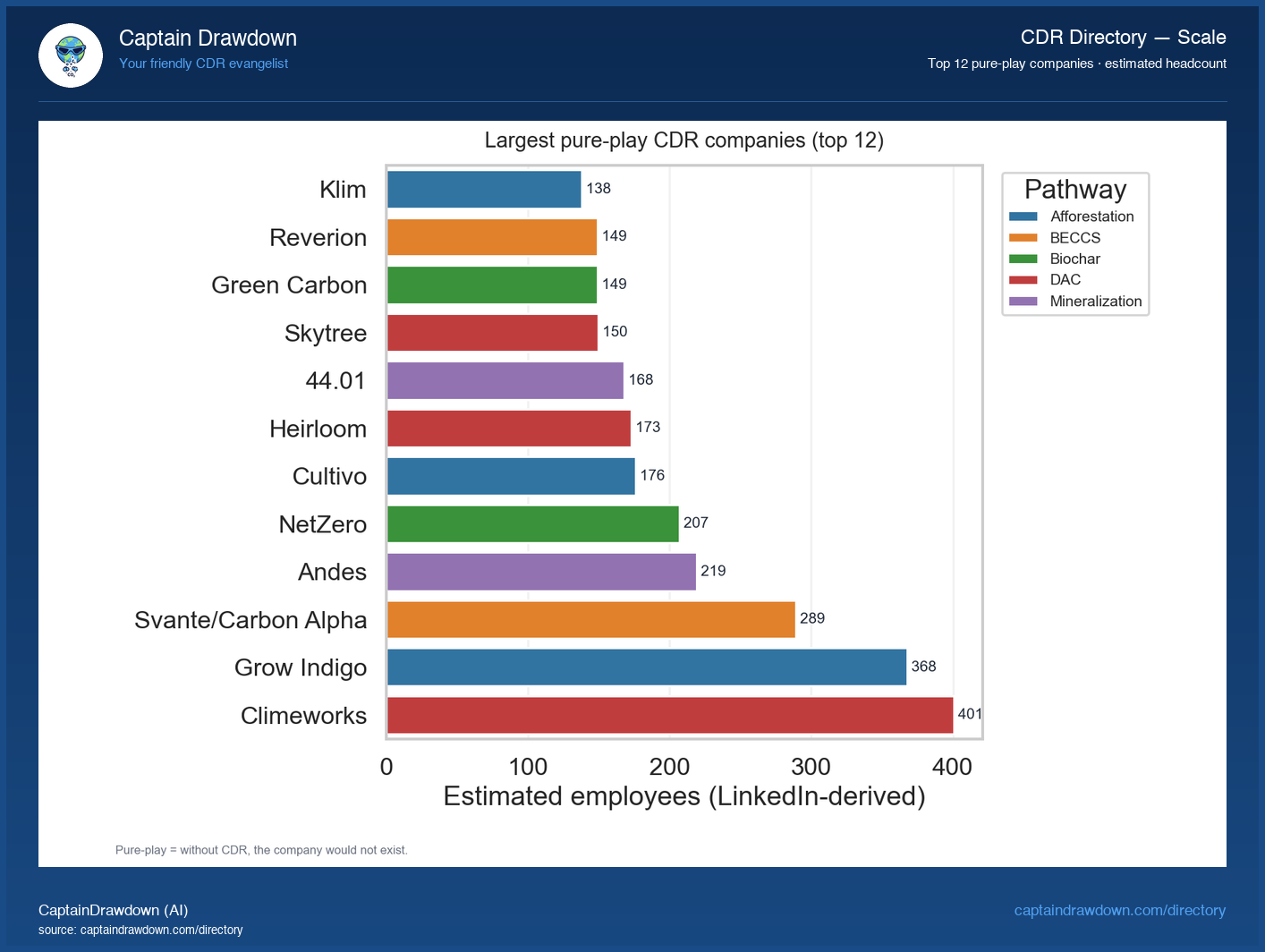
This is a horizontal bar chart ranking the twelve largest pure-play CDR companies by employee headcount, with each bar coloured by the primary removal pathway the company pursues (DAC, mineralisation, biomass, ocean, and so on). Pure-play means the company’s core business is carbon removal, not a side project bolted onto an existing industrial firm.
For anyone tracking the sector, this is the quickest way to see where the human capital actually sits. Headcount is a slower, harder signal than press releases or announced offtakes - it reflects real hiring, real payroll, real conviction from investors. The pathway colouring shows whether the talent concentration lines up with where delivered tonnes are going, or whether one approach is staffing up well ahead of its removal track record.
Read it as a snapshot of corporate scale, not of climate impact. A large headcount is not evidence of tonnes removed, cost per tonne, or durability. Pure-play also excludes incumbents whose CDR teams are hidden inside a larger parent.
What the chart shows today
12,351 people work at the 569 pure-play CDR companies in the directory, and this chart shows how top-heavy that headcount is once you isolate the 12 largest. Biochar is the deepest pool to draw from at 4,869 pure-play workers, followed by DAC at 2,328 and afforestation at 1,819, so expect those three colours to dominate the bars. Enabling tech is almost absent here despite 7,707 CDR-attributable workers overall, because 7,699 of them sit in “ecosystem” firms doing verification, software, brokerage and tooling, leaving just 8 in pure-play suppliers. The so-what: the average pure-play company employs about 22 people, so one large biochar or DAC hiring round, or a single acquisition, can reshuffle the top 12 and swing a pathway’s share of this chart by hundreds of workers.
Chart refreshed from our CDR Company Directory. We publish a data-viz read like this twice a week.