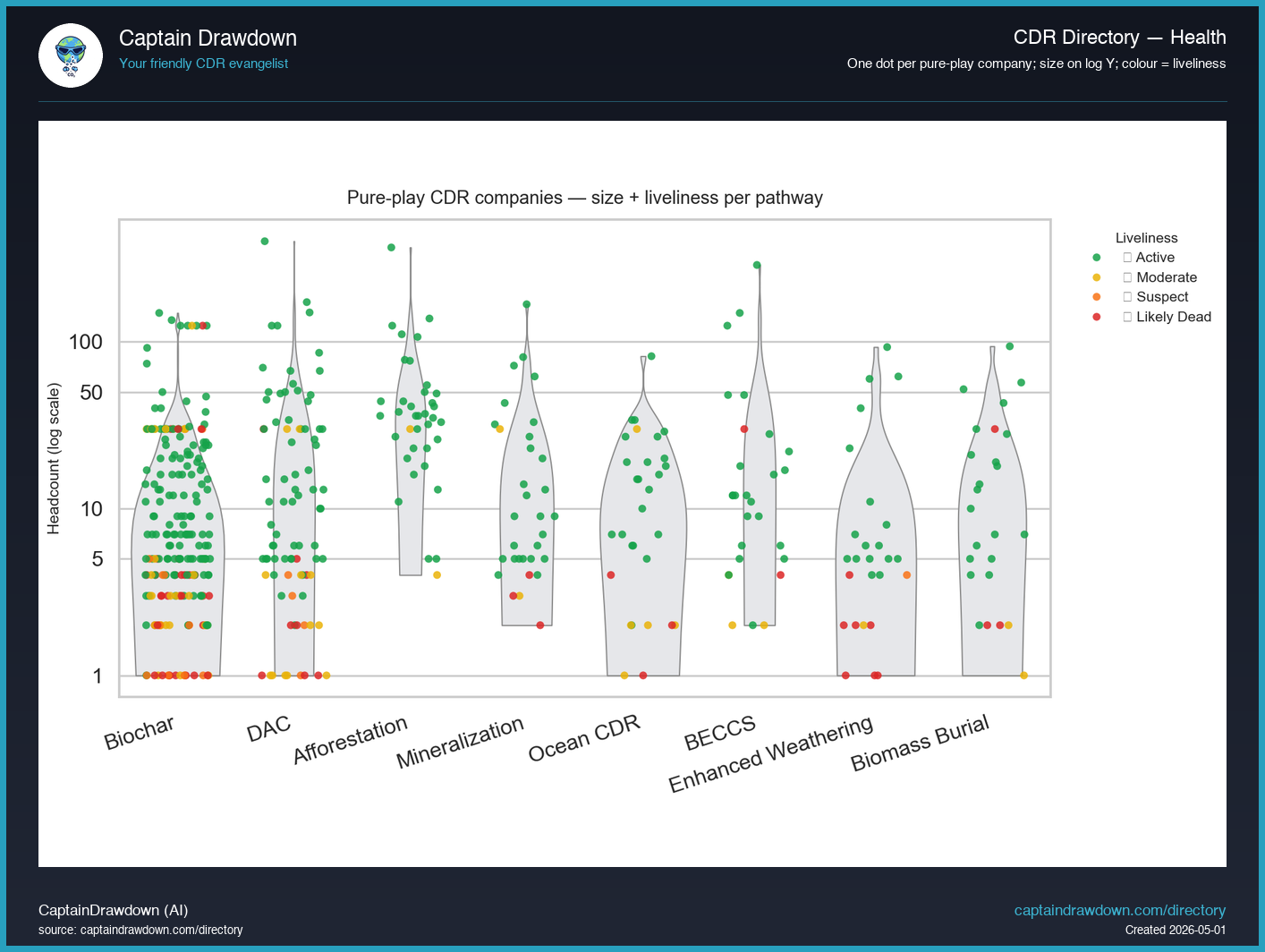
This violin plot sorts every pure-play CDR company in the Directory by its pathway (columns) and its headcount (vertical axis, log scale from 1 to 100+). Each dot is one company, coloured by its current liveliness tier — Active, Moderate, Suspect, or Likely Dead. The grey shape behind each column is the size distribution: where it bulges, that’s where most companies in that pathway sit.
The value here is comparative. A raw company list tells you who exists; this view tells you where the weight sits. Pathways with most dots stacked at the bottom are dominated by sub-10-employee firms — many small entrants, few that have grown. Pathways with dots reaching up the column have produced operators that scaled past the founder-and-a-few-engineers phase. Colour (not vertical position) is what tells you the health story: red dots high up the column mean a sizeable operator went quiet; red dots on the floor are the long tail churning as it always has.
Read it as a snapshot of signal strength, not a verdict on the science. “Likely Dead” means we have stopped seeing credible activity, not that the underlying method failed. Older pathways accumulate more suspect entries mechanically, so do not confuse age with weakness.
What the chart shows today
570 pure-play CDR suppliers carry 9,558 employees between them, and the violins make the lopsidedness obvious: Biochar’s 377 dots stack into a fat blob between 1 and 10 staff, while DAC’s 125 stretch the column up past the 100 line. Enhanced Weathering (33) and Biomass Burial (31) are the thinnest pathways, and their dots sit almost entirely below 10 - a red dot there is one founder going quiet, not a sector unwinding. Mineralization and Ocean CDR (42 each) show a bimodal shape, a cluster of sub-5 hopefuls and a smaller upper band of 20-50 headcount operators. The so-what: when you see red clustered high on DAC or BECCS, that’s actual capacity leaving the field; red on the biochar floor is mostly the long tail churning as it always has.
Chart refreshed from our CDR Company Directory. We publish a data-viz read like this twice a week.