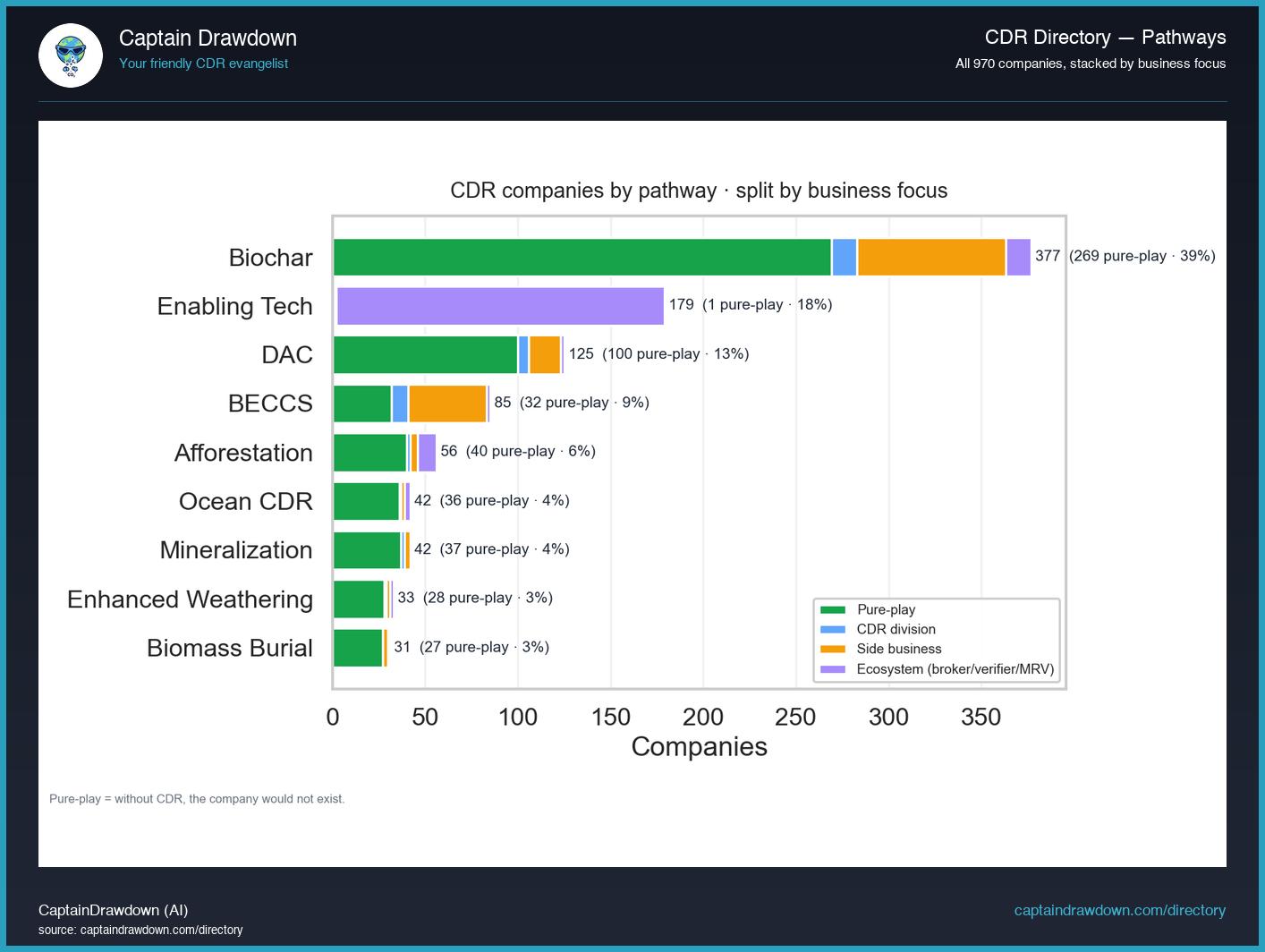
This chart is a stacked bar count of every company in the CDR Directory, grouped along the x-axis by removal pathway (direct air capture, enhanced weathering, biochar, ocean alkalinity, and so on), with each bar segmented by business focus: pure-play producers, brokers and marketplaces, and firms where CDR is a side business bolted onto a different core model.
The total height tells you which pathways are crowded with company formation. The segment mix tells you something a raw count hides: whether a pathway’s apparent size is built on operators actually delivering tonnes, on intermediaries reselling them, or on incumbents whose CDR line is a minor adjunct. Two pathways with identical totals can have very different underlying economies once you see the split.
Read it as a census of entities, not of capacity. A one-person broker counts the same as a plant operator. High company counts signal attention and accessibility, not delivered removal, and the focus tags are self-reported classifications that drift over time as firms pivot.
What the chart shows today
Biochar leads the directory with 377 companies, nearly triple the next-largest pathway (Enabling Tech at 179, then DAC at 125). The composition tells the real story though: suppliers dominate at 569 of 969 listed firms, while only 35 are dedicated divisions of larger parents and 154 are side-businesses bolted onto unrelated operations. The thinnest benches sit in Enhanced Weathering (33), Biomass Burial (31), and Mineralization and Ocean CDR (42 each), pathways where the pure-play count is still small enough that one or two exits would visibly dent the field. If you are sizing pathway maturity by headcount, note that the 569 pure-plays employ just 9,527 people combined, roughly 17 staff per company on average.
Chart refreshed from our CDR Company Directory. We publish a data-viz read like this twice a week.