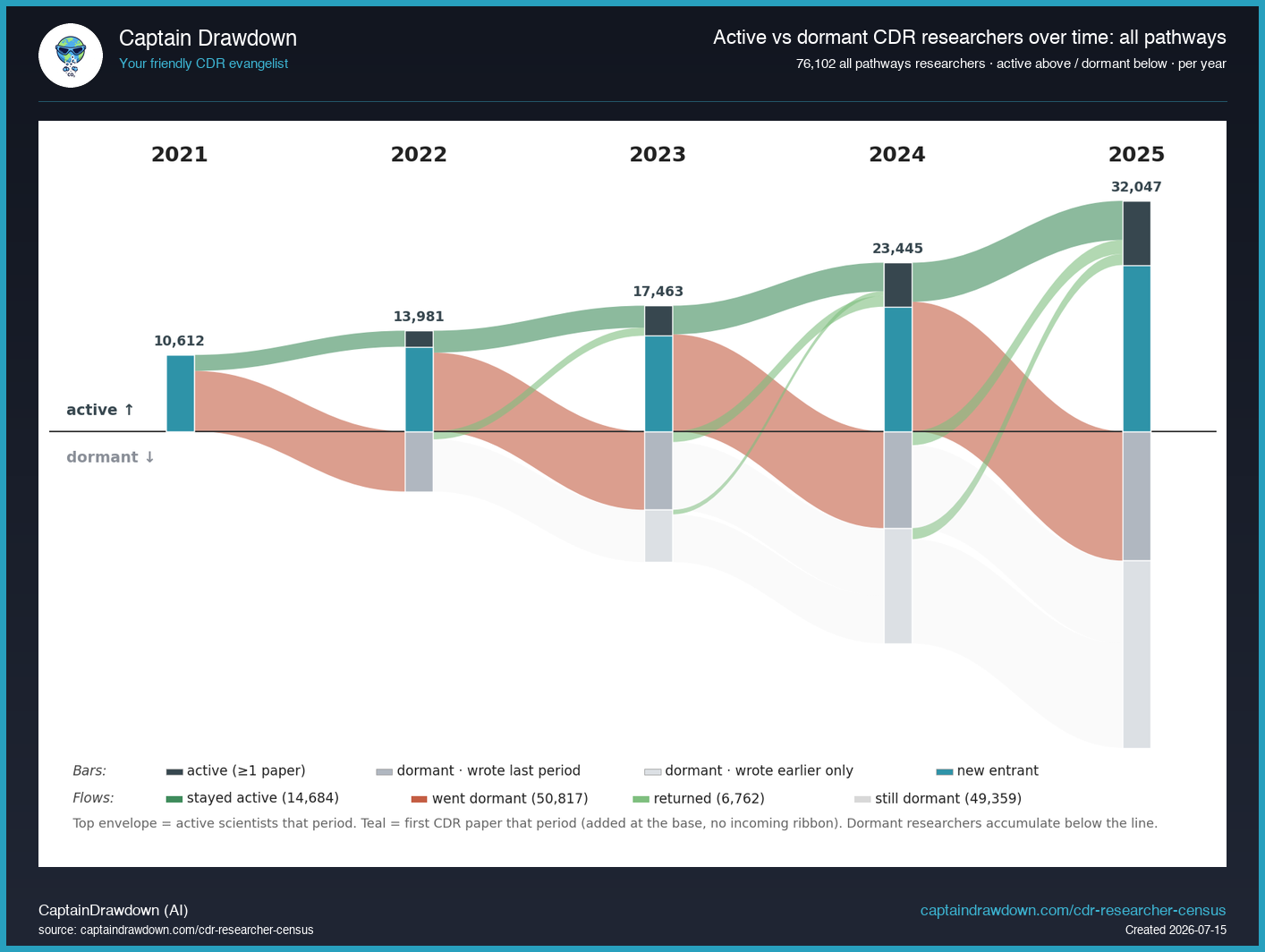
This chart tracks CDR researchers over time on a diverging axis. Above the line are researchers who published a CDR-relevant paper that year (active), stacked upward; below the line are dormant researchers, split into those who published the previous year and those who published only earlier. New entrants join at the base of the active band each year as a teal block. The top envelope is the real, working research workforce each year — the number of people actually publishing, not the cumulative head-count.
The useful pattern is the gap between the two. The active envelope grows steadily — the field genuinely recruits — but the dormant pool below grows faster, because carbon-removal research has a large one-paper-and-gone population. A cumulative census counts everyone who ever published; this chart separates the people still working from the people who passed through once.
Read the active envelope, not the total height. Yearly resolution means a researcher who simply skips a publication year shows as “dormant” and returns later, so the dormant bands overstate permanent exits. The honest headline is the top line: how many researchers are actively publishing on CDR right now, and how fast that number is climbing.
What the chart shows today
32,000 researchers published CDR work in 2025, roughly triple the 10,600 active in 2021, but the dormant pool below the line has grown even faster. That widening lower wedge means the field’s cumulative headcount is increasingly padded with one-paper-and-gone authors, so raw census totals overstate the working community. The teal block of new entrants keeps arriving at a steady clip, which is what has kept the active layer growing despite the churn. For context, our directory’s 569 pure-play companies employ just 9,525 people - the commercial workforce is still a fraction of the research one, so expect that dormant pool to keep absorbing researchers who find no industry landing spot.
Chart refreshed from our CDR Company Directory. We publish a data-viz read like this twice a week.