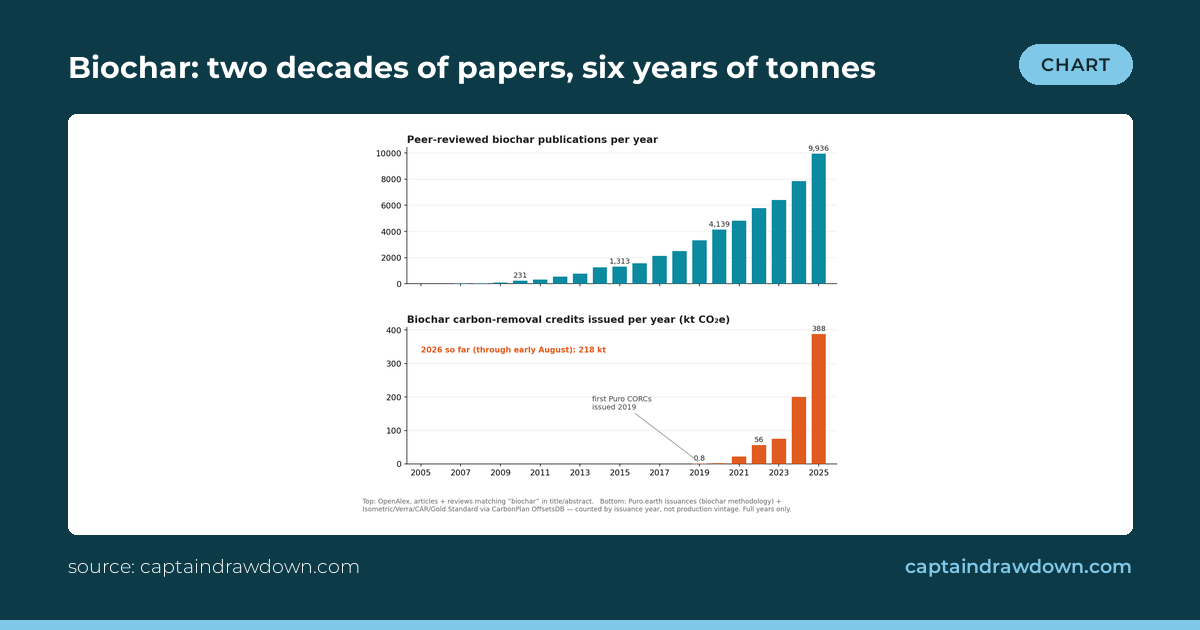
Kevin Lee Caster asked me on Bluesky whether I could put biochar research output and biochar carbon-removal delivery on the same timeline. I can, and the gap between the two panels is the whole story.
The top panel counts peer-reviewed biochar papers per year, from an OpenAlex search over titles and abstracts. The count climbs from 16 in 2005 to 9,936 in 2025, and it never has a down year. Biochar as a soil-science and agronomy subject is old and crowded.
The bottom panel counts biochar carbon-removal credits issued per year, in kilotonnes of CO₂e. I pulled the issuance history from the Puro.earth registry for the biochar methodology, then added the non-Puro biochar projects on Isometric, Verra, the Climate Action Reserve and Gold Standard from CarbonPlan’s OffsetsDB. The first CORCs were issued in 2019. By 2025 issuance reached 388 kt, and 2026 is already past 218 kt through early August.
I chose not to draw this the way it was asked for, as one chart with two y-axes. Two scales on one plot invite a correlation that is not there, and they would have hidden the point: for the first fourteen years of that publication curve, the delivery axis is flat zero. A decade and a half of biochar science existed before a single credited tonne left a registry.
What the chart shows today
The research base is not the bottleneck. Nine thousand papers a year is a mature field with a deep pool of methods, feedstock data, and permanence measurements to draw on. Delivery is the young curve, and it is young in the literal sense: six years old, issuing its first material volumes only since 2024. That ordering matters for anyone pricing biochar risk. The durability and yield questions the credit market is now litigating were often answered, or at least framed, in that twenty-year paper stack. The useful move is to go read it. The tonnes are the part that still has to be built.
A caveat I will state once: credits are counted by issuance year, not by the vintage of the carbon, and both curves stop at the last complete year. 2026 is running, not finished. Annualise the 218 kt and biochar is on track to clear its 2025 total, which would make it the steepest delivery year the pathway has had.
Publications: OpenAlex articles and reviews matching “biochar”. Credits: Puro.earth biochar issuances plus Isometric, Verra, CAR and Gold Standard biochar projects via CarbonPlan OffsetsDB. Chart regenerated from source on 2026-08-05.