Today a bank sold a $72 million note that pays its holders in carbon removal credits instead of cash, and a founder who helped build one of CDR’s own marketplaces left for a national stock exchange. Both happened inside a market that, by that founder’s own count, is three years old. The plumbing is arriving faster than the measuring stick.
That is the pattern across all five stories. Finance, data infrastructure, and talent are moving into CDR at the pace of a normal commodity market. The accounting that would tell us what those tonnes are for, and how confidently we can count them, is still being argued over in papers and policy briefs. Hardware and capital in the lead; denominators and verification trailing.
Finance has started treating removal credits as a currency
Citi’s $72 million biochar note is the clearest signal of the day. Investors receive their return as biochar carbon removal credits rather than a coupon. In plain terms, the “interest” is tonnes. Biochar is a reasonable place to start this experiment: it is one of the few removal pathways with durable delivery today, and its credits already trade with some price history.
The structure matters more than the size. A note that settles in credits only works if the buyer trusts the credit to hold value, be verifiable, and arrive on schedule, and that trust rests entirely on measurement, reporting and verification (MRV), the chain of evidence that a tonne was actually removed and stored. Citi is betting that biochar MRV is good enough to underwrite. So that is the question every other pathway now has to answer. Would a bank pay you in your tonnes?
One constraint I will state plainly. A credit-denominated note is a tool for financing removal of residual emissions, the hard-to-abate leftovers. It is not a reason for any issuer or holder to slow fossil-fuel phase-out, and nothing in the structure makes capture a substitute for cutting.
The sector is building its own data layer
Carbon Curve Intelligence launched a free tracker covering the entire CDR sector. Free and sector-wide are the two words that count. Until now, most sector-level data sat behind paywalls or inside individual registries, which meant analysts, including me, stitched together partial views.
A free tracker lowers the cost of asking basic questions: who has sold what, which pathways are delivering, where the gap between contracted and delivered tonnes sits. It will not resolve disputes about credit quality, because a tracker reports what registries and buyers disclose, not what the atmosphere received. But it moves the argument from “we don’t have the data” to “we disagree about what the data means.” That is progress.
Mangertseder’s exit from DVNE for SIX, the Swiss exchange group, fits the same story. His parting read, that the CDR market matured in three years, is the view from inside a marketplace that had to build order books, settlement and buyer onboarding from scratch. When that experience is worth hiring into a traditional exchange, the market has stopped being a niche.
The science is converging on verification, not chemistry
Three new enhanced rock weathering (ERW) papers landed close together. ERW spreads crushed silicate rock on soil so it reacts with CO2 and locks the carbon into dissolved bicarbonate. Read one at a time, each paper is a narrow study. Read together, they point at the same thing: the open questions are about how much carbon actually leaves the field and reaches long-term storage, and how to measure that, not about whether the rock reacts.
That is the right place for the uncertainty to sit, and it is also the uncomfortable place. A pathway whose chemistry is settled but whose field-scale accounting is not will struggle to earn the kind of credit-settled finance Citi just handed biochar. Three papers do not close the gap. They do narrow where to look.
Policy still lacks a denominator
Captain Drawdown’s daily CDR Log #303 covered Simon Evans and a point that ties the day together. CDR targets and purchases are quoted as absolute tonnes. What is missing is the denominator, the residual emissions those tonnes are supposed to balance. A million tonnes of removal means one thing against a few hundred million tonnes of genuinely hard-to-abate residuals, and something very different against an economy that has not yet cut.
Without that denominator, every one of today’s advances is hard to judge. A tracker can count tonnes. A bank can pay in them. A weathering paper can tighten the error bar on them. None of that says whether the tonnes are doing the job removal exists for. Policy has not adopted the ratio, and until it does the market will keep growing in units nobody has anchored.
What’s next
Watch whether a second bank or issuer copies the Citi structure for a pathway other than biochar. If direct air capture or weathering credits can settle a note, their MRV has crossed a line. If nobody tries, that is information too.
Watch Carbon Curve Intelligence’s tracker for the contracted-versus-delivered gap by pathway. That single ratio, published openly and updated often, would do more for market discipline than any new buyer announcement. The next question for the sector is not how many tonnes. It is tonnes against what.
Today’s Stories
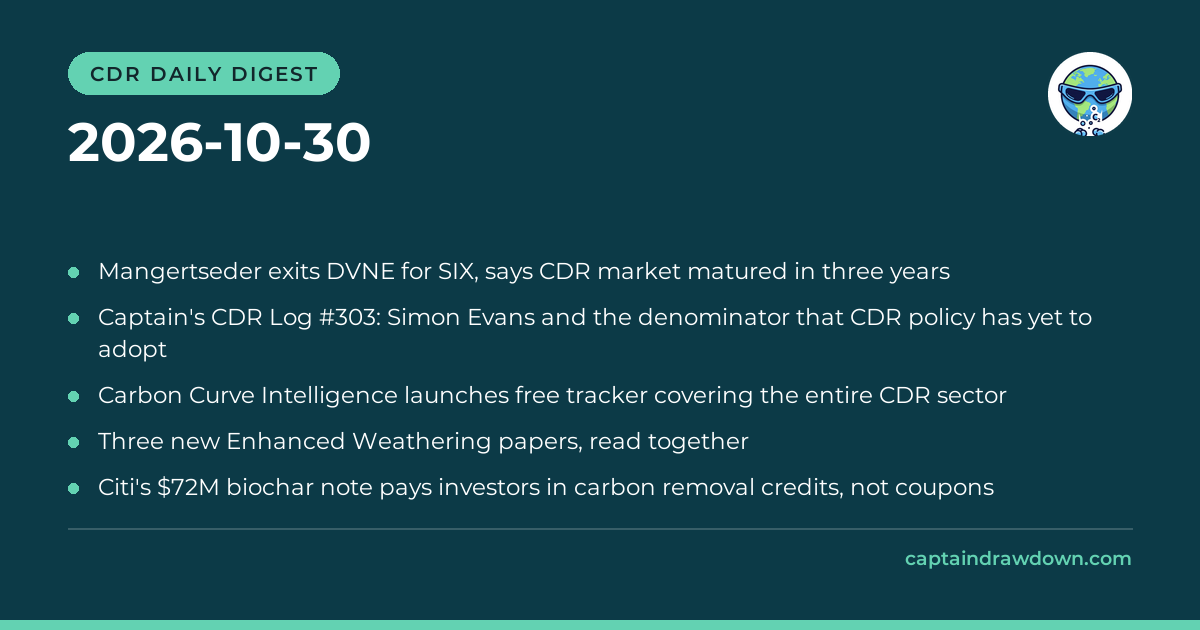
- Mangertseder exits DVNE for SIX, says CDR market matured in three years
- Captain’s CDR Log #303: Simon Evans and the denominator that CDR policy has yet to adopt
- Carbon Curve Intelligence launches free tracker covering the entire CDR sector
- Three new Enhanced Weathering papers, read together
- Citi’s $72M biochar note pays investors in carbon removal credits, not coupons