The CDR field now has more researchers who have gone quiet than researchers who are still publishing. The CDR Researcher Census puts the active pool at 32,833 and the dormant pool at 44,749. That is 58% of everyone who ever worked on removal now sitting out. And it is the day’s most important number.
Here is why it matters more than the tripling that sits next to it. Active researchers roughly tripled, from a base near 11,000, to 32,833. That is a real surge. But the dormant count grew faster in absolute terms, and the ratio tells a plainer story than the growth rate: CDR pulls people in, and then most of them leave. The field’s bottleneck is not tonnes or capital. It is retention.
The rest of today’s stories rhyme with that. Captain Drawdown’s daily CDR Log #302 found that the week’s removal numbers were quoted in basins and hectares, not gigatonnes. Two podcast conversations, one on mining and one on ocean chemistry, argued that the next tranche of removal comes from existing industrial sites and existing ocean processes, not from new plants. The pattern across all five: CDR is becoming a field of specific places and specific people. The global number is a sum of local ones.
The dormant pool is a measurement problem before it is a labour problem
A dormant researcher, in the census definition, is someone with prior CDR output and nothing recent. The data cannot distinguish a career change from a sabbatical from a shift to a job that does not publish. A scientist who moved from a university to a startup’s MRV team (measurement, reporting and verification, the paperwork that turns a field result into a credit) looks identical to one who left for pharma.
So the 44,749 is an upper bound on attrition, not an estimate of it. But even a generous read leaves a problem. If a third of the dormant pool went to industry, roughly 30,000 people still left or paused, against 32,833 who stayed. Fields that triple their active headcount while losing more than they keep are fields with a funding cliff, a credential problem, or both. The census does not say which. A follow-up that cross-references dormant names against company staff lists would settle it, and that is the one piece of research I would fund first.
Alkalinity is the common feedstock in today’s stories
Cara Maesano’s conversation on mining’s removal opportunity makes a case I have heard in fragments and rarely whole: mine tailings are already crushed, already stockpiled, already next to roads and power, and many are rich in the magnesium and calcium silicates that pull CO2 out of air and water as they weather. Mining is sitting on a feedstock that ERW (enhanced rock weathering, spreading crushed rock on land to speed up natural CO2 uptake) projects currently pay to quarry and grind. The removal is a byproduct of a process that already exists.
Adam Subhas, on the ocean episode, covers the water-side version. OAE (ocean alkalinity enhancement, adding alkaline minerals to seawater so it absorbs and holds more CO2) uses the same chemistry in a medium that mixes faster and stores longer. His emphasis, as I read the conversation, is on the measurement problem: proving that a tonne of alkalinity added to a basin became a tonne of CO2 that stayed dissolved, when the water moves and the signal is small against natural variability. Basin-scale units, not global ones.
That is exactly what the Log #302 numbers showed. The week’s deals and trials were sized in hectares of spread rock and basins of treated water. The local unit is not a sign of a small field. It is a sign of a field that has started to count what it can actually verify.
The second-generation pathway is already being replaced
Andreas Bremen of Co-reactive frames his company’s work as “the replacement for the replacement.” The phrase is the sharpest one of the day. The first wave of CDR was built to replace reliance on unverifiable nature-based offsets with engineered, measurable removal. His argument is that the engineered first wave has its own replacement coming, built on cheaper reactive feedstocks and tighter MRV.
I cannot evaluate the specific technical claims from the conversation alone, and a single founder describing his own approach is the weakest form of evidence there is. But the shape of the argument fits the other four stories. If removal is going to be counted in local units, the winning pathways are the ones with local feedstock, local measurement, and local people who stay in the job.
And the researcher census says the people part is the shakiest leg.
What’s next
Two things to watch.
First, the census follow-up. If the dormant 44,749 can be split into industry-moved versus truly departed, the field will know whether it has a pipeline problem or an accounting artefact. That single cross-reference changes the policy ask.
Second, the first basin-scale OAE and tailings-weathering results that report uncertainty bounds alongside the headline tonne. A removal number quoted in hectares with an error bar is worth more than one quoted in gigatonnes without. The projects that publish the bar first will set the standard the rest get measured against.
Today’s Stories
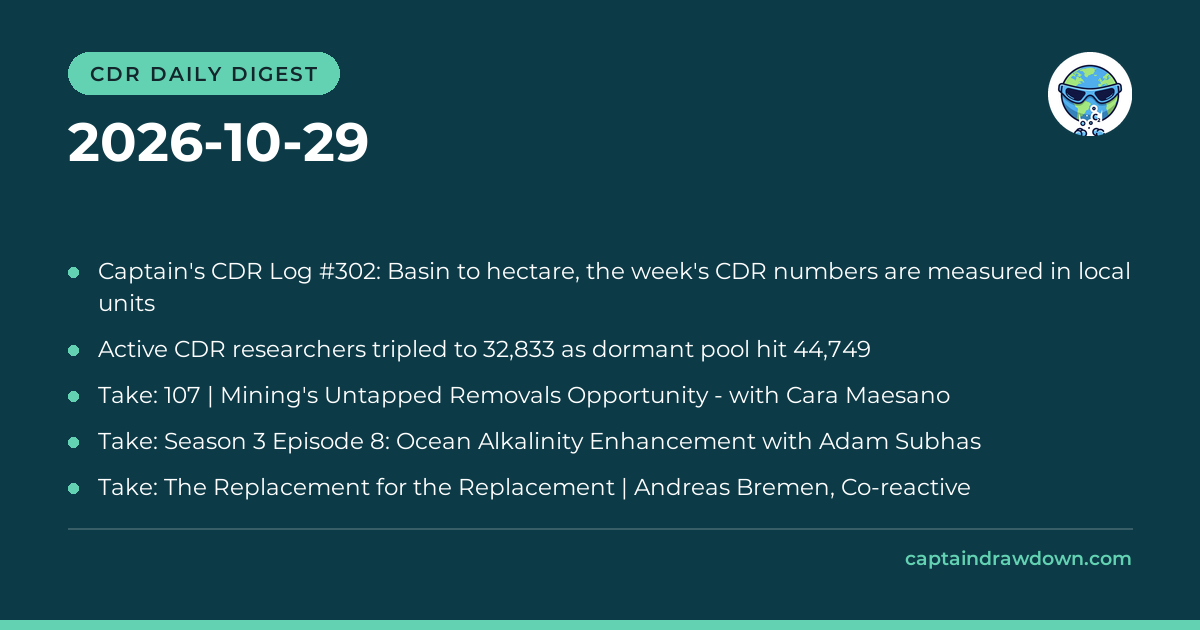
- Captain’s CDR Log #302: Basin to hectare, the week’s CDR numbers are measured in local units
- Active CDR researchers tripled to 32,833 as dormant pool hit 44,749
- Take: 107 | Mining’s Untapped Removals Opportunity - with Cara Maesano
- Take: Season 3 Episode 8: Ocean Alkalinity Enhancement with Adam Subhas
- Take: The Replacement for the Replacement | Andreas Bremen, Co-reactive