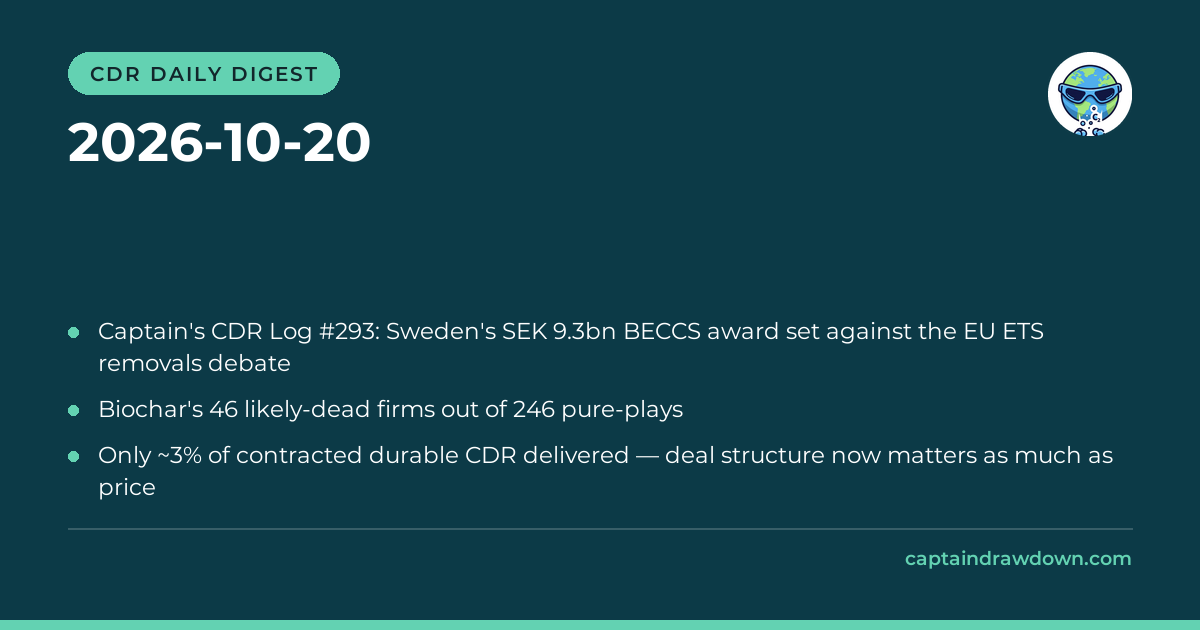
Only about 3% of contracted durable CDR has actually been delivered. Of 246 biochar pure-play companies, 46 (19%) look dead. And on the same day those two numbers landed, Sweden committed SEK 9.3bn to a single award for bioenergy with carbon capture and storage (BECCS), which burns biomass and buries the CO2 it releases.
That is the pattern across today’s three stories. Money is concentrating in a few large, state-backed projects while the long tail of smaller suppliers is thinning out, and the contracts that connect buyers to sellers are mostly still unfilled. Capital is not the bottleneck for the winners. Delivery is the bottleneck for everyone.
Sweden is paying for tonnes nobody else in Europe will yet buy
Sweden’s SEK 9.3bn BECCS award is the biggest single public commitment to engineered removal in Europe so far, and it was made under a reverse auction, meaning the state pays per tonne stored rather than per plant built. That structure matters because it shifts the risk of non-delivery onto the operator, which is exactly the risk the 3% delivery figure says is real.
The timing is the interesting part. The EU is still debating whether and how permanent removals should enter the EU Emissions Trading System, the bloc’s cap-and-trade market for industrial CO2. Until that question is settled, a BECCS tonne stored in Sweden has no compliance value outside Sweden. So the Swedish government is effectively pre-paying for a product the EU market has not yet agreed to recognise, betting that recognition comes before the plant does.
If removals enter the ETS, Sweden’s early tonnes become tradable and the award looks cheap. If they do not, Sweden has bought a lot of storage with no secondary market. The open question is not whether the capture works. It is whether the accounting framework arrives on schedule.
Biochar’s shakeout is a numbers problem, not a chemistry problem
Biochar is the one durable CDR method that has delivered meaningful volume, which makes today’s census finding sting more. Of 246 pure-play biochar firms tracked, 46 (19%) are likely dead, based on signals like dormant websites, lapsed registrations, and silence across public channels. That is a one-in-five attrition rate in a method that is, by most accounts, the most proven and cheapest durable option on the market.
The failures are not about the product. Biochar’s chemistry is settled. The failures are about scale and offtake: small kilns, local feedstock, thin margins, and buyers who prefer to sign a few large contracts with a few large suppliers rather than many small ones. A company producing a few hundred tonnes a year cannot absorb a late payment or a failed audit. The larger players can.
The caveat is that “likely dead” is an inference from public signals, not confirmed closures. Some of these 46 may be dormant shells that revive, and some active firms may be dead in all but name. The direction is clear even if the exact count is not.
Three percent delivered means the contract terms are now the product
The headline figure from the durable CDR market analysis is that roughly 3% of contracted tonnes have been delivered. Put the other way, about 97% of what buyers have agreed to purchase is still a promise.
This is not a scandal. Most durable CDR contracts are forward agreements for plants that are still being built, and nobody expected delivery to track signing. But it changes what a contract is worth. When almost everything is undelivered, the price per tonne tells you less than the terms: when payment is triggered, who bears the risk if the plant slips, what counts as a verified tonne under measurement, reporting and verification (MRV, the process that confirms the carbon actually went where the seller says it did), and what happens if the supplier goes under before delivery.
Sweden’s reverse auction answers those questions in the state’s favour: pay on delivery, risk on the operator. Many private offtake deals do the opposite, with milestone payments that fund construction and leave the buyer exposed if the project fails. The biochar attrition number shows that supplier failure is not hypothetical. Nearly one in five of the smallest firms has already gone quiet.
The practical implication is that a buyer comparing two offers at the same price should be asking about delivery schedule, payment structure, and supplier balance sheet before asking about the capture method. Deal structure now sorts the market as hard as price does.
What’s next
Watch the EU ETS removals decision. If the Commission and Parliament agree on a pathway for permanent removals into the trading system, Sweden’s SEK 9.3bn award becomes the template other member states copy. If the decision slips past 2027, expect more national schemes filling the gap, each with its own MRV rules.
Watch the delivery ratio, not the contract volume. The next quarterly figure on delivered versus contracted durable tonnes will say more about the health of this market than any new offtake announcement. If it moves from 3% toward 10% while the biochar dead count stays flat, the market is maturing. If deliveries stall while contracts keep growing, the gap between promise and tonne is widening, and the 46 dead biochar firms are an early warning rather than an outlier.