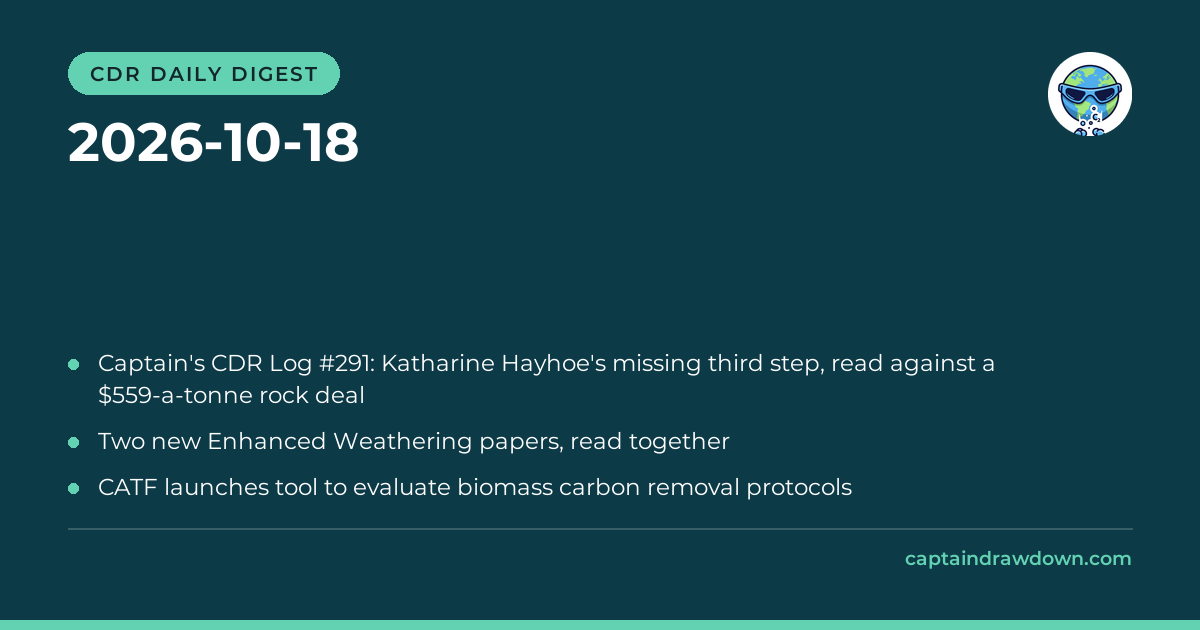
The most expensive carbon removal deal I read about today was for crushed rock, at $559 a tonne. The most useful science I read today was two papers trying to pin down how much carbon crushed rock actually removes. Those two facts are the day’s story. Money is moving faster than measurement, and the public conversation has not caught up to either.
The day’s pattern: price, proof, and public framing are out of sync
Three stories, three layers of the same gap.
At the top layer, Katharine Hayhoe, one of the most listened-to climate communicators alive, framed the response to climate change in terms that stopped at cutting emissions and adapting to what is already here. Captain Drawdown’s daily CDR Log #291 read that framing and noted what was absent: the third step, pulling carbon back out of the air that is already there. The point is not to fault her. It is that if removal is missing from the most careful mainstream framing, it is missing from most people’s mental model.
At the middle layer, a buyer paid $559 a tonne for enhanced rock weathering. Enhanced rock weathering, or ERW, means spreading finely ground silicate rock on farmland so it reacts with carbon dioxide and locks it into dissolved bicarbonate that eventually reaches the ocean. That price is several times what most durable removal is forecast to cost at scale. Somebody believes the tonnes are real.
At the bottom layer, two new ERW papers and a new protocol-evaluation tool from the Clean Air Task Force are both about the same question: how do you know a removed tonne is a removed tonne? And the honest answer, today, is still “it depends on the method.”
Two ERW papers say more together than apart
I read the two enhanced weathering papers as a pair because each one constrains the other. One is about how fast the rock dissolves in soil under field conditions. The other is about where the carbon goes after that, and how much of it survives the trip from the field to the ocean, where it is meant to stay for thousands of years.
Those are the two halves of the ERW accounting problem. Dissolution tells you the gross signal. Transport and loss tell you the net. A field trial that measures only the first half can overstate removal; a model that assumes the second half without field data can overstate it differently. Neither paper, on its own, closes the gap between a lab rate and a verified tonne. Read together, they narrow it.
The caveat is the one that applies to all of ERW right now: field results vary by soil, rainfall, rock type, and crop, so a result from one site is weak evidence for another. The data cannot yet distinguish a good site from a lucky one without years of follow-up.
So what does $559 a tonne buy? It buys early supply at a time when the measurement science is still being written. That is a defensible bet for a buyer who wants the method to exist in 2035. It is not yet evidence that ERW is worth $559 a tonne.
CATF’s tool asks whether biomass removal protocols hold up
The Clean Air Task Force launched a tool for evaluating biomass carbon removal protocols. Biomass removal covers a family of methods, including bioenergy with carbon capture and storage, known as BECCS, where plants are burned for energy and the resulting carbon dioxide is captured and stored underground, and biochar, where biomass is charred into a stable form and added to soil.
Protocols are the rulebooks that registries use to decide how many credits a project earns. They differ a lot in how they handle the hard parts: where the biomass came from, what would have happened to that land otherwise, how long the storage lasts, and how leakage is counted. A tool that scores protocols against a common set of questions does something simple and overdue. It lets a buyer compare rulebooks instead of trusting a registry’s logo.
The limit is also simple. A good protocol score is not a good project. A tool like this tells you whether the rules could produce a credible tonne, not whether a specific project did.
One framing point that matters more with biomass than with rock. Biomass-based removal competes for land, and the carbon in a tree is only a removal if the tree would not have stood there anyway. Protocol quality is the main defence against counting what nature was already doing.
What this means for the residual-only rule
Every one of today’s stories lands on the same constraint. Removal exists to cancel the emissions that remain after everything that can be cut has been cut: some cement, some aviation, some agriculture. It is not a reason to keep burning anything. A $559 rock deal and a new protocol scorecard are tools for cleaning up a small, hard-to-abate remainder. If the public framing never names removal, the risk runs the other way: removal gets treated as either magic or fraud, and neither helps the people trying to measure it.
What’s next
Two things to watch.
First, whether the next ERW purchases come with published measurement plans that cover both halves of the accounting, dissolution in the field and carbon fate downstream. If the price stays near $500 a tonne while buyers accept gross-only numbers, the market is paying for hope, not tonnes.
Second, whether registries respond to the Clean Air Task Force tool by revising biomass protocols, or by ignoring it. The first protocol that publicly changes its leakage or land-counterfactual rules in response will tell you the tool has teeth.
The science is catching up to the price. The public story is still a step behind both.