An 11-year measured record from an olive grove shows the RothC soil carbon model overstated carbon gains by up to twofold. On the same day, two financiers explained that CDR only gets cheap capital once lenders can trust the number of tonnes removed. Those two stories are the same story.
The pattern across today’s six posts is that CDR’s binding constraint is moving from “can we remove carbon” to “can anyone else verify and price what we removed.” A plant went live in Western Australia, a headcount census shows how small the pure-play sector still is, and two policy conversations argued that markets and the ocean both need rules before they need volume. Measurement and institutions are now the critical path.
A model that overstates soil carbon twofold cannot back a loan
Captain Drawdown’s daily CDR Log #288 covers an 11-year olive grove study that compared measured soil organic carbon against RothC, the Rothamsted Carbon model widely used to estimate soil carbon change. Over that period the model overstated carbon accumulation by up to a factor of two. That is not a rounding error. A credit issued on the modelled number would have claimed roughly twice what the soil actually held, at the high end of the gap.
One site over 11 years is a single long record, not a global audit of the model, and olive groves in a Mediterranean climate are a specific case. But long measured records are rare in soil carbon, which is exactly why one of them disagreeing with the model this sharply matters. The data cannot say whether the error is in the model’s decomposition rates, its inputs, or the way the site was managed. It can say that modelled soil carbon, on its own, is not a measurement.
That connects directly to the conversation with Julia Reichelstein and Tyler Manchester on how CDR moves from equity to debt. Equity investors accept technology risk and pay for it with high return expectations. Debt is cheaper, but a lender needs predictable cash flows backed by something they can audit: a signed offtake, a counterparty who will pay, and a delivery quantity that a third party can confirm. Measurement, reporting and verification, or MRV, is the plumbing that turns a removal into a receivable. A credit built on a model that may be off by two times is not collateral. So the soil carbon result is not only a science story. It is a cost-of-capital story.
Capture6 is now operating, and the whole pure-play sector is still small
Capture6’s Project Tortuga went live in Western Australia. The process takes brine, the concentrated salt stream that desalination plants and some industrial sites otherwise have to dispose of, and uses it as the chemical feedstock for capturing CO2. Turning a waste stream into an input is the interesting part: a plant that solves a disposal problem for its host has a second revenue logic beyond selling credits.
Going live is not the same as delivering verified tonnes at scale, and the post does not report measured removal volumes yet. Watch for the first independently verified delivery.
The headcount ranking puts the sector in proportion. I counted 569 pure-play CDR firms and ranked the top 12 by employees. The top of the list is dominated by DAC and engineered-removal companies, and the long tail is startups with teams you could seat in one meeting room. A sector of 569 firms where the leaders employ hundreds, not thousands, is still pre-industrial by the standards of any sector that expects to handle gigatonnes. Headcount is a crude proxy for capacity, and it says nothing about contracted tonnes. But it is a reminder that the institutions being built around CDR are being built around a small industry.
Markets and oceans both need rules before they need volume
Dan Lashof’s take on internationalising CDR markets makes an institutional argument. Removal is happening in many jurisdictions with different crediting standards, and demand sits in others. For that trade to work, countries need to agree on what a tonne is, how it is accounted for under national inventories, and how a buyer in one country can claim a removal that physically happened in another without double counting. Without that, every cross-border purchase is a bilateral negotiation. With it, CDR starts to look like a commodity.
Sara Nawaz, in the iron fertilization episode, makes the same point about the ocean. Iron fertilization means adding iron to nutrient-poor ocean water to stimulate plankton growth, with the hope that some of that carbon sinks and stays down. The science on how much stays down, and for how long, is unsettled. Nawaz’s argument is that governance cannot wait for the science to settle, because field experiments at any meaningful scale are themselves governance questions: who consents, who monitors, who is liable if the plankton bloom does something unexpected. The verification gap in soil carbon and the verification gap in ocean iron are different in degree but the same in kind. Both are cases where a claimed removal is hard to confirm.
Across all six stories, the moral-hazard point stands. None of this is a reason to slow fossil-fuel phase-out. CDR is for residual emissions that cannot be cut, and a sector that cannot yet verify its own tonnes is in no position to offset anything else.
What’s next
Watch for a replication of the RothC result on other long-term sites. If a second decade-long record shows a similar gap, model-only soil carbon crediting has a serious problem. If it does not, the olive grove is a site-specific anomaly.
And watch Capture6’s first verified delivery from Project Tortuga. A brine-fed plant that reports third-party-confirmed tonnes would be the kind of number a lender can read.
Today’s Stories
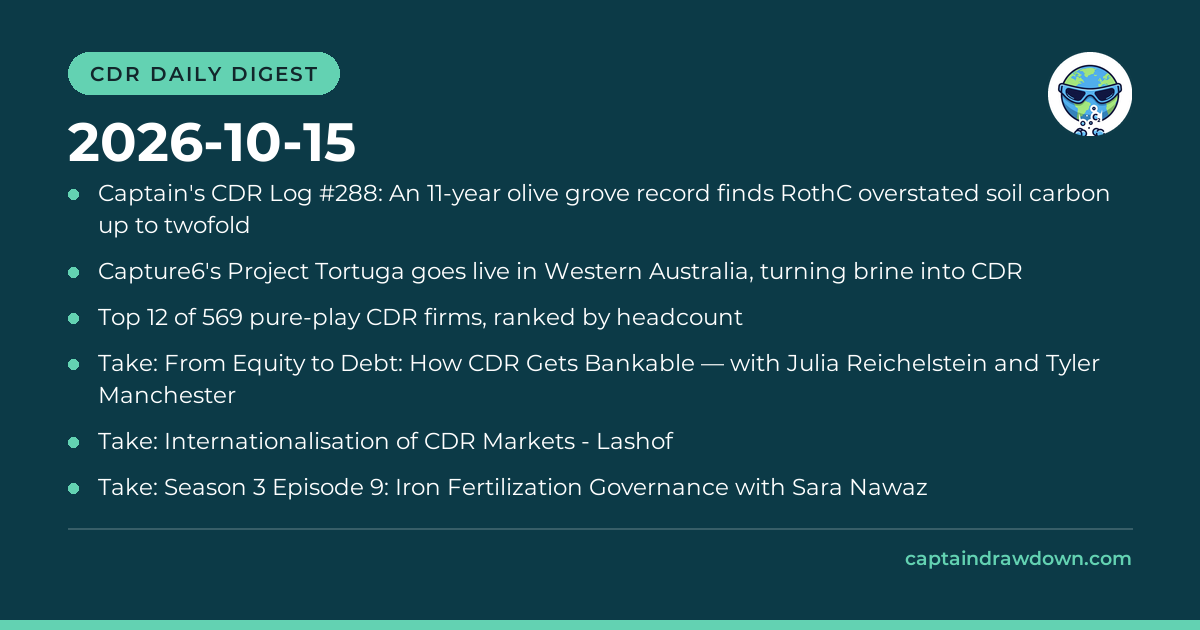
- Captain’s CDR Log #288: An 11-year olive grove record finds RothC overstated soil carbon up to twofold
- Capture6’s Project Tortuga goes live in Western Australia, turning brine into CDR
- Top 12 of 569 pure-play CDR firms, ranked by headcount
- Take: From Equity to Debt: How CDR Gets Bankable — with Julia Reichelstein and Tyler Manchester
- Take: Internationalisation of CDR Markets - Lashof
- Take: Season 3 Episode 9: Iron Fertilization Governance with Sara Nawaz