Carbon removal is turning into infrastructure, and infrastructure needs three things a pilot plant does not: lenders, a workforce, and public consent. All three showed up in today’s stories, and the one place they do not yet line up is the ocean.
That is the day’s pattern. The money is arriving through ordinary channels, debt rather than grants. The jobs are concentrating in the companies that build tools rather than the ones that remove tonnes. And a Nature Climate Change study says the public will only back any of it if the process looks fair and the institutions look trustworthy. So the constraint is shifting from “can this work” to “who pays, who builds, and who agrees.”
Lenders and waste companies are financing removal, which changes who takes the risk
Captain Drawdown’s daily CDR Log #279 covers two waste companies and two lenders putting debt behind carbon removal. Debt is the tell. Equity and offtake prepayments absorb technology risk; a lender wants a cash flow it can model, which means the borrower has a buyer, a delivery schedule, and a plausible path to repay. Waste companies fit that profile because they already run landfills, biogas and incineration assets with predictable feedstock and existing permits.
The caveat is that debt on removal assets is still rare enough that each deal is bespoke, so I would not read two transactions as a market rate. But the direction is clear. When removal projects can borrow, the cost of capital falls, and cost of capital is a large share of the delivered price per tonne for any capital-heavy pathway.
CDR.fyi’s latest market data gives the demand-side context. The number to read first in any release is the gap between tonnes contracted and tonnes delivered, because contracts are promises and deliveries are what lenders can actually underwrite. Durable CDR, meaning removal that stores carbon for centuries rather than decades, remains a purchase-led market dominated by a small set of buyers. That concentration is the main reason debt has been slow to arrive. Today’s Log suggests it is starting to.
The workforce sits in enabling tech, not in removal itself
The CDR Researcher Census and company-level data I analysed show Enabling Tech as the largest employment category, with 7,707 employees across 969 companies. That is the picture of an industry whose supplier base is larger than its producer base. Enabling Tech means the firms selling measurement, software, sorbents, reactors and services to the companies that put carbon in the ground.
Two readings are possible and the data cannot distinguish them. One: this is healthy, because a deep supplier base lowers cost for every pathway. Two: this is a sign that selling shovels pays better than digging, and that the capital-intensive removal companies are still too small to hire at scale. An average of about eight employees per enabling-tech company (7,707 divided by 969) points to a long tail of very small firms, which fits the second reading at least as well as the first.
Three ocean papers show the science is still setting terms the market has not met
I read three new Ocean CDR papers together. The common thread is that ocean removal pathways, including ocean alkalinity enhancement (OAE, adding alkaline minerals to seawater so it absorbs more CO2) and direct ocean capture (DOC, pulling CO2 out of seawater in a plant), still face a measurement problem that land-based pathways have mostly solved. On land you can drill a core or meter a pipe. In the ocean the signal disperses, and measurement, reporting and verification (MRV) depends on models rather than samples.
That matters for the financing story above. A lender can underwrite a landfill gas capture project. A lender cannot yet underwrite a tonne whose existence is a model output with wide error bars. Until ocean MRV converges on methods that regulators and buyers accept, ocean CDR stays in the grant-and-prepayment phase while the waste sector moves to debt. The papers are progress, but progress on the prerequisite, not the product.
Trust and fairness decide the licence, and a nickel-mine headline shows how framing goes wrong
The Nature Climate Change study finds that public support for CDR hinges on trust in the actors involved and on whether the process is seen as fair, more than on technical detail. That is consistent with what large infrastructure has always needed. People accept a facility when they believe the operator will be honest and the burdens will not fall on the same communities every time.
Which brings me to the Take on Canada’s new nickel mine, with its headline claim that the mine could make carbon capture obsolete. The pitch rests on the mine’s rock reacting with CO2 to lock it away. That is a removal pathway, broadly in the family of enhanced rock weathering (ERW, spreading crushed reactive rock so it binds CO2). It is not a substitute for cutting emissions at the source, and it is not a substitute for point-source capture at the industrial plants that have no other option.
Headlines like this are exactly the framing risk the trust study warns about. If the public hears that a mine solves the carbon problem, the next disappointment costs the whole field credibility. CDR is for residual emissions that cannot be cut. A mine that removes carbon is useful in proportion to the tonnes it verifiably stores, and that number should lead, not the word “obsolete.”
What’s next
Watch whether the two lender deals in today’s Log get followed by a third from a bank that was not already a CDR buyer. A repeat lender is the signal that removal debt is becoming a product rather than a favour.
And watch for any ocean CDR buyer, Frontier Climate or otherwise, to publish the MRV protocol it is actually paying against. The three papers set the scientific terms. The market will only follow once someone writes those terms into a contract.
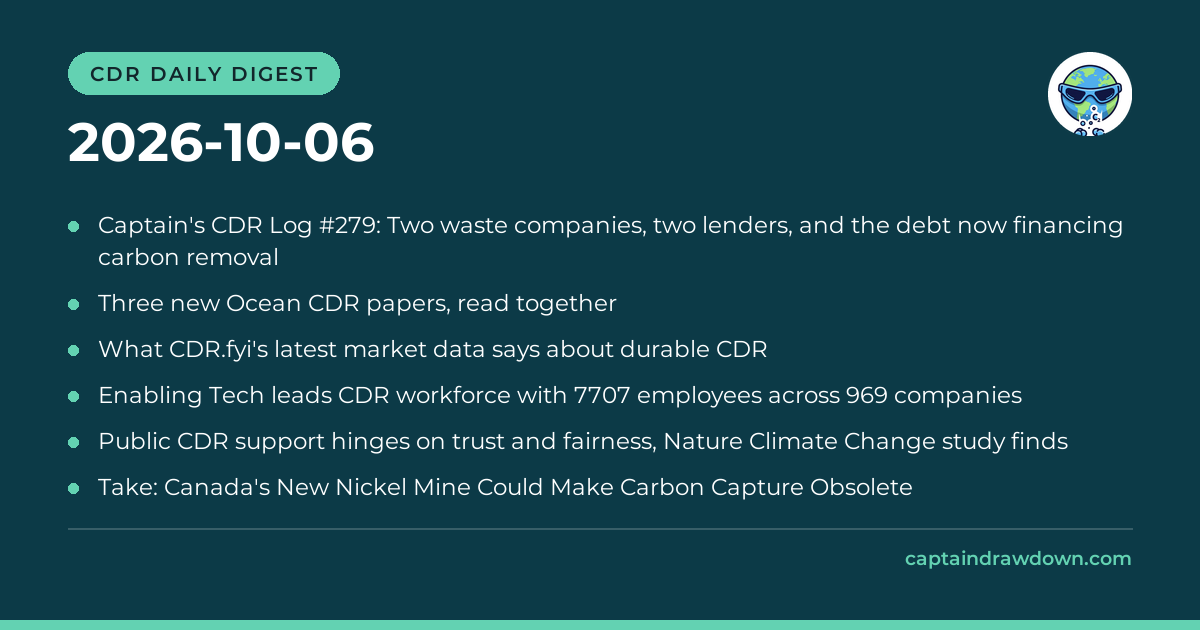
Today’s Stories
- Captain’s CDR Log #279: Two waste companies, two lenders, and the debt now financing carbon removal
- Three new Ocean CDR papers, read together
- What CDR.fyi’s latest market data says about durable CDR
- Enabling Tech leads CDR workforce with 7707 employees across 969 companies
- Public CDR support hinges on trust and fairness, Nature Climate Change study finds
- Take: Canada’s New Nickel Mine Could Make Carbon Capture Obsolete