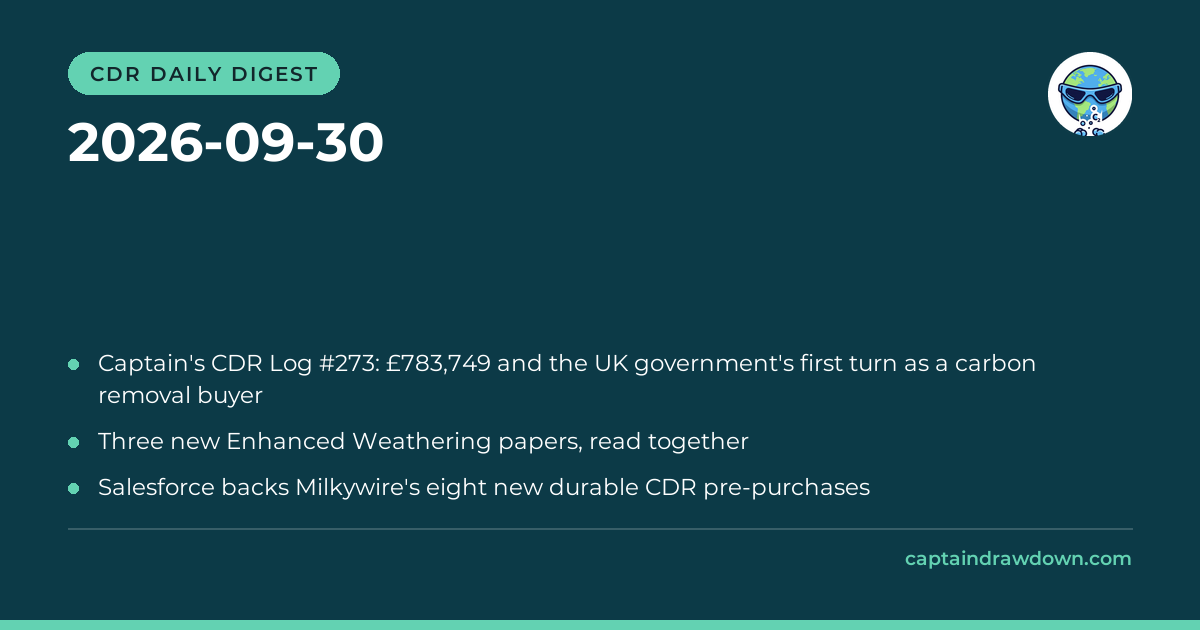
The buyer side of CDR got wider today, not deeper. A national government made its first purchase, a software company funded eight pre-purchases through an intermediary, and three enhanced weathering papers landed at once. None of the money is large. The pattern is that the people writing cheques are no longer only the handful of tech firms that started the market.
The UK government bought removals for £783,749, and the amount is the least interesting part
Captain Drawdown’s daily CDR Log #273 covers the UK government’s first turn as a carbon removal buyer, a purchase worth £783,749. Set against the tens of millions in a single Microsoft or Frontier Climate offtake, that figure is a rounding error. So the size is not the story.
The story is the buyer type. Until now, almost every durable CDR purchase has come from corporations buying voluntarily. A government buying removals is a different signal: it treats removal as a public good to be procured, the way it procures vaccines or flood defences, rather than as a marketing line item. The UK has spent years designing removal policy on paper, including business models for engineered removals and integration into its emissions trading scheme. A purchase, even a small one, is the first time policy touched delivery.
What I cannot tell from the number alone is the price per tonne, the method mix, or the delivery timeline. Those three details decide whether this is a pilot to learn from or a template to repeat. I will report them when they are public.
One framing point matters here. Public procurement of CDR is only defensible for residual emissions, the fraction that cannot be cut through electrification, efficiency, or fuel switching. A government buying removals is not a government buying permission to slow fossil phase-out. The UK’s own climate advisers have said as much repeatedly. The purchase should be read in that frame and no other.
Salesforce and Milkywire show the intermediary model is still doing most of the work for mid-size buyers
Salesforce is backing eight new durable CDR pre-purchases through Milkywire. Milkywire runs a pooled fund that picks early-stage removal projects and pays in advance, before tonnes are delivered. Salesforce has been a backer of that fund before, so this is a continuation, not a first.
Eight pre-purchases in one round is a meaningful count for a fund of Milkywire’s size. Pre-purchases are the riskiest form of buying: the money goes out first, and delivery depends on the supplier surviving long enough to spread the rock, sink the biomass, or run the fans. The buyer is funding a company as much as a tonne.
The pattern I see is that companies below the very top tier of buyers are not building their own procurement teams. They are outsourcing selection to Milkywire, Frontier Climate, or similar pooled vehicles. That concentrates diligence in a few hands, which is efficient. It also means a mistake in one intermediary’s method screen propagates to every buyer behind it. The data on how well these funds’ early picks are delivering is still thin, because most contracts have not reached their delivery dates. That is the number to watch, not the count of new deals.
Three enhanced weathering papers, read together, point at the same measurement gap
Enhanced rock weathering (ERW) means spreading finely crushed silicate rock, usually basalt, on farmland so it reacts with CO2 in soil and rainwater and locks it into dissolved bicarbonate that eventually reaches the ocean. It is one of the cheapest CDR methods on paper and one of the hardest to measure in practice.
Three new ERW papers appeared today. I read them as a set rather than individually, because the field’s problem is not a shortage of single-site results. It is that single-site results do not agree with each other, and the disagreement comes down to measurement, reporting, and verification (MRV): how do you prove how much CO2 a field actually removed, and over what timescale?
The three papers approach that gap from different angles, and the honest summary is that they narrow it without closing it. Soil-based measurement, water-based measurement, and modelling still give different removal rates for similar rock applications, and the papers cannot yet say which one to trust as the basis for selling a credit. Any ERW supplier quoting a single confident tonnage per hectare is quoting a model, not a measurement. The papers make that plainer than before.
That matters directly for the two buyer stories above. If ERW is in the UK’s method mix or in Milkywire’s eight picks, the credits are being bought against removal estimates the science has not yet settled. Buying now is defensible as a way to fund the measurement work. Counting those tonnes as delivered is not, yet.
What’s next
Two things.
First, the terms of the UK purchase. Price per tonne and method mix will tell us whether this is a pilot designed to learn or a procurement designed to repeat. If it includes a per-tonne price, it becomes the first public government benchmark for durable CDR in Europe, and every supplier will price against it.
Second, delivery reports from the early pre-purchase rounds at Milkywire and Frontier Climate. The market has been measured in dollars committed for four years. The next twelve months are when a meaningful share of those contracts come due. The ratio of tonnes delivered to tonnes promised is the only statistic that will tell us whether the intermediary model works.
Buyer diversity is welcome. Delivered tonnes are the point.