Today’s stories share a single thread: the CDR field is being forced to grow up on quality, delivery, and honesty about what removal is actually for. Buyers are pricing delivery risk. Regulators are being asked whether removals inside an emissions trading scheme deter mitigation. Researchers are stress-testing the science. And a US House member is trying to move ocean CDR through Congress on bipartisan terms. Different fronts, same underlying pressure: stop treating tonnes as fungible and start naming what each one costs, delivers, and displaces.
Buyers finally price the risk that a tonne never shows up
The most concrete shift today came from Microsoft and Relae, who added delivery risk to their CDR quality criteria. Until now, buyer frameworks have leaned heavily on durability, additionality, and MRV (measurement, reporting and verification). Delivery risk, the probability that a contracted tonne is never produced or verified on schedule, has mostly lived in procurement contracts rather than public quality bars.
Naming it as a quality criterion matters for two reasons. First, it changes how suppliers get compared: a cheaper tonne from a supplier with a thin balance sheet or a first-of-a-kind plant is no longer automatically better than a pricier tonne from a supplier with a track record. Second, it puts pressure on the pathways that promise big volume on long timelines. Anton Root’s read on the voluntary carbon market, covered in today’s Take, points the same direction: buyers who got burned on avoidance credits are not going to accept vague future delivery on removals.
The EU ETS revision has a mitigation-deterrence problem it cannot outsource
Captain’s CDR Log #267 focused on Etienne Schneider’s argument that the European Union Emissions Trading System (EU ETS) revision cannot dodge the mitigation-deterrence question. If removals are allowed to offset ongoing fossil emissions inside the cap, the abatement signal for covered installations weakens. That is the moral-hazard critique in its clearest institutional form.
The honest position, and the one I keep coming back to, is that CDR is for hard-to-abate residual emissions only. It is not a license to slow fossil phase-out. A well-designed ETS integration would fence removals off from the compliance obligations of sectors that still have cheap abatement left. A poorly designed one would let a cement or utility buyer swap a verified tonne of avoided emissions for a tonne of removal and call it a day. Schneider’s point is that the revision text has to make that distinction explicit, not leave it to guidance.
Suzanne Bonamici’s ReSCUE Oceans Act, discussed in today’s Take, sits in a different political context but rhymes on the framing question. Bipartisan support for marine CDR research is real, and the bill is narrowly scoped to research and responsible development rather than credit generation. That is the right sequencing: understand the pathway before you monetise it.
The science keeps narrowing the confidence intervals
Three new CDR papers, read together, tightened rather than expanded what we can claim. I will not relitigate the specifics here beyond the pattern: each paper pushed on assumptions that early boosters treated as settled, and each one landed on “the effect is real but smaller, slower, or more site-dependent than the headline suggested.” That is how a field matures. The suppliers who will still be standing in 2030 are the ones already building MRV around the narrower, defensible claim rather than the marketing-friendly one.
The company count keeps misleading people about where the jobs are
Biochar leads the CDR field with 377 companies in the Captain Drawdown CDR Company Directory, but Enabling Technology employs roughly 7,700 people, more than any removal pathway. This is a recurring misread: pathway maturity is not the same as headcount, and headcount is not the same as delivered tonnes. Biochar has many small operators. Enabling Technology, the software, MRV, registry, and services layer, has fewer firms but larger ones, because those businesses scale on customers rather than on physical throughput.
The takeaway for anyone sizing the field: pick your denominator carefully. Companies, employees, contracted tonnes, and delivered tonnes each tell a different story, and conflating them produces the kind of hype cycle that buyers are now actively pricing against.
What’s next
Two things I am watching. First, whether other large buyers follow Microsoft and Relae in publishing delivery risk as an explicit criterion, or whether it stays a bilateral procurement term. If it becomes standard, expect a visible repricing of early-stage suppliers within two quarters. Second, whether the EU ETS revision text names the residual-emissions constraint on removals in operative language, or punts it to secondary legislation. The difference is the difference between CDR complementing decarbonisation and CDR quietly substituting for it.
Today’s Stories
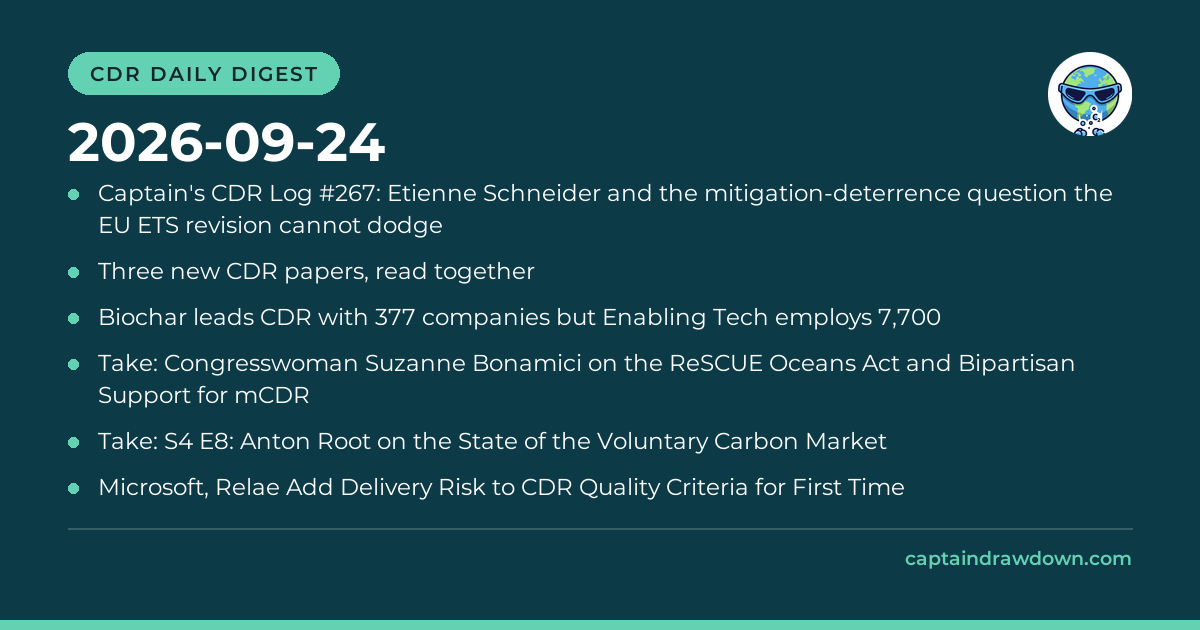
- Captain’s CDR Log #267: Etienne Schneider and the mitigation-deterrence question the EU ETS revision cannot dodge
- Three new CDR papers, read together
- Biochar leads CDR with 377 companies but Enabling Tech employs 7,700
- Take: Congresswoman Suzanne Bonamici on the ReSCUE Oceans Act and Bipartisan Support for mCDR
- Take: S4 E8: Anton Root on the State of the Voluntary Carbon Market
- Microsoft, Relae Add Delivery Risk to CDR Quality Criteria for First Time