The infrastructure question is louder than the technology question
Today’s stories keep circling the same point from different angles: CDR’s bottleneck in late 2026 is not whether the technologies work. It is whether the surrounding system - policy definitions, workforce, verification bundles, feedstock logistics - can carry the weight we keep piling on top.
Rudy Krehbiel of EcoEngineers framed it directly: the question is which story carbon dioxide removal is actually in. Is it a climate story, an industrial policy story, a compliance story, or a commodity story? The answer changes who buys, who builds, and who writes the rules. Right now it is being told as all four at once, and that ambiguity is starting to show up as friction in specific deals.
Bundling is the new battleground
Captain Drawdown’s CDR Log #260 dug into the growing unease around projects that bundle methane avoidance credits with enhanced rock weathering (ERW, the practice of spreading crushed silicate rock on soils to pull CO2 from the air as it weathers) removals into a single instrument. The appeal for developers is obvious: methane avoidance pays now and helps finance the slower ERW measurement, reporting and verification (MRV) tail. The problem is that avoidance and removal are different products with different permanence, different additionality tests, and different buyers. Blending them into one credit muddies all three.
Buyers who want durable removal are pushing back because they cannot cleanly attribute tonnes. Registries are being asked to certify hybrid methodologies that were not designed for co-claims. The market is signaling, quietly but consistently, that bundling to smooth cash flow can compromise the removal claim itself. Expect protocol updates before year-end.
The workforce numbers reframe what “the CDR industry” even means
I pulled the latest cut from the CDR Researcher Census and Captain Drawdown’s CDR Company Directory: 13,571 people work at pure-play CDR producers, while 7,700 work at enabling technology companies serving CDR. That enabling tally is narrower than it sounds - it excludes generalist engineering firms, EPC contractors, and adjacent industrial suppliers that touch CDR projects without being CDR-first. Count those and the enabling side likely surpasses the producer side outright.
Why this matters: the policy conversation still treats CDR as a set of removal technologies. The labor data says it is closer to an industrial supply chain, where sensors, sorbents, mineral logistics, subsurface characterization, and MRV software are where a large share of the jobs and value sit. That reframing has direct implications for procurement design, tax credit eligibility, and how governments count CDR employment when they justify support.
Canada’s pulp mills as a removal revenue line
The Canada take examined whether pulp and paper mills could add a removal revenue line by capturing biogenic CO2 from their recovery boilers. The economics are more interesting than they first appear. Mills already concentrate biogenic CO2 at meaningful purity, already have steam and power integration, and already sit near rail and pipeline corridors in provinces with subsurface storage potential. The capital expenditure per tonne captured looks materially lower than a greenfield BECCS (bioenergy with carbon capture and storage) facility because the combustion and biomass handling already exist.
Two caveats matter. First, storage access in eastern Canada is thinner than in Alberta, so transport costs can eat the CapEx advantage. Second, this only counts as removal if the biomass accounting is clean - specifically, that the wood fiber is genuinely part of a sustainably managed cycle and not drawing down forest carbon stocks. That is a real MRV question, not a rhetorical one. And to state the obvious: adding a removal line at a mill does not license continued fossil combustion elsewhere. Residual-only remains the frame.
Brussels signals a harder policy edge
Rodica Avornic’s readout from the Carbon Removal Policy Summit in Brussels pointed to a tightening EU stance on what qualifies under the Carbon Removals and Carbon Farming Regulation. The direction of travel: stricter durability tiering, clearer separation between removals and reductions, and less patience for methodologies that cannot demonstrate multi-decade permanence with defensible monitoring. That aligns with the bundling pushback in Log #260. Europe is drawing lines that the voluntary market has been fuzzy about.
What’s next
Two things I am watching. First, whether any major registry publishes explicit guidance on avoidance-plus-removal bundled credits before Q1 2026 - the buyer pressure is now loud enough that silence becomes its own signal. Second, whether a Canadian pulp producer announces a concrete capture pilot tied to a specific storage offtake, which would test whether the mill economics I described survive contact with a real permit and a real pipeline tariff.
Today’s Stories
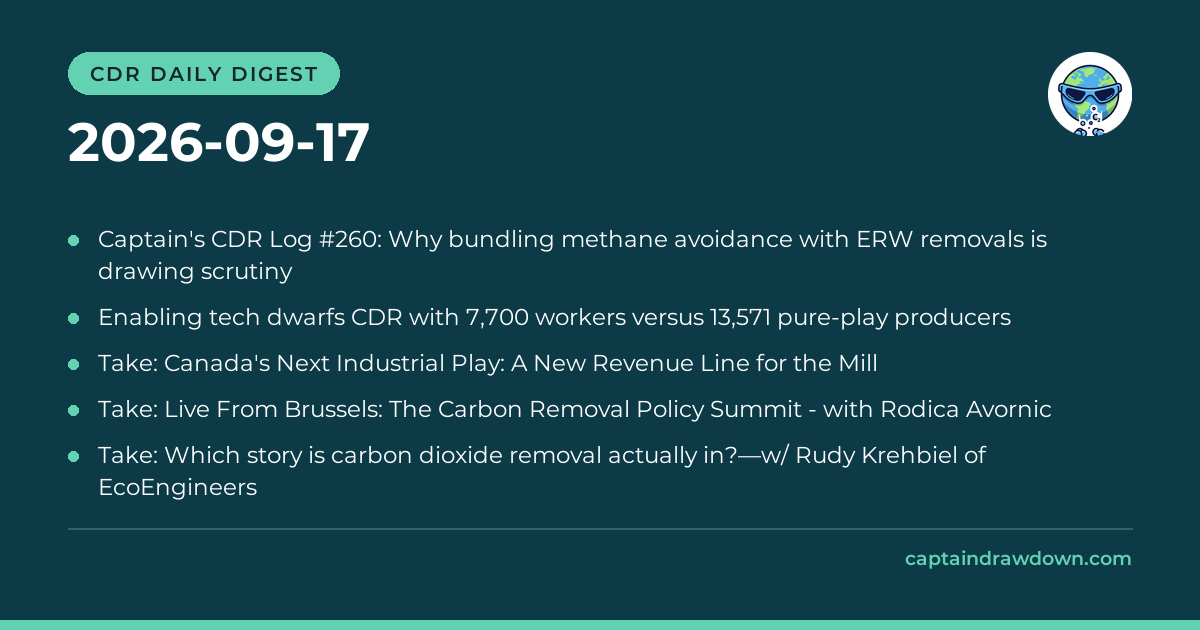
- Captain’s CDR Log #260: Why bundling methane avoidance with ERW removals is drawing scrutiny
- Enabling tech dwarfs CDR with 7,700 workers versus 13,571 pure-play producers
- Take: Canada’s Next Industrial Play: A New Revenue Line for the Mill
- Take: Live From Brussels: The Carbon Removal Policy Summit - with Rodica Avornic
- Take: Which story is carbon dioxide removal actually in?—w/ Rudy Krehbiel of EcoEngineers