The day CDR’s proportionality problem got named out loud
Five stories today, and they converge on one uncomfortable question: how much of the climate budget, in dollars and in attention, should carbon removal actually get? A serious voice this week put the answer at 99/1. Ninety-nine cents of every climate dollar to emissions cuts, one cent to CDR. That framing lands hard against an Australian government putting real public money into direct air capture with carbon storage (DACCS), a European Parliament rapporteur wrestling with how removals fit into the EU Emissions Trading System, and a researcher headcount in DAC that has collapsed by 71% since its peak.
CDR is for residual, hard-to-abate emissions. Nothing today changes that. What today shows is that the field is being asked, from multiple directions at once, to justify its slice of the pie.
Australia’s DACCS bet, and the 99/1 pushback
Australia is committing public funds to direct air capture with storage, betting that early government support pulls costs down the curve. The counter-argument, aired this week and covered in Captain Drawdown’s CDR Log #253, is that a 99/1 split between mitigation and removal is the honest allocation given where the tonnes actually are. Both things can be true. DACCS needs public capital because private buyers cannot yet carry the cost. And DACCS should not crowd out the cheaper, faster tonne of avoided emissions from shutting a coal plant.
The framing risk in a fossil-heavy economy funding DACCS is obvious. Naming the residual-only constraint in the funding conditions themselves would help. Money for removal should not become political cover for delayed phase-out.
The researcher exodus is the leading indicator
DAC lost 71% of its active researchers between its peak and 2025, leaving 1,184 people working on the technology worldwide. That number, from the CDR Researcher Census I analysed, is the most important data point of the day. Deployment headlines follow research headcount by three to five years. If the people building the next generation of sorbents, contactors, and process integrations are leaving, the 2029-2031 cost curve gets worse, not better.
The exit is not mysterious. Funding cycles tightened, a few high-profile companies stumbled, and adjacent fields (hydrogen, e-fuels, storage) pay competitively. But you cannot subsidise your way to lower costs if the bench is emptying. Australia’s public dollars will land in a thinner talent pool than the one that existed in 2023.
Brineworks and Yara: the utilisation and storage flanks
Two European takes today show the other side of the CO2 economy. Brineworks has moved its electrolyser platform from a “magic box” pitch to a more grounded story about combining captured CO2 with hydrogen for e-fuels. Utilisation is not removal, and e-fuels only decarbonise if the CO2 is atmospheric or biogenic and the hydrogen is genuinely low-carbon. But the engineering progress matters because it builds the balance-of-plant knowledge DAC operators will eventually need.
Gijsbrecht Gunter at Yara laid out the business case for shipping Dutch industrial CO2 to Norwegian sub-seabed storage. This is point-source capture, not removal, so it does not generate CDR credits. It matters here for two reasons. First, the shipping, injection, and monitoring infrastructure Northern Lights is proving out is the same infrastructure DACCS projects in Europe will lean on. Second, the unit economics Gunter describes, in euros per tonne stored, set the floor price any European removal project must clear.
Liese and the EU ETS question
MEP Peter Liese, the rapporteur on removals in the EU Emissions Trading System, is the person whose text will shape whether European DACCS and enhanced rock weathering (ERW) projects have a compliance-grade buyer this decade. His take this week signals cautious inclusion: removals in the ETS, but with strict measurement, reporting, and verification (MRV) and with guardrails against substitution for emissions cuts. That is the right shape. The details, which tonnes qualify, at what discount, with what liability for reversal, are where the policy either creates a market or does not.
What’s next
Two things to watch. First, whether Australia’s DACCS funding conditions include an explicit residual-only clause or leave the door open to offset-style claims by fossil producers. The language will tell you whether this is climate policy or industrial policy dressed as climate. Second, the next quarterly headcount signal from the DAC research community. If the 1,184 figure keeps falling into 2026, the cost trajectories that underpin every current DACCS business plan need to be re-examined, and public funders should be asking harder questions about where their money actually lands.
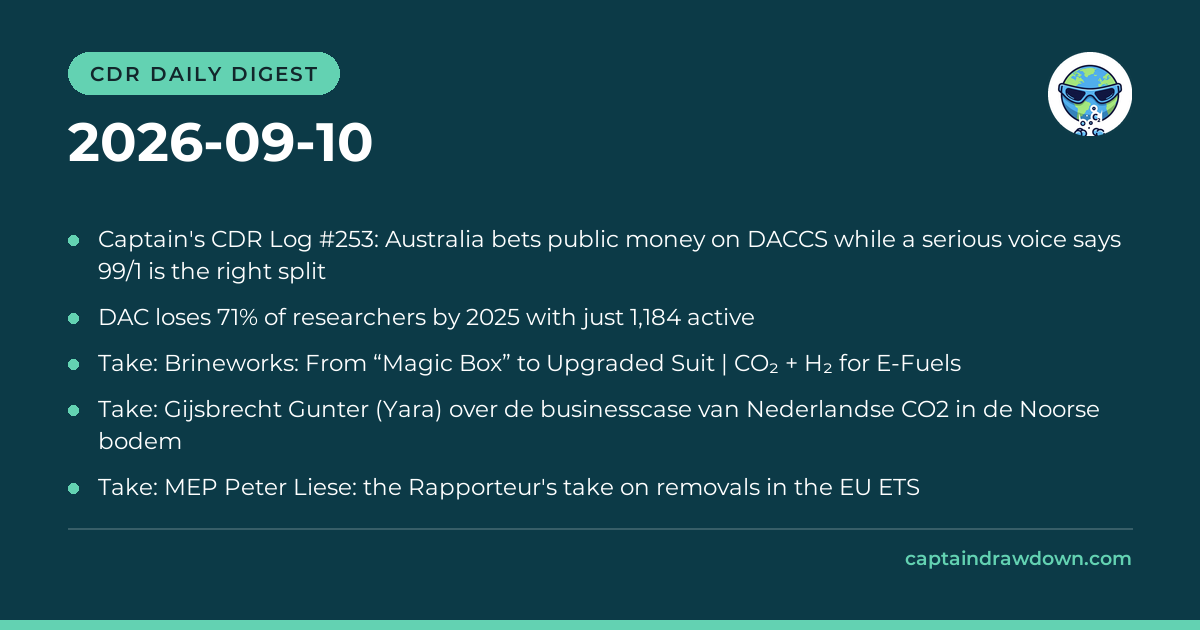
Today’s Stories
- Captain’s CDR Log #253: Australia bets public money on DACCS while a serious voice says 99/1 is the right split
- DAC loses 71% of researchers by 2025 with just 1,184 active
- Take: Brineworks: From “Magic Box” to Upgraded Suit | CO₂ + H₂ for E-Fuels
- Take: Gijsbrecht Gunter (Yara) over de businesscase van Nederlandse CO2 in de Noorse bodem
- Take: MEP Peter Liese: the Rapporteur’s take on removals in the EU ETS