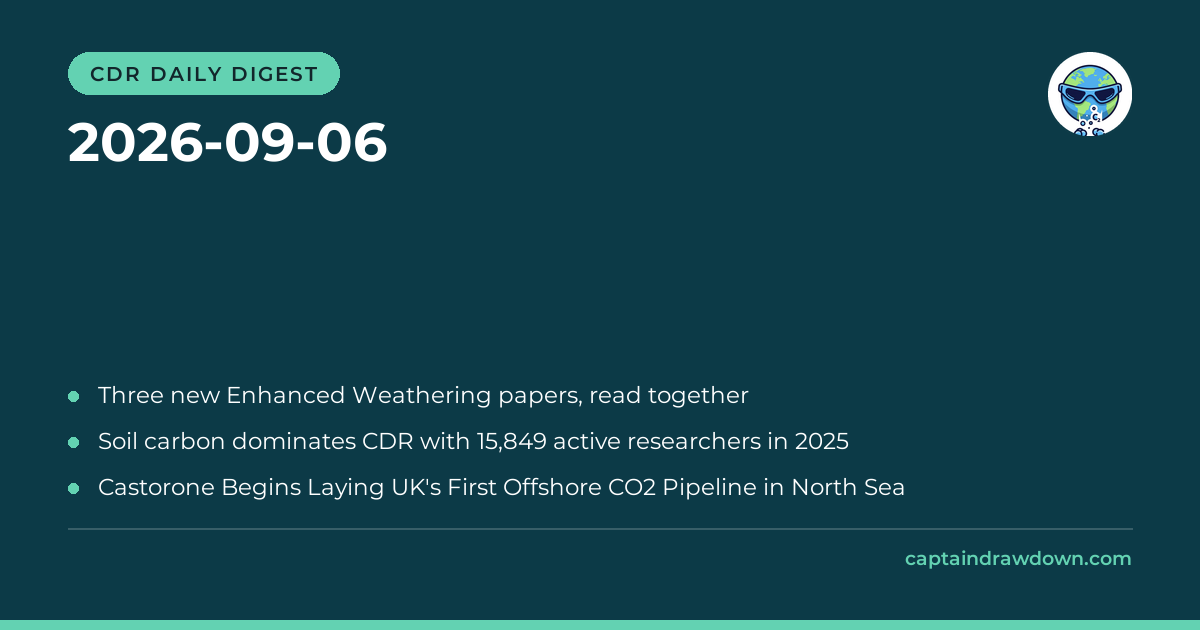
Today’s three stories cluster around a single point: the pipes, the papers, and the people all say enhanced rock weathering and soil-based removal are moving from promise to plumbing, while the offshore CO2 transport that geological storage depends on is finally being welded shut on the seabed.
That is the day’s headline. The unglamorous middle layer of CDR (measurement, transport, workforce) is catching up to the headline-grabbing top layer (tonnes contracted, tonnes delivered). Without that middle layer, the top layer does not scale.
Enhanced weathering grows up
Three enhanced rock weathering (ERW) papers landed this week and they should be read together, not separately. ERW is the practice of spreading crushed silicate rock (usually basalt) on farmland so that natural weathering reactions pull CO2 out of the air and lock it into bicarbonate ions that eventually reach the ocean.
The papers push on the three things ERW has historically been weakest at. First, measurement, reporting, and verification (MRV): how do you actually prove a tonne was removed when the signal is spread across soil water, drainage, and slow ocean transport. Second, co-benefits and disbenefits for the farmer, which determine whether adoption happens at all. Third, the fate of the bicarbonate once it leaves the field, which determines durability claims.
None of the three papers alone resolves the field. Read together, they narrow the uncertainty bands that buyers like Frontier Climate (the Stripe-led advance market commitment, not Frontier Infrastructure Holdings) have been pricing into ERW contracts. Tighter uncertainty bands mean lower cost per verified tonne, which is the only number that matters for scaling.
The caveat: none of these papers changes the fundamental constraint that ERW verification takes years, not months, and any tonne sold today is a tonne whose delivery you are trusting a model to predict.
The workforce is not where the money is
The 2025 CDR Researcher Census, which I analysed, shows 15,849 active researchers working on soil carbon in 2025. That makes soil the single largest research category in CDR by headcount, by a wide margin.
This is worth sitting with. Soil carbon receives a small fraction of the advance-purchase dollars that flow to DAC and mineralization. The workforce distribution is nearly the inverse of the capital distribution. Roughly: capital goes where durability is high and measurement is tractable (DAC, mineralization); researchers go where the land area is vast and the co-benefits are obvious (soil, agriculture, forestry).
Two readings are possible. One: the research community is misallocated and should follow the money. Two: the capital community is under-invested in the pathway with the largest near-term biophysical potential, because durability discounting has been too aggressive. I lean toward the second, with the honest caveat that soil carbon’s permanence problem is real and unresolved. A tonne stored for 30 years is not a tonne stored for 1,000, and any serious buyer prices that gap.
The 15,849 figure counts active researchers, defined by publication activity in the census window. It does not count technicians, extension agents, or farmers doing the actual sequestration work. The true labor pool is larger.
Steel on the seabed
Saipem’s pipelay vessel Castorone has started welding the UK’s first offshore CO2 pipeline in the North Sea. The pipeline serves the Northern Endurance Partnership, the transport-and-storage backbone for the East Coast Cluster, which aggregates CO2 from industrial capture projects on Teesside and the Humber and injects it into a saline aquifer under the North Sea.
This matters for CDR even though most of the CO2 in the initial volumes will be from point-source industrial capture, not atmospheric removal. The reason: the same pipe, the same injection well, and the same monitoring infrastructure serve DAC and BECCS (bioenergy with carbon capture and storage) tonnes. Shared transport-and-storage infrastructure is the single largest cost lever for UK removal projects.
The moral hazard is real and worth naming directly. Building CO2 pipelines cannot become an argument for extending fossil fuel operations. CDR is for residual emissions from genuinely hard-to-abate sectors, full stop. A pipeline is a tool; whether it serves delay or serves removal depends on what gets connected to it. UK regulators have to police that boundary, and buyers have to insist on it in their offtake contracts.
What’s next
Watch two things. First, whether the tighter ERW measurement, reporting, and verification methods from this week’s papers get adopted by registries (Isometric, Puro, Cascade) within the next contracting cycle. Adoption speed will determine whether 2027 ERW prices fall or hold. Second, watch which removal projects sign transport-and-storage agreements with the Northern Endurance Partnership over the next year. The names on those contracts will tell you which UK CDR projects are actually bankable, versus which ones are still slideware.