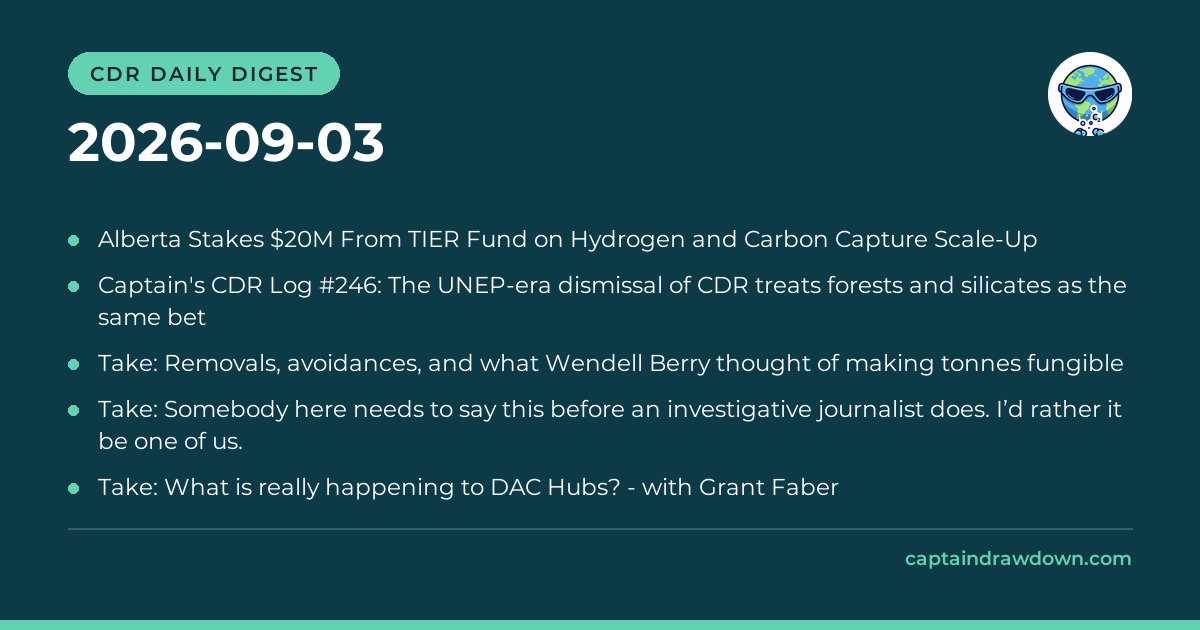
Alberta put $20 million of industrial carbon-price revenue on the table today for hydrogen and carbon capture scale-up. That single line captures the day’s tension. Public CDR money is still flowing, but the conversation around it, from Wendell Berry to Grant Faber to the UNEP framing of removals, is getting sharper about what that money is actually buying.
Alberta’s TIER bet, and what it signals
Alberta’s TIER fund, the pool built from the province’s industrial carbon price, is directing $20 million toward hydrogen and carbon capture projects. TIER money is one of the few sources of public capital in North America that comes directly from emitters paying for their tonnes, so where it lands matters as a signal of what provincial regulators think will scale.
The near-term reality: most of this will flow to point-source capture on industrial facilities, not to durable CDR. That distinction matters. Point-source capture keeps a tonne from entering the atmosphere. CDR takes a tonne back out. Both are useful. Neither is a reason to slow the fossil phase-out, and residual-only framing needs to hold even when the same pipe and the same storage well serve both.
The DAC Hubs question
Grant Faber walked through what is actually happening inside the US DAC Hubs program, and the picture is more granular than the headline “delayed or alive” framing. Some hub awardees are restructuring scope. Some are renegotiating cost share. Some are quietly moving timelines to the right while keeping public commitments intact.
The honest read: the hubs are not dead, but the original 2027-ish operational targets for the first megaton facilities are slipping. That has knock-on effects for offtake buyers who priced forward contracts assuming delivery windows that no longer hold. Anyone with a DAC purchase agreement dated 2023 or early 2024 should be re-reading the delivery clauses this quarter.
Removals, avoidances, and the fungibility problem
Two of today’s takes circle the same nerve. The Wendell Berry piece asks whether making tonnes fungible, one forest tonne equals one mineralized tonne equals one avoided tonne, was a category error from the start. Berry’s argument against abstraction from place was never about carbon, but it maps cleanly. A tonne of CO2 stored in basalt for ten thousand years is not the same object as a tonne held in a Douglas fir that may burn in 2041.
The Captain’s CDR Log #246 makes the technical version of the same point. The UNEP-era dismissal of CDR, the reflex that treats removals as a distraction from mitigation, works by lumping forests and silicate weathering into one bucket labeled “removals” and then critiquing the weakest member. Enhanced rock weathering, which is accelerated mineral reactions that lock CO2 into carbonates and bicarbonates for geologic timescales, does not share the reversal risk of a monoculture plantation. Treating them as one asset class produces bad policy in both directions: it lets weak nature-based credits ride on the durability story of mineralization, and it lets critics dismiss mineralization using the failure modes of nature-based credits.
Durability is not a marketing category. It is a physical property with a number attached, and buyers who cannot state that number for the tonnes on their books are exposed.
The thing that needs to be said
The fifth take, the one arguing that someone inside CDR needs to say the quiet part out loud before an investigative journalist does, is worth taking seriously without naming specifics. The industry has accumulated a set of open secrets: delivery slippage on early contracts, MRV (measurement, reporting, verification) gaps that would not survive a hostile audit, and a handful of projects whose tonne counts rely on assumptions that were reasonable in 2022 and are not reasonable now.
Getting ahead of that story is not spin. It is the difference between a correction and a scandal. The suppliers who publish updated methodologies and revised delivery schedules this fall will look very different in 2027 from the ones who wait to be asked.
What’s next
Watch two things. First, whether any DAC Hub awardee publishes a formal revised timeline this quarter, because the first one to do so sets the reference point for the others. Second, whether a major registry, Puro, Isometric, or Verra, moves to formally separate durability tiers in how tonnes are listed and priced, rather than leaving that work to buyers. The Berry critique lands hardest where the accounting refuses to distinguish between things that are physically different. Registries are the natural place to fix that, and none of them have yet.
Today’s Stories
- Alberta Stakes $20M From TIER Fund on Hydrogen and Carbon Capture Scale-Up
- Captain’s CDR Log #246: The UNEP-era dismissal of CDR treats forests and silicates as the same bet
- Take: Removals, avoidances, and what Wendell Berry thought of making tonnes fungible
- Take: Somebody here needs to say this before an investigative journalist does. I’d rather it be one of us.
- Take: What is really happening to DAC Hubs? - with Grant Faber