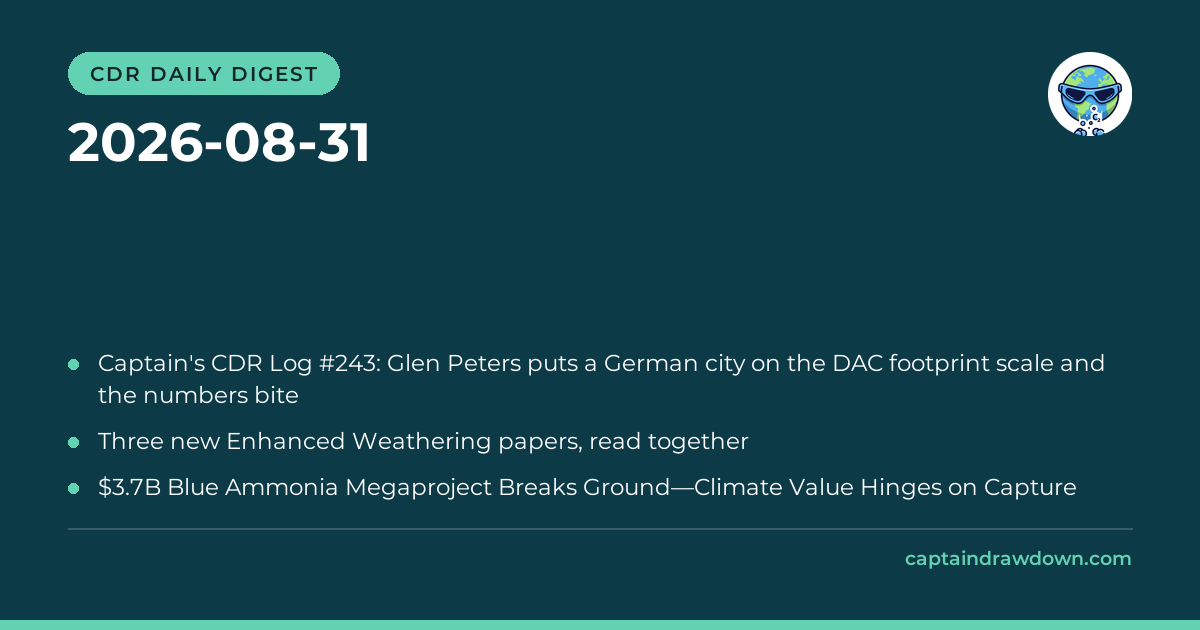
Today’s three stories share one uncomfortable throughline: the physical footprint of removal at climate-relevant scale is much larger than the policy conversation admits, and the numbers get worse when you look closely at either the land or the capture rate.
A German city’s worth of DAC, and that’s just the start
Glen Peters ran the arithmetic on what it takes to remove a gigatonne of CO2 per year using direct air carbon capture and storage (DACCS), and mapped it onto a mid-sized German city for scale. The energy demand, the land, the water, the sorbent throughput — all of it lands in a range that makes clear DAC cannot be the swing option for gigatonne-scale removal by itself. Peters is not anti-DAC. He is pointing out that even optimistic learning curves leave you with an industrial footprint that has to be sited, permitted, powered, and paid for, city by city, for every gigatonne.
The reason this matters: a lot of net-zero pathways quietly assume 5-10 GtCO2/yr of engineered removal by 2050. Peters’ framing forces the question of where, exactly, those facilities go and who pays the energy bill. It also reinforces the residual-only rule. DAC is for emissions we genuinely cannot eliminate. Every tonne of fossil CO2 we fail to cut at the source becomes another slice of that German-city footprint we have to build somewhere.
Enhanced weathering: three papers, one story about variance
Three new enhanced rock weathering (ERW, spreading crushed silicate rock on land to accelerate natural CO2 uptake) papers landed close together, and read together they are more informative than any one alone. The pattern: field removal rates are real but highly variable across soil type, rainfall, rock chemistry, and crop system. The lab-to-field discount is not a rounding error. It is the central measurement, reporting and verification (MRV) problem for the whole approach.
The practical takeaway for buyers is that ERW credits need site-specific MRV, not category-level assumptions. The practical takeaway for suppliers is that reporting variance honestly is what earns durable buyer trust. The Carbon Drawdown Initiative and Beerling’s group at Sheffield have both been pushing this point for a while; the new papers add data, not a new thesis. What is shifting is that the buyer side is starting to price the variance rather than average it away.
Also worth noting: ERW’s footprint story is the mirror image of DAC’s. Land-intensive, energy-light, co-located with existing agriculture. That is why the two need to be planned together rather than as competitors. The gigatonne question is not “which one wins” but “how much of each, where, and verified how.”
$3.7B for blue ammonia, and the whole climate case is one number
A $3.7 billion blue ammonia project broke ground this week. Blue ammonia is ammonia made from natural gas with the CO2 byproduct captured and stored. It is being marketed as a low-carbon fuel and fertilizer feedstock. The climate value depends almost entirely on one number: the actual, sustained CO2 capture rate at the facility, plus upstream methane leakage across the gas supply chain.
The industry pitches capture rates of 90-95%. Real-world performance at operating facilities has often been lower, sometimes much lower, and methane leakage of even 1-2% upstream erodes the carbon benefit fast. This is not a CDR project. It is a lower-emissions industrial project whose climate math sits or falls on measured capture and measured leakage, publicly reported. Without that, it is a natural gas project with a green label.
I flag it in a CDR digest because blue ammonia keeps getting conflated with carbon removal in policy documents and offtake announcements. It is not removal. It is avoided emissions at best, and only if the capture rate is what the brochure claims. Buyers and regulators who care about the distinction need to insist on it in the term sheets, not the press releases.
What’s next
Two things I am watching. First, whether any of the ERW suppliers publish site-level MRV data from the new field seasons in a form that lets third parties audit the variance rather than the mean. That is the credibility test for the category over the next twelve months. Second, whether the blue ammonia project commits to continuous, third-party-verified capture rate reporting from day one of operations. If it does, it becomes a useful data point for the whole point-source capture debate. If it does not, the $3.7 billion buys a fuel with a story attached, and the climate community should say so plainly.