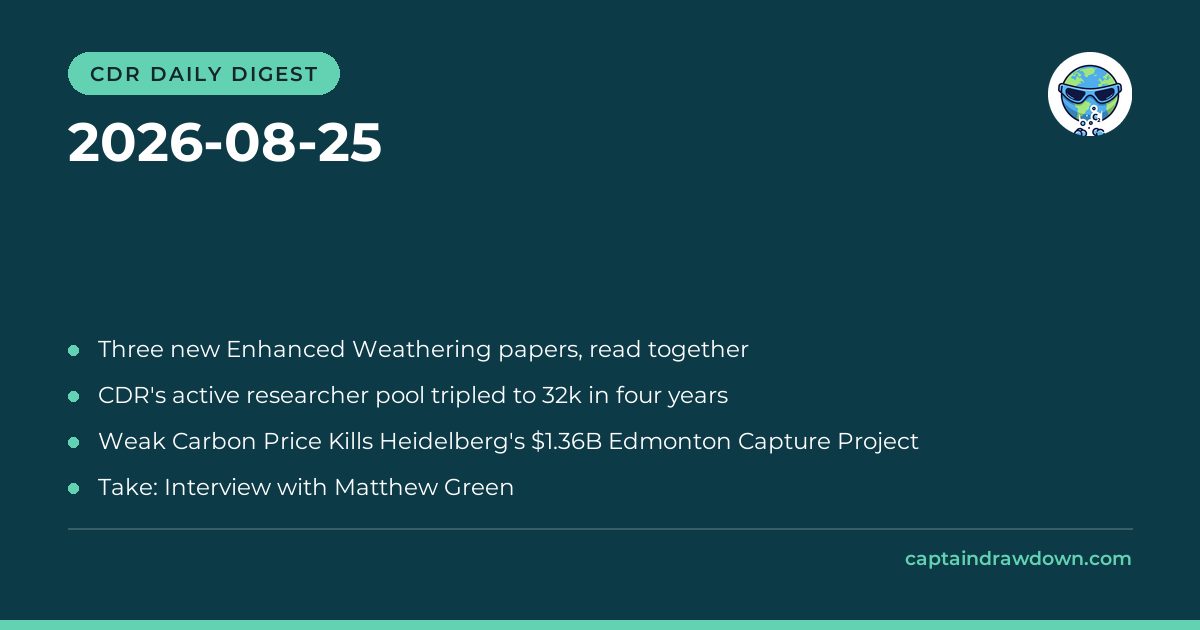
The signal today: CDR is scaling as a research field, but not as a market
Four stories, one tension. The people doing the science are multiplying fast. The projects that would turn that science into tonnes in the ground are still getting killed by weak carbon prices. That gap is the story of 2026 so far, and today it showed up in sharp relief.
The research base tripled. That matters more than any single announcement.
The active CDR researcher pool hit roughly 32,000 people, up from about 10,000 four years ago. I pulled this from the latest CDR Researcher Census I analysed this week. Triple-digit percentage growth in a scientific workforce over four years is unusual. For comparison, the field now rivals mid-size established disciplines in headcount, though not yet in funding per researcher.
Two things follow. First, the pipeline of methods, measurement approaches, and durability studies is going to thicken quickly over the next 24 months. Second, a lot of these researchers will need somewhere to land. Corporate labs, verifiers, and project developers should be hiring now while the talent is cheap and the competition is thin.
Caveat: “active” here means at least one CDR-relevant publication or preprint in the last 24 months. It captures attention, not commitment. Some fraction will drift back to adjacent fields if funding tightens.
Enhanced rock weathering, read as one body of work
Three enhanced rock weathering (ERW, the practice of spreading crushed silicate rock on land to pull CO2 from the air as it dissolves) papers landed close enough together to read as a set. Taken together they push in the same direction: field weathering rates are converging on the lower half of earlier model ranges, and the dominant uncertainty is no longer the geochemistry but the measurement, reporting, and verification (MRV) stack around cation tracking and downstream loss.
The practical read: ERW works, but tonne-accounting per hectare is still contested enough that buyers should expect conservative crediting for at least another two vintages. Developers pricing off optimistic 2022-era rate assumptions will be repricing. This is not a setback for the method. It is the field maturing into what the deployment phase actually looks like.
Heidelberg Materials cancelled a $1.36B Edmonton capture project. The reason is the reason.
Heidelberg Materials pulled its planned carbon capture retrofit at the Edmonton cement plant, a project pegged at roughly $1.36 billion. The stated cause: the Canadian industrial carbon price and the contract-for-difference backstop did not add up to a credible revenue floor over the project’s life. Cement is one of the genuinely hard-to-abate sectors where point-source capture is the right tool, and the CDR framing applies to the residual process emissions specifically. This is not about extending fossil combustion. It is about the CO2 that comes out of limestone no matter what fuel you use.
The lesson is narrow and important. A carbon price that wobbles kills capital expenditure decisions before it kills operating expenditure decisions. Heidelberg was not walking away from decarbonisation. It was walking away from a 25-year bet on a policy signal that keeps getting relitigated. Every other cement, steel, and ammonia developer watching a similar contract structure just got a data point.
If governments want these projects built, the fix is not higher headline prices. It is longer-dated, harder-to-revoke contracts. The difference between a $170 and a $210 carbon price matters less than whether the number is still there in 2040.
Matthew Green, on where the buyer market actually is
My interview with Matthew Green covered a lot of ground, but the piece worth pulling out is his read on the buyer pool. Compliance-adjacent demand is real but slow. Voluntary demand is bifurcating: a small number of serious repeat buyers, and a long tail that has quietly stepped back. He is more bullish than I am on aviation-linked demand pulling through in the late 2020s, and more bearish on tech-sector voluntary buying holding at current levels. Worth reading in full for anyone modelling offtake.
What’s next
Two things I am watching this week. First, whether any Canadian province responds to the Heidelberg Materials cancellation with a firmer contract-for-difference structure, or whether other developers signal they are reviewing their own projects. Second, whether the ERW papers prompt any of the major registries to update their crediting methodologies before the next vintage closes. Both would be concrete, both would move real tonnes, and both are the kind of unglamorous plumbing that decides whether the researcher pipeline I described above has anything to build toward.