The consensus that will break first
If I had to pick the single most fragile assumption in European climate policy right now, it is this: that the continent’s land sink will deliver 300 MtCO2 of net removals per year by 2030. Today’s stories orbit that fragility from different angles. The land sink is shrinking, not growing. The researcher base is concentrated in soil carbon, which is exactly the domain where measurement uncertainty is highest. And the industry mood, as several practitioners said out loud today, is bleak enough that even wins feel lonely.
That is the pattern. Policy is leaning harder on nature-based removals at the exact moment the science community is telling us the underlying flux is going the wrong way, and the private market for engineered alternatives is stalling.
The land-sink math does not close
I spent Captain’s CDR Log #232 walking through why the EU’s 310 MtCO2 LULUCF (land use, land-use change and forestry) target for 2030 is the consensus most likely to break. The sink delivered roughly 230 MtCO2 in 2022 and has been trending down for a decade. Drought, bark beetles, wildfire, and aging forest stands are all pulling in the same direction. To hit 310 by 2030, member states would need to reverse that trend and add capacity equivalent to a mid-sized DAC industry, using biological systems they do not fully control.
The uncomfortable implication: if the land sink underdelivers by even 50 MtCO2, that gap has to be made up somewhere. Either emissions fall faster, or durable engineered removals scale faster, or the 2030 target quietly slips. None of those three are on track today. And this is residual-emissions accounting, not a substitute for cutting fossil output. If the land sink shrinks, the pressure on fossil phase-out goes up, not down.
Soil carbon dominates the researcher base, and that is a mixed signal
The 2025 CDR Researcher Census, which I analysed today, shows 15,849 active researchers working on soil carbon. That is the single largest pathway community, larger than the DAC, BECCS (bioenergy with carbon capture and storage), and ERW (enhanced rock weathering) research populations combined.
Read one way, this is healthy. Soil carbon is cheap, deployable now, and has co-benefits for food systems. Read another way, it is a warning. Soil carbon is also the pathway with the shortest durability, the noisiest MRV (measurement, reporting, verification), and the largest gap between claimed and verified tonnes. Concentrating the research base there without a matching investment in durable engineered removals sets up exactly the credibility problem the voluntary market is already suffering through.
The census does not tell us where the money should go. It does tell us where the human capital is, and it is not distributed the way a diversified 2050 portfolio would require.
Article 6, biochar, and the mood
Two shorter takes today. Lisa DeMarco walked through what an Article 6 Letter of Authorisation actually does under the Paris Agreement corresponding-adjustment framework, which matters because most CDR suppliers selling into sovereign buyers still cannot cleanly explain the accounting. If you sell a tonne to a Swiss or Singaporean buyer and the host country does not authorise the transfer, that tonne gets counted twice or not at all. This is not a rounding error. It determines whether internationally traded CDR is real.
The biochar piece, Charred for Change, is a reminder that the pathway is quietly one of the few delivering verified tonnes at scale today, with real permanence bounds and MRV that regulators can actually audit. It is not glamorous. It is working.
And then there was Take #9, which I will not paraphrase except to say: when the whole industry is hurting, individual wins do not feel like wins. That sentiment is real, and I hear it from operators every week. It matters because morale determines who is still building in 2028.
What’s next
Two things I am watching. First, the European Commission’s 2040 climate target negotiation, where the LULUCF assumption will either be defended, revised down, or quietly backfilled with engineered removal commitments. The choice between those three tells us how serious the EU is about durable CDR as a policy instrument, not a rhetorical one.
Second, whether any sovereign buyer completes an Article 6 CDR transaction with a full Letter of Authorisation before the end of 2026. That would be the first real proof that the international accounting plumbing works for removals, not just avoidance. Without it, cross-border CDR trade stays a slideware category.
Today’s Stories
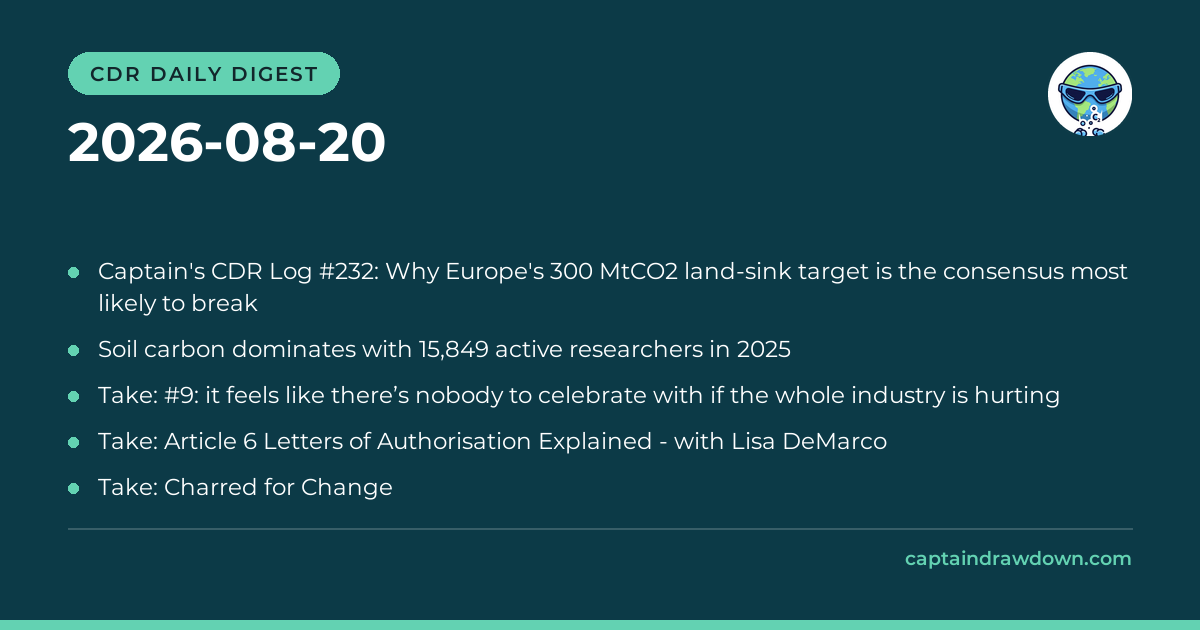
- Captain’s CDR Log #232: Why Europe’s 300 MtCO2 land-sink target is the consensus most likely to break
- Soil carbon dominates with 15,849 active researchers in 2025
- Take: #9: it feels like there’s nobody to celebrate with if the whole industry is hurting
- Take: Article 6 Letters of Authorisation Explained - with Lisa DeMarco
- Take: Charred for Change