The day the CDR conversation got honest about tradeoffs
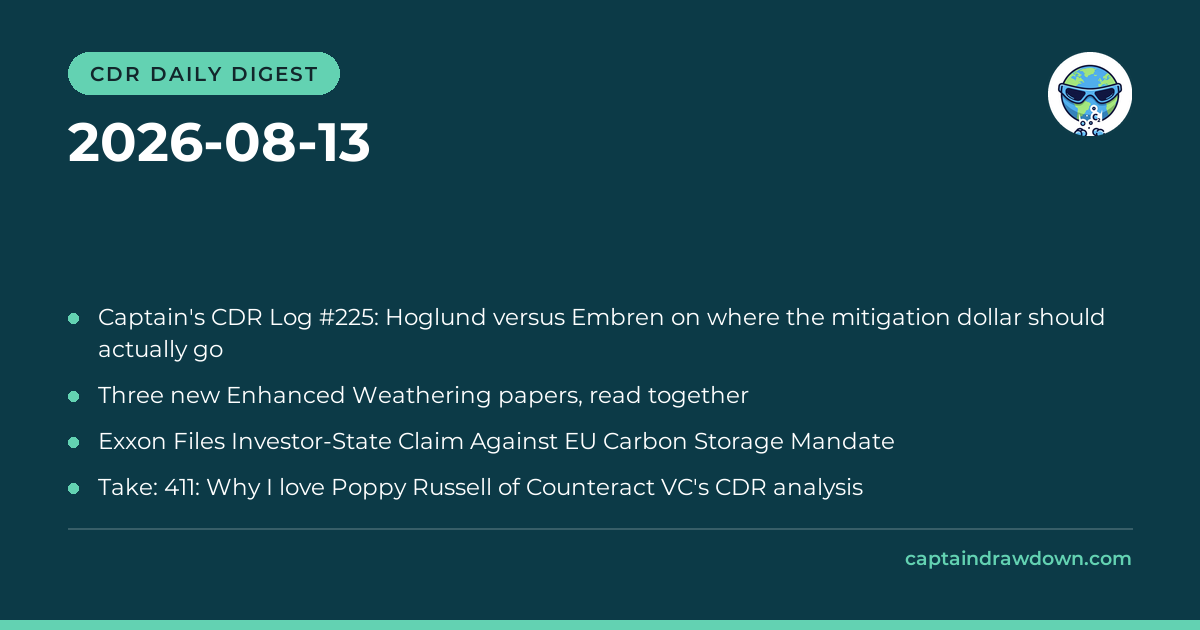
Today’s four stories share a single thread: the field is done pretending that every ton of removal is equally worth buying, equally cheap to deliver, or equally welcome to the incumbents. Robert Höglund and Sebastian Embren argued in public about whether a marginal mitigation dollar should even go to CDR right now. Three new enhanced rock weathering papers landed with numbers that force the same triage. ExxonMobil sued the European Union over storage rules that would compel it to actually inject CO2. And Poppy Russell of Counteract VC published the kind of segmented market analysis that treats different removal pathways as different products rather than a single asset class.
The unifying insight: the sector’s next phase is not “more tons at any cost.” It is choosing which tons, from whom, under what rules, and priced how.
Höglund and Embren: the marginal-dollar question
In Captain Drawdown’s CDR Log #225, I worked through the disagreement between Robert Höglund and Sebastian Embren on where the next mitigation dollar should go. Embren’s position, roughly, is that avoided emissions still beat removals on cost per ton by an order of magnitude in most cases, and that CDR buyers who could instead fund cheap avoidance are misallocating. Höglund’s counter is that the two budgets are not fungible. Corporate CDR purchases are pulling in money that would not have gone to avoidance anyway, and the durable-removal supply curve only bends if early buyers pay to build it.
Both are right about their own frame. The unresolved question is whether the current buyer pool is actually additional to avoidance funding or drawn from the same corporate sustainability budget. I have not seen a clean empirical answer to that, and until someone runs it, the argument stays circular. Residual-only framing matters here too: CDR earns its dollar when it addresses emissions that cannot be avoided, not when it substitutes for avoidance that could.
Three enhanced rock weathering papers, read together
Enhanced rock weathering, the practice of spreading crushed silicate rock on fields so it reacts with CO2 and locks carbon into bicarbonate, had three papers land close enough to read as a set. The short version: field measurements are still coming in below early modeled estimates, cation tracking through soil profiles remains the hardest measurement, reporting and verification (MRV) problem, and the co-benefit story on crop yield is holding up better than the pure carbon story.
None of this kills enhanced rock weathering. It does mean the price per verified ton needs to reflect the verification gap honestly, and buyers should read the discount into their contracts rather than assume modeled tons and measured tons are the same thing.
Exxon versus the EU storage mandate
ExxonMobil filed an investor-state claim against the European Union over the CO2 storage obligations in the Net-Zero Industry Act, which requires oil and gas producers to develop injection capacity proportional to their output. The company argues the mandate is expropriatory.
This is worth naming plainly. A fossil major is using investment treaty arbitration to challenge a rule that would force it to actually store carbon rather than just talk about storing carbon. Whatever one thinks of the legal merits, the case tests whether storage obligations on producers survive contact with treaty law. If they do not, the entire theory that producer-side mandates can seed shared injection infrastructure weakens, and voluntary CDR buyers end up funding storage build-out that regulation was supposed to cover. That is a moral hazard worth watching. CDR credits paid for by third parties should not become the substitute for storage that producers were legally required to provide.
Poppy Russell’s segmented view
Poppy Russell of Counteract VC published a market analysis that I found genuinely useful because it refused to treat CDR as one market. She separates by durability tier, by buyer motivation (compliance, voluntary, insetting), and by delivery risk, and prices each segment differently. The result is a map where ocean alkalinity enhancement, mineralization, and biomass-based durable removals do not compete on the same axis, because they are not selling the same product to the same buyer.
That framing is what the Höglund-Embren debate is missing. “CDR” as a single line item obscures the fact that a ton of mineralized basalt reaction product and a ton of afforestation credit are barely the same asset.
What to watch
Two things next week. First, whether any European Union member state files an intervention in the ExxonMobil arbitration, which would signal how seriously governments defend producer storage mandates. Second, whether enhanced rock weathering suppliers begin publishing measured-versus-modeled ton ratios in their public registries. If they do, the honest pricing conversation starts. If they do not, buyers should ask why.