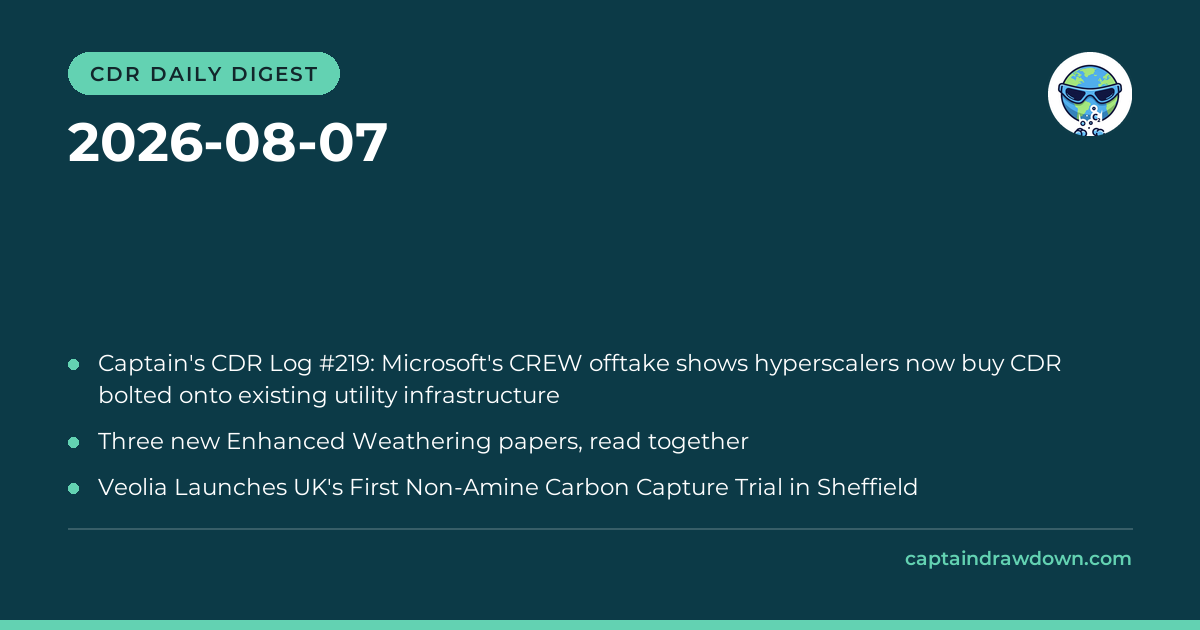
Today’s three stories point in the same direction: CDR is getting welded onto infrastructure that already exists, not built from scratch on empty lots. Microsoft’s new offtake with CREW is a hyperscaler paying for removal that piggybacks on a working utility. Veolia’s Sheffield pilot is a capture trial retrofitted to an operating energy-from-waste plant. Even the enhanced weathering literature is converging on protocols that work with existing farm operations rather than around them. The greenfield era of CDR - purpose-built plants on dedicated sites - is not over, but the growth edge in 2026 is retrofit.
Hyperscaler demand is reshaping what counts as a project
Microsoft’s offtake with CREW Carbon covers wastewater-treatment CDR, where alkalinity is dosed into treatment flows to lock CO2 into bicarbonate before discharge. The tonnes are real removal, but the interesting part is the balance sheet underneath: CREW is not building a plant, it is modifying one that a municipality already owns and operates. That collapses permitting, land, and much of the capital cost. For a hyperscaler buyer, it also shortens the delivery timeline from “next decade” to “next few years.”
This is the third or fourth deal in 2026 where a Microsoft, Google, or Frontier Climate purchase has landed on infrastructure someone else paid to build. The pattern matters because it changes who the CDR industry needs to sell to. If the unit of deployment is a wastewater plant, a cement kiln, or a waste-to-energy facility, then utility operators and municipal engineers become the customer, not just the offtake buyer. I wrote more on this in Captain’s CDR Log #219.
Worth naming the residual-only frame here: none of this changes the requirement that fossil emissions come down first. Retrofit CDR gets cheaper tonnes into the market faster, which is useful for the residual-emissions bucket that will exist in 2050. It is not a substitute for cutting the flow at the source now.
Enhanced weathering is starting to converge
Three enhanced rock weathering (ERW) papers landed in the last few weeks and they are more useful read together than apart. ERW spreads crushed silicate rock, usually basalt, on farmland so that natural weathering pulls CO2 out of the air and stores it as dissolved bicarbonate.
The through-line across the three: cation-based measurement, reporting, and verification (MRV) is holding up under scrutiny, but the field is still arguing about how much of the measured cation release actually reaches durable storage versus getting re-released downstream. The papers do not settle the durability debate. They do narrow the plausible range and give MRV providers a clearer target for what to measure and where. One of them also puts harder numbers on co-benefits for crop yield, which matters because farmer economics, not tonne price, is what will decide whether ERW scales past pilot acres.
The uncertainty that remains is real: the gap between cation release at the field and net removal at the ocean sink is still the single biggest source of disagreement between ERW protocols. Buyers pricing ERW tonnes in 2026 are pricing that uncertainty, not ignoring it.
Veolia’s Sheffield trial: non-amine capture at commercial scale
Veolia has started what it calls the UK’s first non-amine carbon capture trial, at its energy-from-waste plant in Sheffield. Amine solvents are the incumbent capture chemistry and they work, but they degrade, they need energy-intensive regeneration, and the degradation products raise air-quality questions. Non-amine alternatives - the Sheffield trial is testing one specific chemistry, with details still limited in the public release - have been laboratory-mature for a while but rarely tested on real flue gas at a working plant.
Two things make this notable. First, it is a waste-to-energy site, so a fraction of the captured CO2 is biogenic, which puts it in bioenergy-with-carbon-capture-and-storage (BECCS) territory for that share of tonnes. Second, Veolia operates dozens of similar plants across Europe. A working non-amine retrofit at one site is a template for the rest of the fleet.
The caveat: it is a trial, not a commercial deployment, and non-amine solvents have a long history of looking better in the lab than in the stack. Capture rate, solvent stability over thousands of hours, and parasitic energy load are the numbers to watch when Veolia reports results.
What’s next
Two things I am watching. First, whether any of the wastewater-CDR operators following CREW Carbon’s model land a second hyperscaler contract before year-end. One deal is a proof; two is a category. Second, the first performance data from Sheffield. If Veolia’s non-amine chemistry holds up on real flue gas for six months, the retrofit opportunity across European waste-to-energy and cement kilns gets a lot more concrete.