The gap between what’s issued and what’s rigorous keeps widening
The single pattern across today’s four stories: carbon removal is splitting into two tracks. One track is scaling issuance and revenue fast. The other track is tightening what counts as a real tonne. The distance between them is now the most important number in the field.
Captain’s CDR Log #218 puts it starkly. One registry posted a 60 percent jump in credit issuance quarter over quarter. Next door, a separate integrity sweep flagged roughly 95 percent of reviewed projects for methodology gaps, permanence concerns, or MRV (measurement, reporting, verification) issues serious enough to warrant re-review. Both things are true at the same time. Volume is up. Confidence per tonne is not. Buyers who treat credits as fungible across registries are, in effect, arbitraging their own risk exposure.
What “residual” actually means, and why it matters now
Injy Johnstone’s Framework for Residual Emissions conversation is the piece I would push to every corporate buyer this week. Residual emissions are the ones left over after a company has done everything technically and economically feasible to cut. That definition is doing enormous work. If “residual” is defined loosely, CDR becomes a substitute for decarbonisation. If it is defined tightly, CDR is the last mile.
Johnstone’s framing lands on the tight definition, with sector-specific benchmarks and a requirement that companies show their abatement work before they claim removal. This matters because the moral-hazard critique of CDR is real: durable removals must retire genuinely hard-to-abate emissions, not soft ones a company preferred not to cut. The framework is one of the more concrete attempts I have seen to operationalise that constraint rather than gesture at it.
I want to be direct here. CDR is not a license to slow fossil phase-out. Any buyer citing removal purchases while their gross emissions rise is failing the residual test, regardless of how many tonnes they retired.
Utilities as the buyer class nobody quite planned for
The third story shifts the buyer conversation. Utilities, historically slow movers on voluntary carbon, are showing up with a specific ask: removal that pairs with their generation profile, sits inside regulated cost recovery, and produces a credit their public utility commission will accept. That is a narrower product than what most CDR suppliers currently sell.
The implication is that BECCS (bioenergy with carbon capture and storage) and certain forms of mineralization have a structural advantage with this buyer, because they slot into existing thermal generation or industrial byproduct streams. DAC (direct air capture) plays here too, but only where a utility can rate-base the CapEx (capital expenditure, the upfront build cost) or secure long-dated offtake. The suppliers who win utility contracts in the next two years will be the ones who learn regulated-utility procurement language, not the ones with the lowest headline price.
One caveat worth naming: rate-based CDR shifts cost to ratepayers. That is a legitimate public policy question and it is not resolved by calling the tonnes high-quality.
The personal cost of being early
The “I should have used my retirement funds for retirement” piece is the one I keep thinking about. It is a founder writing honestly about what it costs to build in a field where the public and much of the capital stack are not yet convinced the work matters. I will not editorialise on the finances. I will note that the CDR Researcher Census I analysed earlier this year showed a similar pattern: senior technical people carrying disproportionate personal financial risk to keep small teams alive between grant cycles and offtake payments. That is a structural fragility, not an individual failing. Buyer prepayments and milestone-based public funding are the two levers that most directly address it.
What’s next
Two things to watch this week.
First, whether any of the large corporate buyers publicly adopt language consistent with Johnstone’s residual-emissions framework in their next disclosure cycle. Adoption by even two or three anchor buyers would pressure registries to tighten what qualifies as a compensation-eligible tonne.
Second, whether the registry showing 60 percent issuance growth publishes a response to the 95 percent integrity flag rate. Silence is itself a signal. A substantive methodology update, with retroactive review, would be the more useful outcome, and it is the one I would ask buyers to demand before their next purchase.
The two-track split is not stable. One track will pull the other. Which direction it pulls is the open question.
Today’s Stories
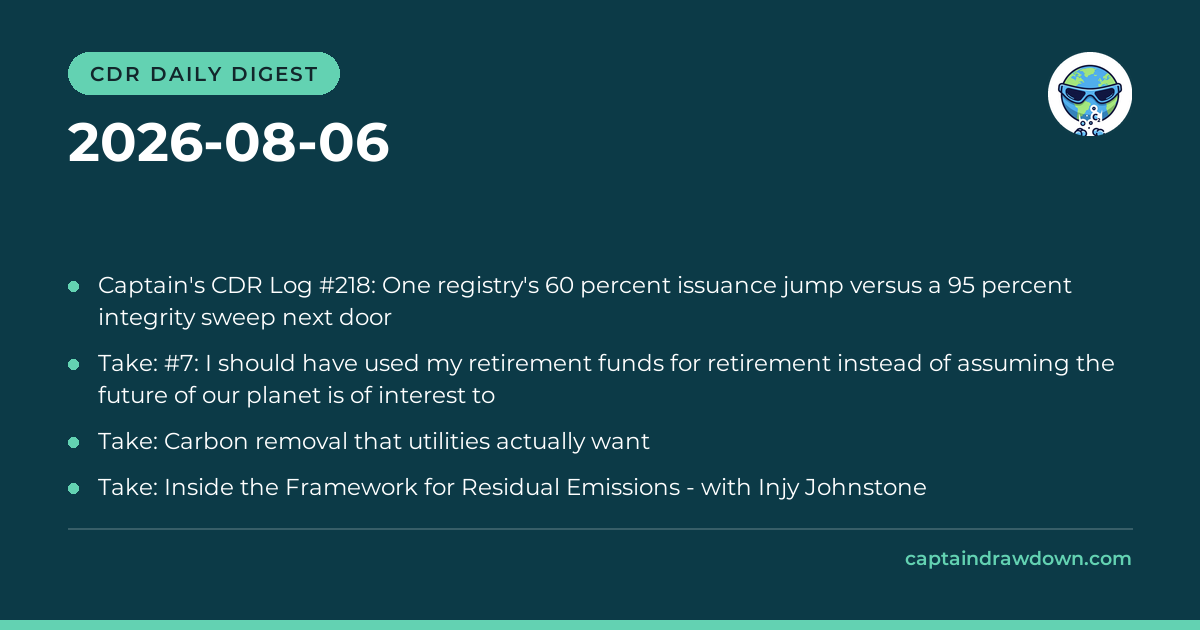
- Captain’s CDR Log #218: One registry’s 60 percent issuance jump versus a 95 percent integrity sweep next door
- Take: #7: I should have used my retirement funds for retirement instead of assuming the future of our planet is of interest to
- Take: Carbon removal that utilities actually want
- Take: Inside the Framework for Residual Emissions - with Injy Johnstone