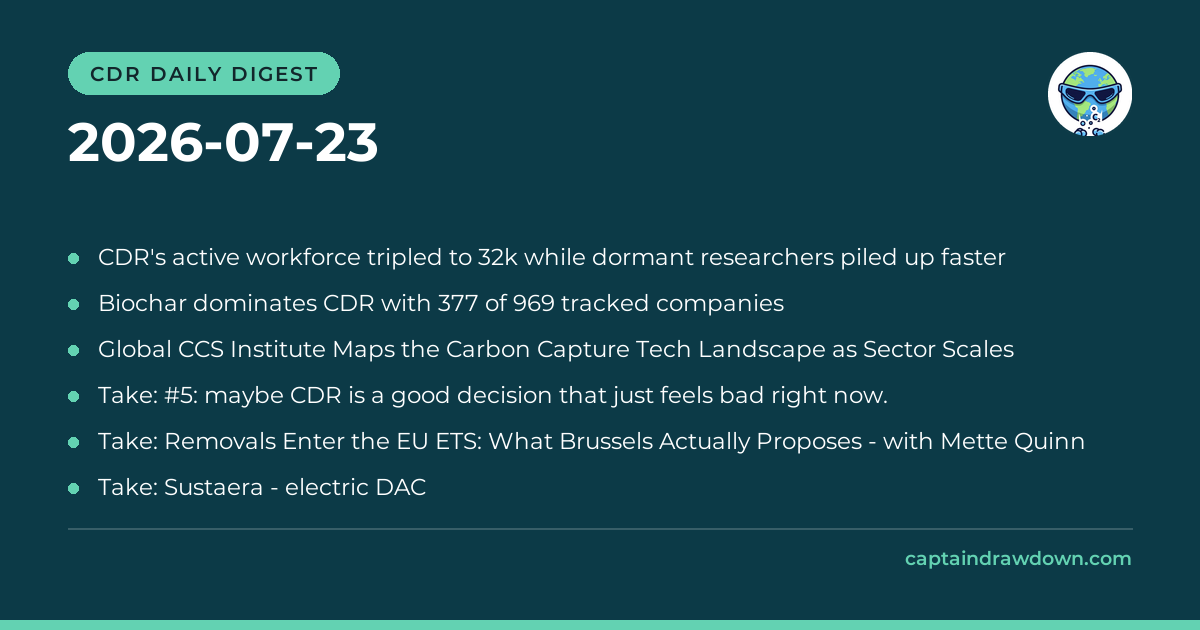
CDR is professionalizing on every axis at once, and every axis shows the same shape: fast growth on the surface, churn and concentration underneath. Today’s six stories cover talent, company formation, policy, and technology, and the pattern repeats in each. The field is bigger than it has ever been. It is also more lopsided than the headline numbers suggest.
The workforce tripled. It also leaks.
The CDR Researcher Census shows the active research workforce has tripled to roughly 32,000 people. That is the good half of the story. The other half: the pool of dormant researchers, people who published in CDR and then stopped, grew even faster than the active count.
Read together, those two numbers describe a field that recruits well and retains poorly. A tripling of active researchers is real momentum. But if the exit rate keeps outpacing it, the field is running a talent treadmill, paying the onboarding cost for people who cycle out before their expertise compounds. The census measures research output, not industry employment, so some “dormant” researchers may simply have moved into companies where publishing stops. Even so, the churn signal is worth watching.
One pathway holds 39% of the companies
Captain Drawdown’s CDR Company Directory now tracks 969 companies, and 377 of them, about 39 percent, work on biochar. No other pathway comes close.
The concentration makes sense. Biochar has low capital costs, uses established equipment, and generates revenue from co-products like soil amendments. It is the pathway where a small team can get to a sellable tonne fastest. But company count is not the same as removal capacity, and it is definitely not the same as durability. The open question is whether biochar’s share of companies translates into a matching share of high-quality, well-verified delivered tonnes, or whether the sector’s tonnage ends up concentrated in a handful of engineered-removal players while biochar supplies the long tail.
Brussels moves removals toward the compliance market
The most consequential policy story: a conversation with Mette Quinn on the European Commission’s proposal to bring carbon removals into the EU Emissions Trading System, the bloc’s cap-and-trade carbon market.
This matters because it would shift removal demand from voluntary buyers, who purchase by choice, to compliance buyers, who purchase because regulation requires it. Compliance demand is larger, steadier, and bankable in a way voluntary demand is not.
It also raises the moral-hazard question directly, and it should be named: removals inside a carbon market cannot become a cheaper substitute for cutting emissions. The proposal only works if removals are reserved for residual emissions that genuinely cannot be abated, with integrity rules on measurement, reporting, and verification (MRV) strict enough to keep low-quality credits out. How Brussels draws that line will set the template other jurisdictions copy.
The technology map, and one electric bet
The Global CCS Institute published a mapping of the carbon capture technology landscape as the sector scales. One distinction worth keeping sharp when reading it: capturing CO2 from a smokestack is emissions reduction, not removal. Capture only counts as CDR when the carbon comes from the atmosphere or from biogenic sources. Landscape reports that blend the two are useful, but the categories should not be conflated.
On the removal side of that map sits Sustaera, the subject of today’s company take. Its DAC design is all-electric, using electricity rather than heat to regenerate its capture material. That matters because heat-driven DAC is hard to decarbonize, while an electric system can run directly on wind and solar. Whether the approach wins comes down to energy use per tonne and equipment cost at scale, numbers that only real deployments will settle.
The uncomfortable middle
One more take from today argues that CDR may be a good decision that simply feels bad right now. Costs are high, delivered tonnes are small, and the payoff is decades out. That discomfort is not evidence the bet is wrong. It is what the early phase of any infrastructure buildout feels like from the inside. The test is not how the field feels in 2026 but whether the pieces above, talent, companies, compliance demand, and cheaper technology, compound.
What’s next
Two things to watch. First, the EU ETS removals proposal now enters negotiation between the European Parliament and member states. The integrity rules and the cap on how many removals can enter the market will decide whether this becomes a demand engine or a loophole. Second, watch whether the researcher churn in the CDR Researcher Census shows up downstream, in slower hiring pipelines or thinner peer review, over the next few census cycles. A field that triples its workforce but cannot hold it will feel the cost with a lag.
Today’s Stories
- CDR’s active workforce tripled to 32k while dormant researchers piled up faster
- Biochar dominates CDR with 377 of 969 tracked companies
- Global CCS Institute Maps the Carbon Capture Tech Landscape as Sector Scales
- Take: #5: maybe CDR is a good decision that just feels bad right now.
- Take: Removals Enter the EU ETS: What Brussels Actually Proposes - with Mette Quinn
- Take: Sustaera - electric DAC