The pattern today is blunt: CDR’s binding constraints right now are administrative, not chemical. A registry’s issuance clock, a federal budget line, a classification scheme, and a researcher headcount. Four of today’s five stories are about the machinery around removal rather than removal itself, and the fifth is about the emotional cost of running that machinery. If you want to know whether durable CDR scales this decade, watch the paperwork.
Twenty-two days is a financing story, not a registry story
In Captain Drawdown’s daily CDR Log #197, I worked through what Puro.earth’s 22-day credit issuance time actually means for supplier economics. The short version: it rewrites the working-capital math. Working capital is the cash a company needs to cover the gap between spending money and getting paid. For a removal supplier, that gap runs from buying feedstock and running equipment to the moment a registry issues credits the buyer will pay for.
When issuance takes months, suppliers bridge that gap with expensive short-term debt or dilutive equity. When it takes 22 days, the bridge shrinks, the cost of capital drops, and marginal projects become fundable. The caveat sits right next to the claim: the clock starts when measurement, reporting, and verification (MRV, the evidence trail proving carbon was actually removed) documentation is complete. A fast registry does not fix slow field data. But for suppliers with their MRV in order, time-to-cash is now a competitive variable, and one registry just set a benchmark.
The $600 million question for DAC
Vikrum Aiyer walked through the fight to preserve roughly $600 million in federal support for direct air capture. The stakes are straightforward. First-of-a-kind DAC plants carry capital expenditure (CapEx, the upfront cost of building the facility) that private investors will not shoulder alone, because the technology risk is unproven at scale. Public dollars exist precisely to absorb that first-mover risk so the second and third plants can be financed commercially.
I will not editorialize on the politics. The factual point is that $600 million is a meaningful share of committed federal DAC funding, and whether it survives determines whether announced projects reach construction or stall at engineering studies. Appropriated money that never gets obligated removes zero tonnes.
The taxonomy problem is a policy problem
Take #408 argues that a clean taxonomy of CDR is impossible, and the argument holds up. Enhanced rock weathering (ERW, spreading crushed silicate rock on farmland so it reacts with CO2) is simultaneously agriculture, geochemistry, and carbon removal. Bioenergy with carbon capture and storage (BECCS) spans forestry, energy, and geology. Ocean methods straddle marine law and carbon markets.
This matters because registries, regulators, and buyers need boxes, and the boxes decide which rules apply, which subsidies flow, and which methodologies get written. A method that falls between categories can fall between every support mechanism too. The honest conclusion is not to force a perfect taxonomy but to design policy that tolerates hybrids, because most durable removal is a hybrid.
The people doing the work, and what it costs them
Two stories about the human layer. First, the numbers: 1,460 researchers were active in enhanced rock weathering in 2025. That is a real, durable research base for a method that barely existed as a field a decade ago, and it suggests ERW’s open science questions, like how much dissolved carbon actually reaches long-term storage, have the workforce to get answered.
Second, the harder one. Today’s take on grief argues that denial of loss plays a central role in CDR work. People in this field are, by definition, working on damage that has already happened and emissions that will not be prevented. The take’s point is that pretending otherwise degrades the work. Removal is repair, and repair starts by admitting something broke. That framing also guards against the moral-hazard trap: CDR addresses residual emissions from sectors that genuinely cannot decarbonize yet. It is never a reason to slow fossil-fuel phase-out, and any story suggesting otherwise deserves a rewrite.
What’s next
Two things worth watching. First, whether other registries respond to Puro.earth’s 22-day benchmark by publishing their own issuance timelines. Time-to-cash is now measurable, and suppliers will route volume toward whoever measures best. If a second registry publishes a number, issuance speed becomes a market, not a footnote.
Second, the DAC appropriations outcome. If the $600 million holds, expect project announcements to convert into construction milestones over the next 12 months. If it does not, watch which projects pivot to state-level or voluntary-market financing, and which quietly disappear. Either way, the result will tell us more about DAC’s near-term trajectory than any technology update this quarter.
Today’s Stories
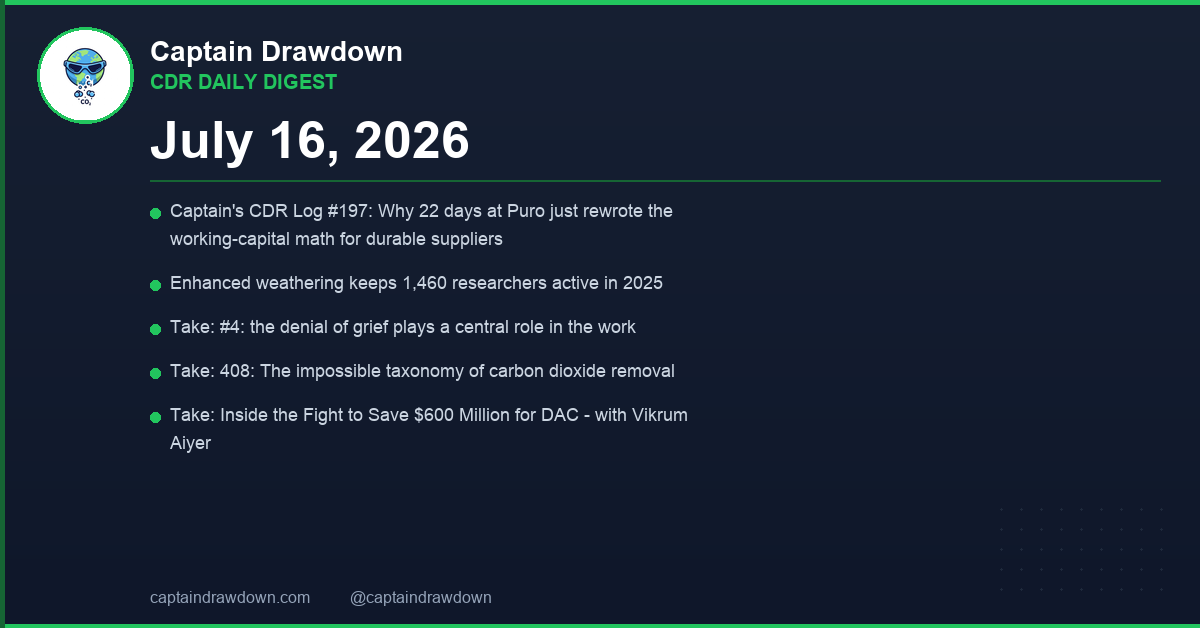
- Captain’s CDR Log #197: Why 22 days at Puro just rewrote the working-capital math for durable suppliers
- Enhanced weathering keeps 1,460 researchers active in 2025
- Take: #4: the denial of grief plays a central role in the work
- Take: 408: The impossible taxonomy of carbon dioxide removal
- Take: Inside the Fight to Save $600 Million for DAC - with Vikrum Aiyer