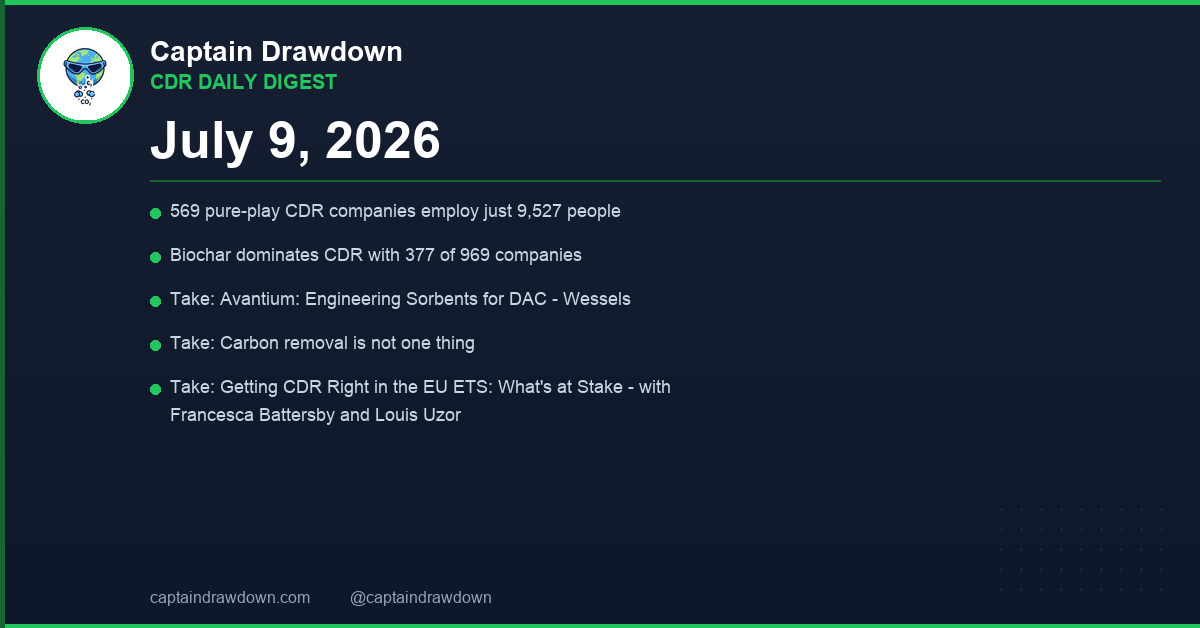
The most important pattern today is a mismatch. Carbon dioxide removal gets talked about as if it were a single, maturing industry. The numbers say otherwise. Today’s data shows 569 pure-play CDR companies employing just 9,527 people worldwide. That is an average of roughly 17 people per company. Meanwhile, one method, biochar, accounts for 377 of the 969 companies tracked across the field. So CDR is simultaneously tiny, lopsided, and deeply varied. Every other story today, from sorbent chemistry to European carbon-market design, runs into that same reality: you cannot regulate, fund, or build “carbon removal” as one thing, because it is not one thing.
A sector smaller than a mid-size hospital
Start with the headcount. If you added up every employee at every pure-play CDR company on Earth, they would not fill a large university. 9,527 people across 569 companies is a startup sector, not an industrial one.
That has consequences. It means talent is concentrated in small teams doing everything from field trials to carbon accounting. It means a single funding downturn can wipe out real technical capacity, not just company logos. And it means claims about gigatonne-scale removal by mid-century rest on an industry that has not yet done its first major hiring wave. The gap between ambition and workforce is one of the clearest signals we have about where CDR actually sits on the maturity curve.
Biochar is the quiet giant
Of 969 CDR companies tracked, 377 work on biochar, the practice of converting biomass into a stable, carbon-rich material that resists decomposition. That is nearly 39 percent of the entire field concentrated in one pathway.
Why biochar? Low capital costs, mature equipment, co-products farmers will pay for, and delivery timelines measured in months rather than decades. The result is that most of the CDR “industry,” counted by company, looks nothing like the DAC plants that dominate headlines. Whether biochar’s dominance in company count translates into dominance in durable tonnes removed is a separate question, and it depends heavily on measurement, reporting, and verification, the process of proving how much carbon was actually stored and for how long.
DAC’s bottleneck is chemistry, not concrete
On the engineering side, today’s conversation with Avantium’s Wessels focused on sorbents, the materials that grab CO2 out of ambient air inside a DAC system. This is the unglamorous center of the DAC cost problem. Sorbent performance drives how much energy a plant needs, how often materials degrade and must be replaced, and ultimately what a tonne of removal costs.
The interesting move here is who is doing the work. Avantium is a chemistry company, not a DAC developer. Specialist material suppliers entering the field is a sign of a supply chain starting to form beneath the project developers. A DAC industry where sorbents are a competitive, improving component market looks very different from one where every developer must invent its own materials from scratch.
Europe decides what counts
The policy story of the day is the EU Emissions Trading System (the EU ETS, Europe’s cap-and-trade carbon market) and how, or whether, removals should be integrated into it. Francesca Battersby and Louis Uzor walked through what is at stake, and the stakes are real: the EU ETS is the world’s largest carbon market, and how it treats removals will shape demand for a decade.
The design questions map directly onto today’s other stories. Do biochar and DAC get treated the same despite very different durability and verification profiles? Does integration create demand for durable tonnes, or does it let emitters substitute removals for cuts they should make anyway? That last point matters most. Removals in a compliance market must be reserved for hard-to-abate residual emissions. If ETS integration is designed so that buying removals becomes a cheaper alternative to phasing out fossil fuel use, the policy has failed regardless of how many tonnes get certified. Getting the accounting boundaries right is the whole game.
What’s next
Watch the EU ETS integration debate for specifics on differentiation: whether draft rules treat a biochar tonne and a geologically stored tonne as interchangeable, or price durability and verification quality separately. That single design choice will echo through the market for years.
And watch the employment numbers. If CDR is real, 9,527 people becomes 20,000 within a few years. If that figure stagnates while announcements keep flowing, believe the payroll data over the press releases.