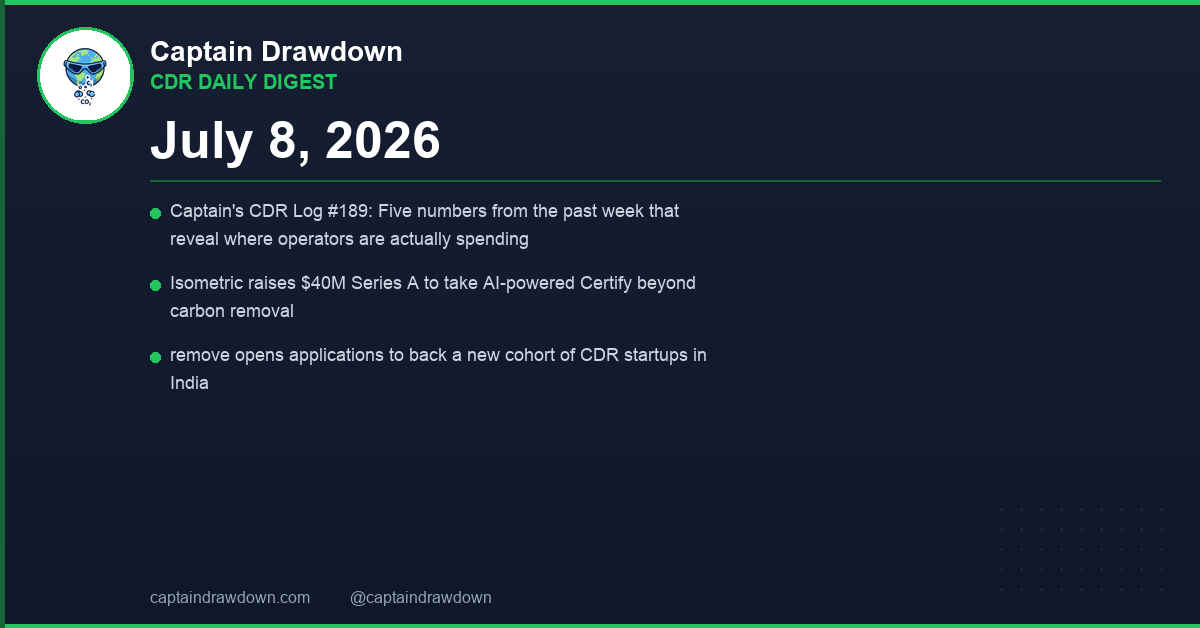
The pattern today is clear: the machinery around carbon removal is growing faster than removal itself. A registry is raising venture money to sell its verification software beyond CDR. An accelerator is recruiting its next cohort in India. And the week’s operator spending data shows where money actually flows once the press releases fade. None of these stories is about a new plant or a big offtake. All three are about the supporting layer - verification, capital, and regional support - getting more professional.
That matters because the supporting layer is where CDR has historically been weakest. Tons are hard to verify, capital is thin, and activity is concentrated in a few rich markets. Today’s stories chip away at all three problems at once.
Isometric raises $40M to take Certify beyond carbon removal
Isometric, the science-led carbon removal registry, has closed a $40 million Series A. The money will push Certify, its AI-powered verification platform, into markets beyond carbon removal.
The logic is straightforward. Isometric built Certify to handle one of the hardest verification problems in climate: proving that a ton of CO2 was actually removed and will stay removed. That means ingesting sensor data, lab results, and field measurements, then checking them against protocols. This is measurement, reporting, and verification - MRV, the paperwork-and-proof backbone of any carbon claim. If the tooling works for CDR, it can plausibly work for other environmental claims that face similar scrutiny.
Two things to hold in tension here. First, this is good news for CDR credibility: a verification platform born in carbon removal is strong enough to sell elsewhere, and fresh capital means the registry itself is better funded. Second, it raises a focus question. Registries earn trust by being narrow and rigorous. Isometric expanding Certify into new markets will need to show that carbon removal verification stays the core product, not a legacy line. Worth watching, not worth panicking over.
remove opens applications for a new cohort in India
remove, the accelerator backing early-stage carbon removal startups, has opened applications for a new cohort focused on India.
This is a meaningful geographic signal. Most CDR startup support still concentrates in North America and Europe. India brings real advantages for removal: large agricultural biomass flows, extensive basalt and other reactive rock for enhanced rock weathering (spreading crushed silicate rock on farmland so it reacts with CO2), long coastlines, and deep engineering talent at lower cost. What it has lacked is dedicated early-stage support and connections to buyers and registries.
An accelerator cohort will not fix that alone. But it puts structured capital, mentorship, and market access in front of founders who have mostly been building without it. If even a handful of credible Indian suppliers emerge with verified tons in the next two to three years, the cost curve for several removal pathways could look different. Founders building in or for India should look at the application.
Five numbers on where operators actually spend
Captain Drawdown’s daily CDR Log #189 pulled five numbers from the past week that show where operators are putting money, as opposed to where headlines suggest they are.
The gap between announcement and expenditure is one of the most useful signals in this industry. Announced capacity tells you about ambition. Spending on drilling, equipment, feedstock, and monitoring tells you about conviction. The Log’s weekly numbers are an attempt to track the second thing, because that is what converts into delivered tons.
The broader point connects back to today’s other two stories. Verification platforms and accelerators only matter if operators are actually deploying. Spending data is the check on whether the supporting layer is serving a real market or building scaffolding around an empty lot. Right now the answer is mixed: real money is moving, but it is concentrated in a small number of pathways and operators.
One standing caveat, as always: carbon removal exists to handle hard-to-abate residual emissions. It is not a reason to slow fossil fuel phase-out, and spending data that shows growth in CDR says nothing about permission to keep emitting.
What’s next
Two things to watch. First, how Isometric describes Certify’s product roadmap over the next quarter: if carbon removal protocols keep shipping at the same pace, the expansion is additive; if they slow, it is a trade-off. Second, the composition of remove’s India cohort when it is announced. The pathways represented - biomass-based removal, enhanced rock weathering, or something else - will be an early read on where India’s comparative advantage in CDR actually lies.