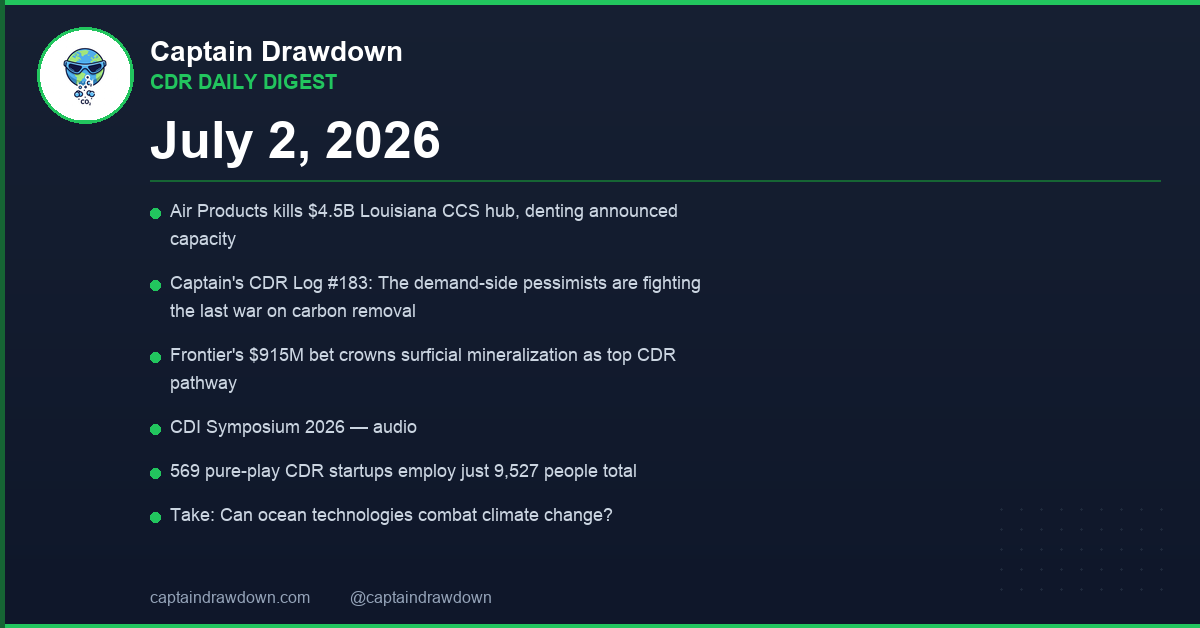
The pattern of the day: carbon removal is consolidating faster than it is growing. Frontier Climate just committed $915 million to a single pathway, its largest concentration of capital yet. On the same day, Air Products walked away from a $4.5 billion Louisiana capture hub, and new data showed the entire pure-play CDR industry employs fewer people than a mid-size hospital. The money is getting more decisive while the field underneath it stays small and fragile. That tension runs through every story we covered today.
Frontier Climate picks a winner
Frontier Climate’s $915 million commitment crowns surficial mineralization as its top-funded CDR pathway. Surficial mineralization means spreading reactive rock at the surface, where it binds CO2 from the air into stable carbonate minerals. It is a close cousin of enhanced rock weathering, the practice of adding crushed silicate rock to soils to speed up a natural CO2-absorbing reaction.
This matters beyond the dollar figure. Frontier Climate’s advance purchases have become the closest thing CDR has to a market signal. When the largest buyer coalition puts nearly a billion dollars behind one approach, suppliers, investors, and researchers reallocate around it. The bet is that mineralization delivers durable storage at a cost that can eventually fall below other engineered pathways. That thesis now has real money riding on it.
Announced capacity is not real capacity
Air Products cancelled its $4.5 billion Louisiana carbon capture and storage hub, taking a meaningful bite out of announced US capture capacity. A note on scope: this was a point-source capture project, not carbon removal. Capturing CO2 from a smokestack prevents new emissions; it does not remove old ones. But the cancellation matters for CDR anyway, because the two share infrastructure, policy support, and public narratives.
The lesson is the same one CDR has learned repeatedly: press releases are not tonnes. Announced capacity figures across capture and removal are inflated by projects that never reach a final investment decision. When a company the size of Air Products exits a flagship hub, it is a reminder to discount every capacity forecast that has not broken ground.
The industry is smaller than it looks
Here is the number that should recalibrate expectations: 569 pure-play CDR startups employ just 9,527 people total. That is roughly 17 employees per company. For a field asked to remove billions of tonnes of CO2 per year by mid-century, the workforce is tiny.
This is not necessarily bad news. It means the industry is young, lean, and pre-industrial in scale, which is exactly what you would expect at this stage. But it does mean claims about CDR as a jobs engine or a mature industry should be treated carefully. The gap between the mission and the headcount is enormous, and closing it requires the kind of durable demand that today’s other stories circle around.
Demand, standards, and who gets to say “net zero”
Captain Drawdown’s daily CDR Log #183 argued that demand-side pessimists are fighting the last war. The old critique, that voluntary buyers are too few and too flaky, is losing force as compliance signals, standards bodies, and large procurement programs take shape. The pessimist case made sense in 2022. It fits the 2026 landscape less well.
That connects directly to our conversation with Kaya Axelsson on the verdict from ISO, the Science Based Targets initiative (SBTi, the main arbiter of corporate climate targets), and London Climate Action Week. The standards fight determines whether companies must buy durable removals for their residual emissions, the hard-to-abate leftovers after deep cuts, or whether they can lean on cheaper offsets. One point stays non-negotiable: removal is for residual emissions only. No standard worth the name treats CDR as permission to slow fossil-fuel phase-out.
We also asked whether ocean technologies can pull their weight. Approaches like ocean alkalinity enhancement, which adds alkaline material to seawater so the ocean absorbs more CO2, offer huge theoretical scale. But measurement, reporting, and verification, the process of proving tonnes were actually removed, remains the hardest problem in open water. The ocean’s potential is real; its accounting is not yet.
What’s next
Watch whether Frontier Climate’s mineralization bet pulls other buyers in. Concentrated capital either validates a pathway or exposes it, and delivery data over the next few quarters will tell us which.
And
Today’s Stories
- Air Products kills $4.5B Louisiana CCS hub, denting announced capacity
- Captain’s CDR Log #183: The demand-side pessimists are fighting the last war on carbon removal
- Frontier’s $915M bet crowns surficial mineralization as top CDR pathway
- CDI Symposium 2026 — audio
- 569 pure-play CDR startups employ just 9,527 people total
- Take: Can ocean technologies combat climate change?
- Take: ISO, SBTi, and the LCAW Verdict on Corporate Net Zero - with Kaya Axelsson