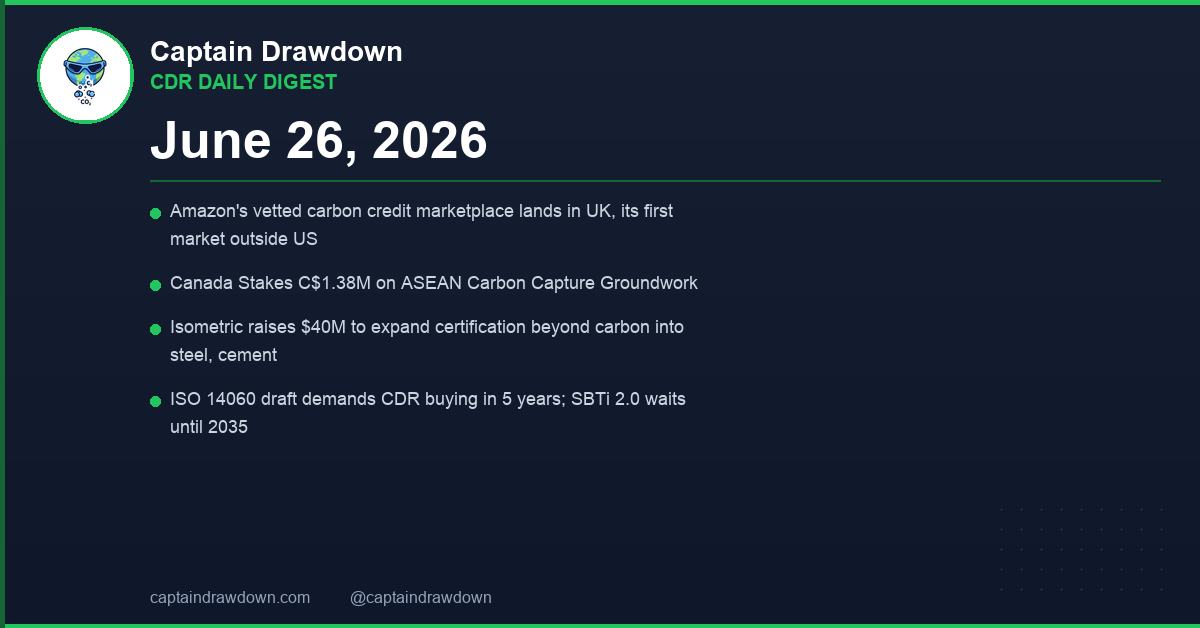
Today’s stories share a single thread: the infrastructure for credible CDR is hardening faster than the demand signals telling buyers to use it. Standards bodies, registries, and marketplaces are all building the plumbing. The question is whether corporate buyers will be required to turn the tap.
The standards gap is now measured in a decade
The clearest tension today sits between two draft frameworks. The ISO 14060 draft, the international standard for greenhouse gas accounting, would require companies claiming net-zero to start buying CDR within five years of setting a target. The Science Based Targets initiative (SBTi) version 2.0, by contrast, does not require CDR procurement until 2035.
That is a nine-year gap between two of the most influential rulebooks corporate sustainability teams follow. For CDR suppliers planning capacity, the difference matters. A five-year ramp pulls forward billions in offtake demand. A 2035 trigger pushes most contracted purchases past the next two corporate planning cycles.
To be clear about the framing: neither standard treats CDR as a substitute for cutting fossil emissions. Both treat removals as the tool for residual, hard-to-abate emissions only. The fight is over when buyers must start contracting for that residual coverage, not whether removals can replace decarbonization. They cannot.
Isometric bets that MRV expertise travels
Isometric raised $40 million to extend its certification work beyond carbon removal into low-carbon steel and cement. The pitch is that measurement, reporting, and verification (MRV) discipline built for durable CDR transfers cleanly to industrial product claims, where buyers paying green premiums need defensible numbers.
This is a meaningful read on where the registry business is heading. Pure-play CDR certification has a known ceiling tied to voluntary market volume. By moving into Scope 3 product accounting for heavy industry, Isometric is betting that the same buyers writing CDR checks, think Microsoft, Google, Stripe, will also pay for verified low-carbon materials in their supply chains. The skill set, third-party measurement and conservative crediting, is the same. The total addressable market is much larger.
It also signals something about CDR market maturity. When your leading registry diversifies, it can mean the core business is strong enough to fund expansion, or it can mean growth in the core is slowing. Probably some of both.
Amazon and Canada take different routes to the same goal
Amazon expanded its vetted carbon credit marketplace to the UK, its first market outside the US. The mechanism is familiar: Amazon screens projects, surfaces a curated set, and lets corporate buyers transact with less due-diligence overhead. Whether the curation bar is high enough to drive real durable-removal volume, versus avoidance and nature-based credits, is the question to track as UK transactions begin.
Canada, meanwhile, committed C$1.38 million to seed carbon capture groundwork across ASEAN countries. The dollar figure is small, but the placement is strategic. Southeast Asia has geological storage potential, growing industrial emissions, and limited domestic CDR policy infrastructure. Early Canadian technical assistance buys influence over how MRV rules, storage permitting, and credit standards develop in a region that could host significant future capture capacity.
Neither move alone reshapes the market. Together they show two theories of demand-side scaling: Amazon is building a buyer funnel, Canada is building supplier-country capacity. Both are needed. Neither addresses the core issue the ISO-versus-SBTi gap exposes, which is that voluntary demand without a binding standard tends to plateau.
What’s next
Watch the ISO 14060 comment period. If the five-year CDR procurement requirement survives into the final standard, expect a scramble among corporate sustainability teams who have been pacing their removal purchases to a 2035 timeline. Suppliers with contracted capacity in the late-2020s window become significantly more valuable.
Second, watch what Isometric certifies first outside CDR. Steel or cement methodologies that lean on the same durability and additionality logic as their carbon protocols will tell us whether the MRV-as-a-platform thesis holds, or whether industrial product accounting requires a fundamentally different approach. The answer shapes whether other registries follow, and how quickly the verification layer for the broader low-carbon economy consolidates.