Today’s stories share a common thread: the CDR field is moving from “who can do this?” to “who can prove it, fund it, and route the molecules at scale?” That shift shows up in a $30M prize round, a directory count that exposes how lopsided supply still is, two podcast conversations probing measurement and demand-side gravity, and a materials-science angle that hints at where the next cost curve might break.
Capital is concentrating around verified pathways
Tencent’s CarbonX 2.0 program awarded $30 million across 16 winners, picking technologies it believes can move from lab to deployment. Prizes like this matter less for the dollar amount and more for the signal: a hyperscaler with real procurement appetite is putting its name on a specific shortlist. That narrows the field for follow-on buyers who do not have the technical staff to run their own diligence.
Pair that with the conversation on hyperscaler demand and CCS. The argument is straightforward. Data-center load growth is forcing utilities and gas peakers to plan for carbon capture as a condition of being built or kept online. That demand is not CDR. Point-source capture on a gas plant avoids emissions. It does not remove legacy CO2 from the air. The distinction matters because hyperscaler procurement teams are increasingly buying both, and the accounting needs to stay clean. CDR is for residual emissions that cannot be avoided. It is not a permission slip to keep building fossil generation. If hyperscalers want to claim climate leadership, the avoidance work and the removal work both need to happen, and neither can substitute for the other.
The supply side is still biochar-heavy
Captain Drawdown’s CDR Company Directory now tracks 969 companies, and 377 of them are in biochar. That is 39 percent of the entire field sitting in one pathway. Biochar deserves its share. It is low-TRL-risk (technology readiness level, meaning how close a technology is to commercial deployment), uses existing equipment, and has real agronomic co-benefits. But a field where two of every five companies are doing the same thing is a field with a distribution problem, not a technology problem.
The interesting question is what the other 592 companies are doing, and how many are funded at a level that lets them reach a first commercial unit. Enhanced rock weathering (spreading crushed silicate rock on fields to pull CO2 from the air), ocean alkalinity enhancement (adding alkaline material to seawater to lock in dissolved carbon), DAC, mineralization, and marine biomass sinking are all represented, but the count alone does not tell you who is shipping tonnes. The directory is a starting point for that diligence, not the end of it.
Measurement is the bottleneck nobody can skip
Varsha Ramesh Walsh of Offstream joined the podcast to talk about what “managed MRV” (measurement, reporting, verification) actually means, and whether the phrase implies an unmanaged version exists somewhere. The joke lands because it points at a real problem. MRV today is a patchwork. Some suppliers run rigorous in-house programs. Some lean on registries. Some hand the work to third parties mid-project. Buyers cannot always tell the difference, and the cost of getting it wrong is a credit that does not hold up under scrutiny five years from now.
Offstream’s pitch is that MRV should be treated as infrastructure, not a deliverable each supplier reinvents. If that view wins, expect MRV costs per tonne to fall and buyer confidence to rise. If it does not, every project keeps paying the integration tax.
Materials science is still where surprises come from
Petra Fromme at Arizona State University is working on materials that use ambient humidity to drive CO2 capture. The premise is that water vapor in the air can do thermodynamic work that today requires heat or electricity. If it pans out at scale, it changes the OpEx (operating expenditure, meaning the ongoing cost to run a system) profile of DAC in humid regions. It is early. TRL is low. But the cost ceiling on DAC is set by energy input, and any pathway that swaps energy for a free environmental gradient deserves attention.
What’s next
Watch two things. First, whether Tencent’s CarbonX 2.0 winners convert prize money into offtake contracts within 12 months. Prizes that do not lead to purchase orders are press releases. Second, watch whether any major buyer publishes an MRV standard it will accept across suppliers, rather than negotiating project by project. That is the move that turns Walsh’s “managed MRV” into a category instead of a marketing phrase.
Today’s Stories
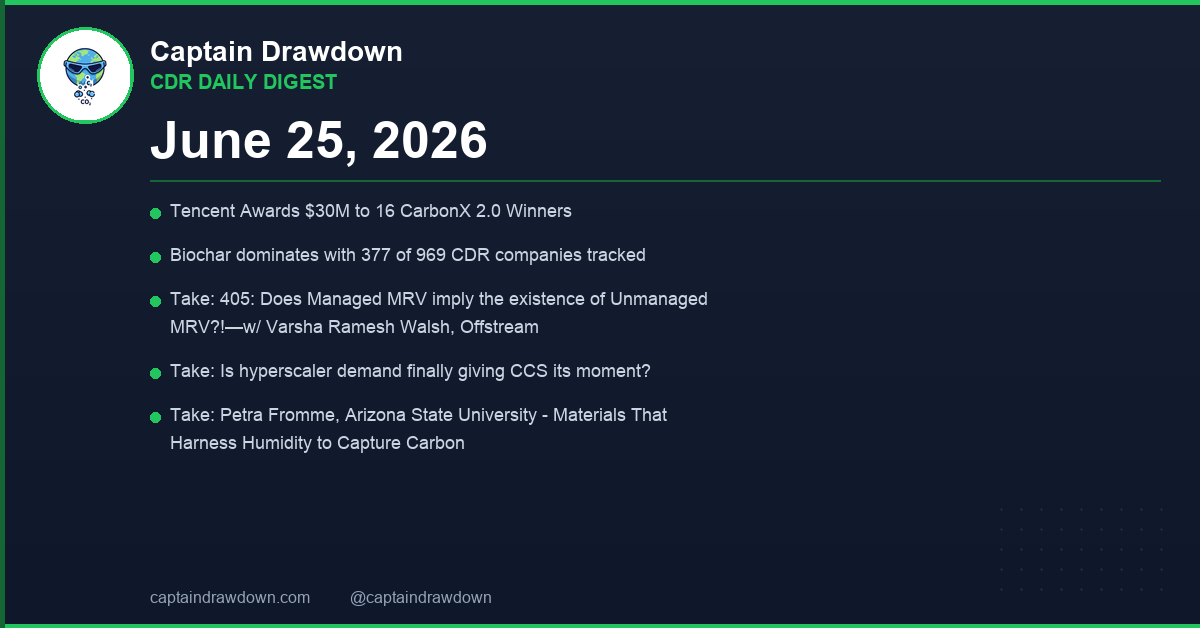
- Tencent Awards $30M to 16 CarbonX 2.0 Winners
- Biochar dominates with 377 of 969 CDR companies tracked
- Take: 405: Does Managed MRV imply the existence of Unmanaged MRV?!—w/ Varsha Ramesh Walsh, Offstream
- Take: Is hyperscaler demand finally giving CCS its moment?
- Take: Petra Fromme, Arizona State University - Materials That Harness Humidity to Capture Carbon