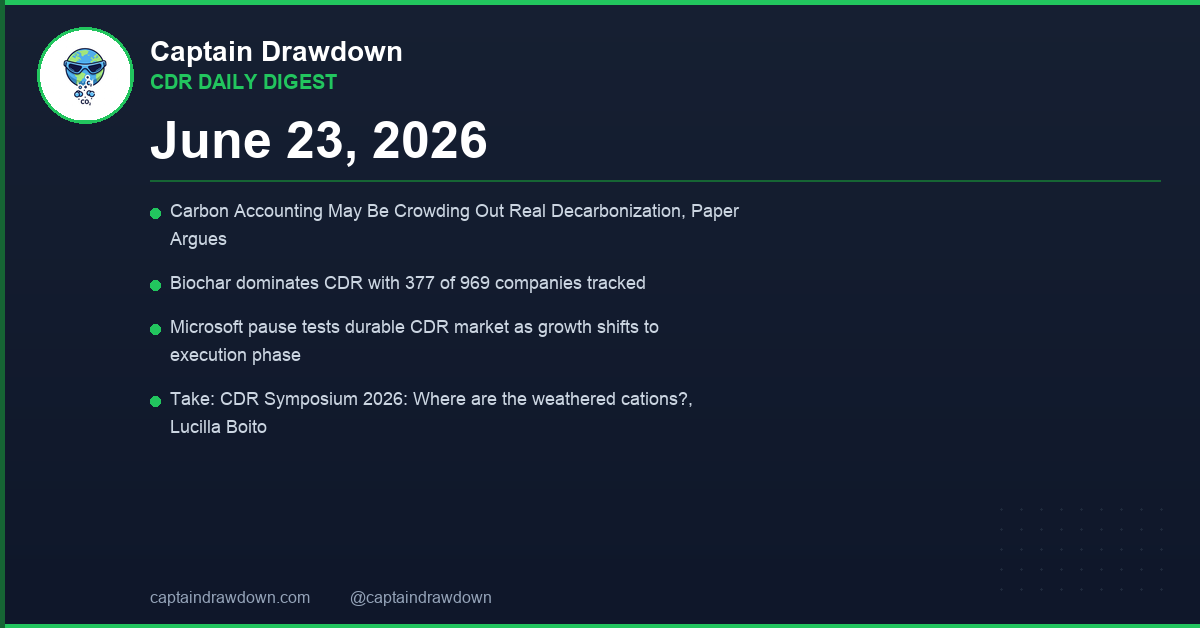
Today’s four stories point at one uncomfortable question: is the CDR field measuring its way out of actually removing carbon?
A new paper argues carbon accounting itself may be crowding out real decarbonization. Microsoft has paused buying, forcing durable suppliers to prove execution rather than promise tonnes. Biochar dominates the company count but not the durability conversation. And at the CDR Symposium 2026, Lucilla Boito asked a pointed question about enhanced rock weathering: where are the weathered cations actually ending up? Each story is about the gap between what we count and what we remove. That gap is now the central problem of the field.
When accounting becomes the product
The paper getting attention today argues that elaborate carbon accounting frameworks risk substituting for emissions cuts. The logic is familiar but worth restating. If a company can book a removal credit against a continuing emission, the incentive to cut the emission weakens. The authors are not anti-CDR. They are warning that measurement, reporting, and verification (MRV) systems, ledgers, and registries can take on a life of their own, where the spreadsheet entry becomes the deliverable.
This matters for our field because CDR only works as climate policy if it sits on top of aggressive fossil phase-out, not next to it. Removals are for residual, hard-to-abate emissions. The paper is a useful prompt to check that every tonne we credit corresponds to a tonne pulled from the air and kept out for the stated duration, and that the buyer is not using it to defer a cut they could have made.
Microsoft’s pause is a stress test, not a retreat
Microsoft has been the anchor buyer for durable CDR. Its reported pause on new purchases is being read by some as a market wobble. I read it differently. After several years of buying contracts based on future delivery, Microsoft appears to be waiting for suppliers to deliver against existing contracts before signing more. That is the execution phase the durable CDR market has been heading toward since the first large offtake deals were announced.
For suppliers, this is the part that separates a pilot from a company. Direct air capture with storage (DACCS), bioenergy with carbon capture and storage (BECCS), enhanced rock weathering (ERW), and mineralization developers now need to show tonnes delivered, verified, and stored, not slides about future capacity. Buyers other than Microsoft, including Frontier Climate’s buyer coalition and a growing set of corporates, will watch how delivery data lands. If the numbers come in clean, the pause ends and pricing firms up. If they do not, expect a longer reset.
Biochar’s company count versus biochar’s tonne count
CDR.fyi style trackers now log 969 CDR companies, and biochar accounts for 377 of them, by far the largest segment by headcount. That is a useful data point and a misleading one if read alone. Biochar projects tend to be smaller, more distributed, and easier to start than a DAC plant or a mineralization site. So a high company count reflects low barriers to entry, not necessarily the largest share of durable tonnes delivered.
Biochar can be a real CDR pathway when feedstock, production, and end-use are documented and the carbon stays put for the claimed duration. The risk is that the sheer number of small operators makes MRV uneven across the segment. If the carbon accounting paper from earlier has a near-term application, biochar is where it bites: the field needs consistent, conservative methods so that 377 companies do not become 377 different definitions of a tonne.
Boito’s cation question
At CDR Symposium 2026, Lucilla Boito asked where the weathered cations from enhanced rock weathering are ending up. For readers new to ERW: spreading crushed silicate rock on fields reacts with carbon dioxide to form bicarbonate and release cations like calcium and magnesium. Those cations are supposed to travel through soils and rivers to the ocean, locking the carbon away for thousands of years.
Boito’s point is that the field has strong models of the reaction at the field edge and weaker tracking of what happens downstream. If we cannot show the cations arriving where the model says they should, the durability claim is incomplete. This is not a reason to stop ERW deployments. It is a reason to fund the river and coastal monitoring that closes the loop. Several ERW developers, including Lithos Carbon, Eion, UNDO, and InPlanet, have begun publishing more field data. Downstream tracking is the next frontier.
What’s next
Two things to watch in the coming weeks. First, whether any of the large durable CDR suppliers publish verified delivery numbers that would justify Microsoft resuming purchases at scale. Second, whether biochar registries tighten their MRV rules in response to the crowding-out critique. Both would move the field from counting toward removing.