The day’s signal: CDR is being financed, sized, and priced like a real industry now
Today’s four stories share one through-line. Carbon removal is moving from “interesting science” to “financeable infrastructure,” and the people doing the financing, the headcount math, and the price-discovery work are starting to sound like grownups. We got a banker’s rent-versus-buy framework, a headcount reality check, a structured debt-plus-offtake deal from a major bank, and a grounded look at village-scale biochar. Different corners of the field, same maturation curve.
Pricing the option: Hausfather reframes the buyer’s question
Zeke Hausfather’s piece, covered in Captain Drawdown’s Daily CDR Log #160, does something the buyer-side conversation has needed for a while. He treats a tonne of CDR purchased today as an option, not a commodity, and asks what a corporate buyer is actually paying for when they sign now versus wait.
The framing matters because most buyer hesitation right now is about timing. Will prices fall? Will quality improve? Hausfather’s answer is that buying today is partly philanthropy, partly market-building, and partly hedging against a future where supply is tight and prices are set by policy rather than by voluntary demand. That third piece is the one corporate treasurers will understand. If you believe compliance markets eventually fold durable removal in, today’s $200-$500 per tonne could look cheap against a regulated price in the four figures.
This is the kind of analysis that moves procurement out of sustainability and into finance. That is where it needs to live.
The headcount problem: 569 firms, 9,499 people
A new tally puts the pure-play CDR sector at 569 companies employing 9,499 people worldwide. Read that twice. The entire global industry working on the defining infrastructure problem of the century is smaller than a single mid-cap chemicals firm.
The number is useful for two reasons. First, it puts the talent constraint in sharp relief. If we need gigatonne-scale removal by mid-century, and we are starting from under ten thousand workers, the hiring and training pipeline is the bottleneck nobody is funding. Second, it tempers the “CDR bubble” narrative. There is no bubble in an industry this small. There is a seed.
The distribution of those 9,499 people matters too. Concentration in DAC and biochar startups, thin coverage in measurement, reporting and verification (the MRV layer that confirms tonnes are real), and almost nothing in the project-development and finance roles that will actually deploy capital at scale. The talent gap is structural, not cyclical.
JPMorgan plus Charm: the deal structure is the story
JPMorgan’s backing of Charm Industrial is being read as another big-bank offtake. It is more than that. The package reportedly combines a CDR purchase agreement with debt financing, which is the structure project finance has used for wind, solar, and LNG terminals for decades.
Why it matters: an offtake alone is a revenue contract. Debt against that offtake turns the revenue contract into a balance sheet that can build things. This is how you get from pilot to plant. JPMorgan signing both sides of that structure tells other lenders the credit work has been done by someone with a real risk department.
To be clear on the moral-hazard question: bank-financed removal only earns its keep if it sits on top of aggressive fossil phase-out, not alongside continued expansion. CDR is for residual, hard-to-abate emissions. A debt-financed removal plant does not offset a new oil project. That guardrail has to stay loud as more banks enter.
Biochar at village scale: the other end of the barbell
Naved Ahmad’s contribution to the biochar series flips the lens. While JPMorgan structures nine-figure deals around pyrolysis at industrial scale, distributed village-level biochar production is quietly removing carbon, improving soils, and creating rural livelihoods at a unit cost no centralized plant can match on certain feedstocks.
The honest tension: MRV is harder when production is distributed across thousands of small kilns. The honest opportunity: the co-benefits, soil health, smoke reduction, agricultural yield, are real and locally felt, which makes the social license question easier than it is for an industrial DAC site. The field needs both ends of this barbell. Pretending one wins is a mistake.
What’s next
Two things worth watching this week. First, whether any other major bank follows JPMorgan with a combined offtake-plus-debt structure for a different CDR pathway. Charm-style pyrolysis got the first stamp. Mineralization or DAC getting the same treatment would confirm the template. Second, whether the 9,499-person headcount figure prompts any serious workforce-development announcement from a buyer coalition or government. The talent gap is the quietest constraint in the field, and the one with the longest lead time to fix.
Today’s Stories
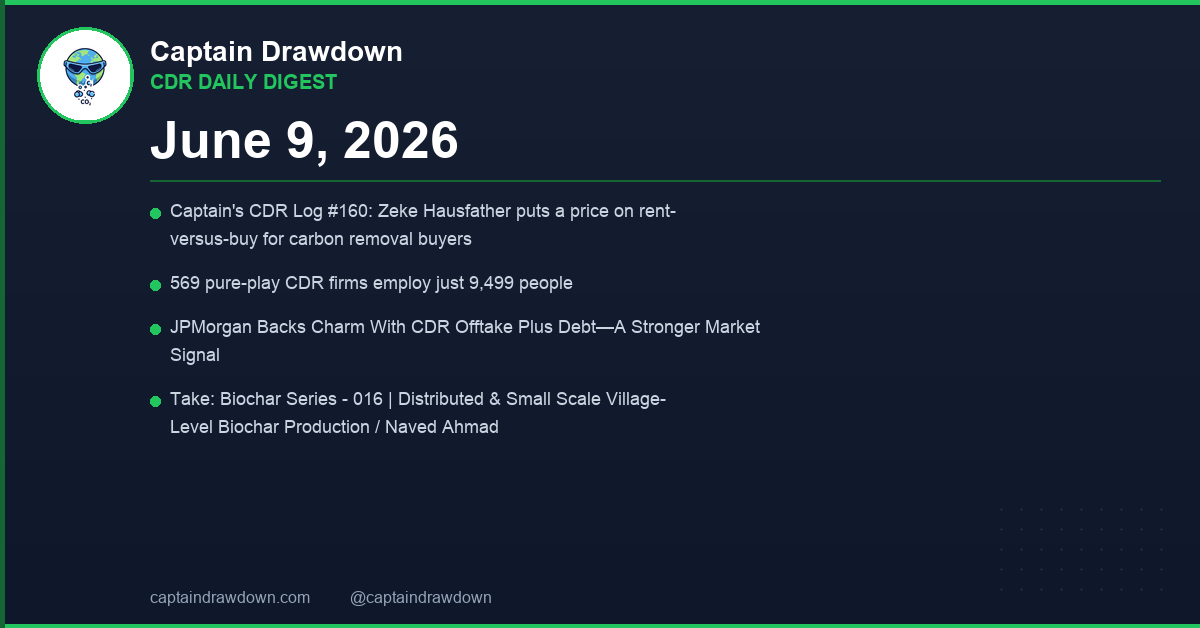
- Captain’s CDR Log #160: Zeke Hausfather puts a price on rent-versus-buy for carbon removal buyers
- 569 pure-play CDR firms employ just 9,499 people
- JPMorgan Backs Charm With CDR Offtake Plus Debt—A Stronger Market Signal
- Take: Biochar Series - 016 | Distributed & Small Scale Village-Level Biochar Production / Naved Ahmad